

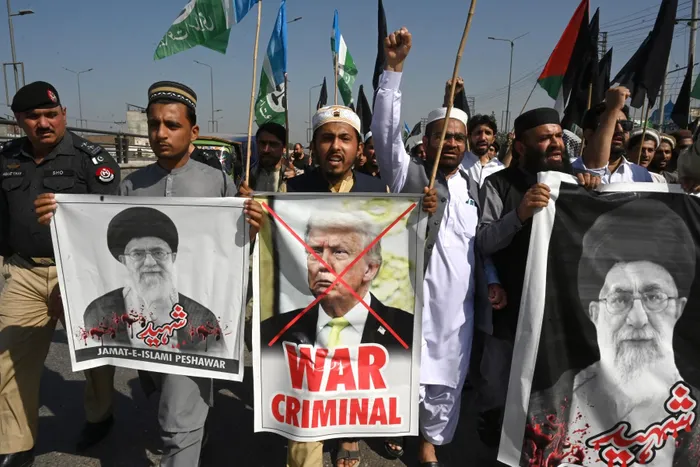
Activists and supporters of the Jamaat-e-Islami party hold posters of US President Donald Trump (C) and Iran's supreme leader Ayatollah Ali Khamenei during an anti-US and Israel protest in Peshawar on March 2, 2026 after the death of Khamenei amid US-Israel strikes.
Image: AFP
Dr. Reneva Fourie
Iranian children slaughtered. Missiles are raining across West Asia. A US president and Israeli prime minister calling for the overthrow of a foreign government. And the world was watching as if it were entertainment. This is the face of the new world order.
On 28 February 2026 – reminiscent of the large-scale aerial attacks applied from Vietnam to Iraq, to Afghanistan and Gaza – the United States and Israel launched major combat operations against Iran.
This action, comprising information warfare, precision warfare, joint operations and military operations other than war, constitutes an unprovoked use of force in violation of the United Nations Charter, including Article 2(4)’s prohibition on the use of force against the territorial integrity or political independence of any state.
Alongside the assassination of Iran’s supreme leader, Ayatollah Khamenei, 167 girls between the ages of 7 and 12 were killed in their classrooms at an elementary school in southern Iran. Sixty others were wounded and hospitalised.
Later, 40 women volleyball players died from a single airstrike. The Pentagon named this campaign Operation Epic Fury, depicting it as a moral intervention. It should be called what it is: state terrorism.
Iranians, a resilient people belonging to an ancient civilisation, retaliated. They shelled Israeli military sites and officials as well as US diplomatic and military facilities in Bahrain, Iraq, Jordan, Kuwait, Qatar, Saudi Arabia, the United Arab Emirates and Cyprus.
Lebanon, acting in defence of Iran, also came under crossfire. At the centre of this escalation stands what can only be described as an axis of evil, an alliance between Donald Trump and Benjamin Netanyahu.
This partnership constitutes a grave threat to international peace and order. During his first presidency, Trump weakened multilateral institutions. He withdrew from international agreements, moved the US Embassy to Jerusalem, recognised Israeli sovereignty over the Golan Heights and undermined the Iran nuclear deal. With his return to power, the assault on global diplomacy has intensified.
The second term escalation is devastating. Tens of thousands of lives are being lost. International law is disregarded. Israeli influence expands across regions as bilateral arrangements undercut broader continental and multilateral efforts. The pursuit of strategic advantage overrides collective stability.
Trump has also drawn American society into a posture of compliance. Protests occur but lack transformative force. External conflicts distract from domestic decline. War becomes spectacle and diversion.
The escalations of late February and early March deepened regional religious and political divisions. Often misrepresented as historical or inevitable, these fractures are cultivated because fragmentation prevents societies from exercising control over their land, labour and resources. Sectarianism is being used as an instrument of power.
The consequences permeate West Asia, where neighbouring states host US military bases. Israel appears as a structural constant. From Gaza and the West Bank to Lebanon, the pattern is consistent – overwhelming force, limited accountability and steadfast diplomatic protection.
The United Nations, conceived as a forum for resolving conflict, has become an arena in which power is diffused behind procedure. Resolutions pass without consequence. International law is invoked rhetorically while enforcement depends on political alignment. Double standards have become institutionalised, and entire societies are subjected to collective punishment, with their suffering normalised.
Iran’s position within this system exposes the contradiction. Tehran is treated as uniquely suspect for asserting regional influence, while other states annex territory, violate borders and escalate militarily with impunity.
Nuclear standards remain profoundly unequal. Some states openly debate expanding nuclear capabilities without sanction, while Iran is treated as an existential threat for asserting its right to technological development.
Sanctions reinforce the hierarchy. The long-standing blockade against Iran, like that against Cuba, demonstrates how economic warfare disciplines defiance. Hospitals struggle, infrastructure decays, and civilians bear the cost.
The message to the South is clear: resistance invites collective punishment regardless of humanitarian impact. West Asia has been rendered a permanent theatre of pressure rather than a community of human societies.
The silence of powers that present themselves as alternatives to Western hegemony speaks volumes. The international landscape has become barren of reliable allies. When faced with the axis of evil, traditional counterweights have proven incapable of effective response, unwilling to challenge the new order and content with symbolic gestures. There is no reliable partner. This captures the profound isolation felt by progressive forces worldwide.
Russia and China are not peripheral actors. They are central superpowers within BRICS Plus. Yet when a fellow BRICS partner, Iran, faces persistent threats to its sovereignty and territorial integrity, their posture remains one of caution bordering on abstention. Statements are issued. Forums are convened. However, material support remains virtually absent.
Their reluctance is a strategic error. The collapse of the current Iranian government would resemble a geostrategic denial of space and deepen Russian and Chinese encirclement. It also subverts the institutionalisation of BRICS+ as a non-Western pole of economic and geopolitical coordination.
Meanwhile, as Iran burns and Palestinians in Gaza and the West Bank endure continued aggression, ties between Narendra Modi and Benjamin Netanyahu strengthen through trade and strategic cooperation. India, another BRICS+ partner, was once a leading voice of the Non-Aligned Movement and a supporter of the Palestinian cause. It now aligns with a government that is aggressively expanding its influence in West Asia with diminishing prospects for peace.
The consequences of disregarding international law and diplomatic norms are severe. Energy corridors such as the Strait of Hormuz underpin the global economy. Escalation there would reverberate across Asia, Africa and Europe. The destruction already inflicted will take generations to repair.
The outcome of the war remains uncertain. The US and Israel seek a durable means of applying pressure or engineering political change without becoming trapped in prolonged conflict, yet no viable path is evident. Iran, by contrast, draws on strategy, organisation, patience and domestic legitimacy.
What is unfolding is not merely a regional war but a deep crisis of global diplomacy, defined by eroding multilateralism, weakened international law and paralysed institutions. Naming and shaming the axis of evil is necessary, but so is rebuilding a credible diplomatic order grounded in principled negotiation, collective security and genuine restraint of power.
* Dr Reneva Fourie is a policy analyst specialising in governance, development and security.
** The views expressed do not necessarily reflect the views of IOL, Independent Media or The African.