
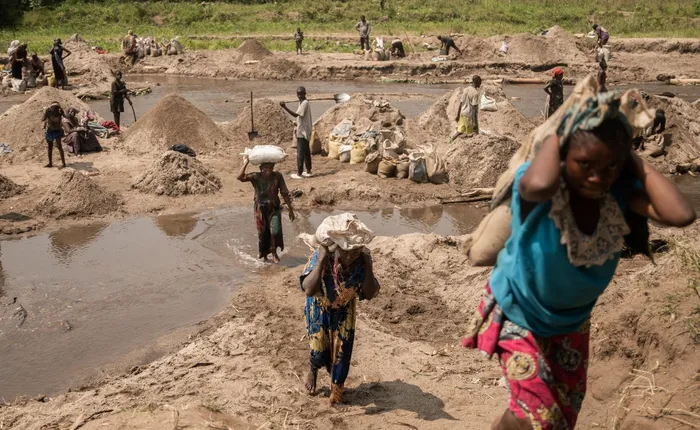
Women hauling sacks of sand extracted from the Renga River in conflict ridden Eastern DRC on February 27, 2025. The safety, dignity, economic and social well-being of all women has to become a non-negotiable for the AU and its member states, says the writer.
Image: AFP
Kim Heller
International Women's Day celebrations have come and gone. Rehashed government statements on women's rights were abundant. There were the customary tributes to women's resilience and contributions. Social media was flooded with acknowledgements and accolades. International Women's Day on Sunday, 8 March, may have been a day of cheer.
However, for millions of women across Africa, on Monday, it was back to the reality of daily danger, indignity, and desperation.South Africa remains among the most dangerous places in the world to be a woman. Chilling statistics from gender advocacy groups show that approximately 15 women are killed daily due to femicide and gender-based violence.
South Africa's femicide rate is amongst the highest globally. This is despite constitutional protections, well-funded annual summits, and an endless stream of prettily worded government pledges. While there has been an admirable rise in gender parity in South Africa's Parliament, where women hold approximately 44% of seats and far stronger lobbying for gender justice, the plight of gender-based violence continues to stain democratic South Africa.
South Africa's gender-based violence crisis is mirrored across much of the Continent. According to UN Women, approximately 42% of women living in Eastern and Southern Africa experience physical or sexual violence during their lifetimes.
UNICEF reports reveal that in sub-Saharan Africa, an estimated 79 million girls and women were raped or sexually assaulted before they reached the age of eighteen. In high conflict zones such as the Democratic Republic of Congo and Sudan, women's vulnerability is heightened dramatically. Sexual violence and exploitation remain widespread.
Poverty carries deep social impacts. Girl children are often forced to stop their schooling, which exacerbates their vulnerability. Child marriage remains a significant challenge affecting approximately one in three girls in sub-Saharan Africa, according to UNICEF.
It would be inaccurate to portray Africa as a place of gender despair. Across the Continent, women are making remarkable strides in politics, business, academia, and civil society. Rwanda provides an exemplary case study of women's political representation. In Rwanda, women occupy around 64% of seats in the country's national Parliament, making it the most gender-balanced legislature in the world according to the Inter-Parliamentary Union.
In Namibia, the 2025 inauguration of Netumbo Nandi-Ndaitwah as the country's first female president marked a historic milestone for women's leadership in Africa. Ghana's Vice President Naana Jane Opoku-Agyemang and Tanzania's President Samia Suluhu Hassan are also part of a new era of strengthened women's representation at the highest level.
These breakthroughs are not merely symbolic.
They represent a vital shift away from a patriarchal socio-political order that has restricted and diminished women's leadership through the ages. Improved access to education and healthcare has also led to measurable progress. Maternal mortality rates have declined in many parts of Africa, according to the World Health Organisation.
UNESCO reports that the number of women graduating from universities is on the rise. As important as these gains are, they too often obscure the persistent reality of gender-based violence and the structural exclusion of women from power, participation, and decision-making across the Continent.
On International Women's Day 2026, the Chairperson of the African Union Commission, Mahmoud Ali Youssouf, acknowledged the many achievements of women across the Continent as well as their many challenges. He reaffirmed the African Union's commitment to advancing gender equality through key frameworks such as the Maputo Protocol and the African Union Convention on Ending Violence Against Women and Girls.
He implored member states to ratify and implement these instruments. Youssouf also took the opportunity to link gender equality to the African Union's 2026 Theme of the Year on Water and Sanitation, highlighting the disproportionate burden borne by women in accessing water and managing household sanitation needs across the Continent. Such statements are welcome.
However, grand declarations alone will not solve the deeper structural problems that fuel and perpetuate gender inequality. In many African countries, gender programmes remain chronically underfunded and politically marginalised. Even within the African Union itself, women constitute only around 35% of professional staff.
The way forward cannot be confined to annual conferences, policy declarations, or symbolic commemorations. Gender-based violence and gender-related structural inequality must be treated as a national and continental emergency. Gender equity needs to be placed at the heart of the democratic integrity of an African nation.
The undercarriage of patriarchy embedded within political, economic, and social systems needs to be dismantled. The economic empowerment of women must be given pride of place in government and corporate policy and practice. This would entail ensuring that women have meaningful access to credit, markets, digital infrastructure, and trade opportunities—particularly within the African Continental Free Trade Area.
Women-led businesses in climate-resilient sectors would be a win. Economic empowerment will be central to any serious gender equality strategy. It is vital for women's advancement and for economic development as a whole that women have equal access to credit, markets, digital infrastructure, and trade opportunities within the framework of the African Continental Free Trade Area.
Expanding support for women-led enterprises, especially in key emerging industries such as renewable energy and sustainable agriculture, would not only boost economic growth but also advance gender equity. Governments must also commit to gender-responsive budgeting, ensuring that public spending directly addresses disparities in healthcare, education, employment, and social protection. Support services for survivors of gender-based violence are also a necessity.
The safety, dignity, economic and social well-being of all women, not merely a privileged minority, has to become a non-negotiable for the AU and its member states. For now, International Women's Day is a dull echo in a continent where women are crying out for change.
* Kim Heller is a political analyst and author of No White Lies: Black Politics and White Power in South Africa.
** The views expressed do not necessarily reflect the views of IOL and Independent Media.