
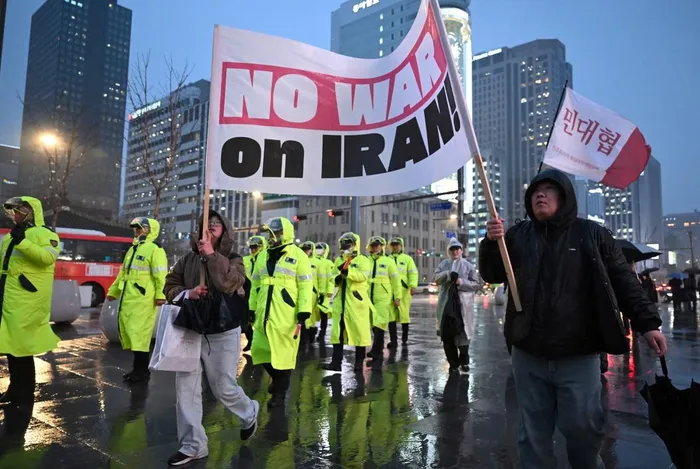
Protesters carry a banner reading "No war on Iran!" as they march toward the US embassy during a rally condemning the US and Israeli attacks on Iran in Seoul on March 5, 2026. The writer says the most profound and tragic consequence of war is the loss of human life, particularly the most vulnerable.
Image: Photo by Jung Yeon-je / AFP
The early 21st century has been defined by a series of high-stakes conflicts that have reshaped geopolitical landscapes, fractured international alliances, and, most critically, exacted a devastating toll on civilian populations. The full-scale Russian invasion of Ukraine, the devastating war in Gaza, and the invasion of the US and Israel of Iran, has resulted in the deaths, mutilation and economic suffering of many women and children and continue to have a detrimental impact on the global economy.
The most profound and tragic consequence of war is the loss of human life, particularly the most vulnerable. While precise numbers are notoriously difficult to verify in active conflict zones, international bodies and local ministries provide harrowing data.
Since Russia's full-scale invasion of Ukraine in February 2022, the United Nations has monitored a steady and horrifying rise in civilian casualties. By early 2025, the UN High Commissioner for Human Rights (OHCHR) had verified over 12,654 civilian deaths in Ukraine, stressing that the real figure is likely significantly higher as data from occupied territories remains incomplete.
Among these verified deaths, the suffering of women and children is stark. As of February 2025, the UN reported that at least 3,799 women and 776 children had been killed. Thousands more have been injured. This does not account for the millions of refugees and internally displaced persons (IDPs), the vast majority of whom are women and children, who have fled their homes, facing acute trauma, loss of education, and increased risk of gender-based violence.
The conflict that began with the October 7, 2023, Hamas attack on Israel has seen an unprecedented level of civilian death in the Gaza Strip. The Gaza Ministry of Health, whose figures have generally been considered reliable by the UN, reported by March 2026 that over 72,120 Palestinians have been killed.
International organisations have consistently highlighted that the majority of these casualties are women and children, estimated to represent nearly 70% of the total. This includes tens of thousands of children.
In addition to direct violence, the humanitarian catastrophe in Gaza – characterised by a collapse of the healthcare system, widespread displacement, and acute food and water shortages – has led to indirect deaths from disease and malnutrition, disproportionately affecting pregnant women, newborns, and young children. On the Israeli side, approximately 1,200 people were killed in the initial October 7 attacks, including numerous women and children.
While the war between the US, Israel and Iran shifted in 2024 from a "shadow war" of proxy attacks to direct military exchanges, it has not resulted in a sustained ground war with mass civilian casualties on the scale seen in Ukraine or Gaza. The direct strikes – including Iran’s large-scale missile and drone barrages in April and October 2024, and Israel’s subsequent retaliatory airstrikes – have primarily targeted military infrastructure and air defence systems.
The known direct civilian deaths from these specific exchanges have been low. However, this confrontation poses a catastrophic risk of escalation. A full-scale war between these two regional powers, particularly if it involved densely populated areas or non-conventional weapons, would lead to devastating civilian casualties across the Middle East.
Recent reports however indicate a significant and tragic loss of life following a missile strike on an elementary school in Minab, Iran, on February 28, 2026. While initial reports were shrouded in conflicting claims, recent findings from a preliminary Pentagon investigation and independent monitoring groups have pointed to US responsibility for the strike.
Most sources, including Iranian state media and independent human rights observers, place the death toll between 165 and 180 people. The vast majority of the victims were schoolchildren – specifically girls aged 7 to 12. Reports confirm that teachers, school staff, and the school principal were among those killed. Some parents who were at the school at the time of the morning strike also lost their lives. Approximately 95 to 100 people were reported injured.
Each conflict is accompanied by a battlefield of narratives, where combatants seek to provide legal, moral, or strategic justification for their actions. These justifications are frequently contested by the international community.
Russian President Vladimir Putin cited "demilitarization" and "denazification" of Ukraine as primary goals. Russia also claimed it was protecting Russian speakers in the Donbas region and acting defensively against NATO expansion, which it viewed as an existential threat to its security. The UN General Assembly has repeatedly condemned the invasion as a violation of the UN Charter and an act of aggression. The international consensus rejects Russia’s narrative as a pretext for an imperial war to conquer territory and dismantle Ukrainian sovereignty, emphasising that Ukraine poses no threat to Russian territory and its right to choose its alliances is paramount.
Israel declared war with the stated dual objectives of destroying Hamas's governing and military capabilities and securing the release of the hostages taken on October 7. Israel asserts its inherent right to self-defence against a genocidal terrorist group that embedded its assets within civilian areas, arguing that Hamas is responsible for the civilian toll by using Gazans as "human shields."
While acknowledging Israel’s right to defence against terrorism, numerous international organisations, UN experts, and nations have strongly condemned the scale and nature of the Israeli military response. They argue the operation violates international humanitarian law principles of distinction and proportionality, citing the colossal civilian death toll, the destruction of essential infrastructure, and the creation of a humanitarian catastrophe as evidence of collective punishment and indiscriminate warfare. Some have accused Israel of committing genocidal acts, a claim under review by the International Court of Justice.
In terms of the US-Israeli attacks against Iran, all of them frame their direct strikes as defensive or retaliatory. Iran claimed its 2024 attacks were in response to Israeli strikes on its diplomatic facility in Damascus and the killings of allied leaders. Israel maintains that its strikes are necessary to degrade Iran's ability to launch future attacks and to dismantle its supporting network of regional proxies (like Hezbollah), which it views as a unified threat to its existence.
The international community, led by the UN Security Council, has called for immediate de-escalation from both sides, warning that this cycle of retaliation risks precipitating a wider regional war. Most nations condemn the direct attacks as escalatory, stressing that a state-to-state conflict would have catastrophic humanitarian and economic consequences far beyond their borders.
The economic impacts of war are vast, immediate, and long-lasting, destroying physical capital, displacing labour, and disrupting global markets. The Pentagon reported to Congress that the first week of Operation Epic Fury cost the United States approximately $11.3 billion.
The economic toll of the invasion of Ukraine has been global and profound. By late 2024, estimates from the World Bank and other international bodies suggested the cost of reconstruction in Ukraine would exceed $486 billion – more than double the country’s pre-war GDP. Ukraine has lost massive amounts of productive capacity, critical infrastructure (especially its energy grid), and human capital, with its economy kept afloat through massive international financial and military aid.
The war triggered a global energy and food security crisis. Russia and Ukraine are key suppliers of oil, gas, and grain (particularly wheat and corn). The disruption of these supplies, combined with post-pandemic factors, led to a worldwide surge in inflation. European nations, in particular, faced a massive economic shock as they pivoted away from Russian energy.
The cost of the Gaza conflict has resulted in the utter devastation of the Gaza Strip and significant economic disruption in Israel. The war has led to a near-total collapse of Gaza’s economy. The vast majority of its population is displaced, and infrastructure – homes, hospitals, water systems, agricultural land, and factories – has been destroyed. International agencies estimate that restoring pre-war living standards will cost tens of billions of dollars and take decades.
The war has also extracted a heavy economic price from Israel. Costs include mobilization of hundreds of thousands of reservists, a complete halt to tourism, significant disruptions in the agricultural and construction sectors, and the massive direct expense of prolonged military operations. Estimates from early 2025 suggested the war could cost Israel up to $400 billion in lost economic activity over the next decade.
The cost of the US-Israeli invasion of Iran is astronomical and poses a systemic threat to the global economy. Sustained conflict has already led to massive destruction of critical infrastructure in both nations, particularly Iran's oil and gas facilities, which are crucial to its economy.
The primary global risk is the disruption of the Strait of Hormuz, a narrow waterway through which roughly one-fifth of the world’s daily oil consumption passes. The targeting of oil tankers severely disrupted this strait and led to an unprecedented oil price shock, that could paralyse global shipping, and trigger a worldwide recession. Markets have already shown immense sensitivity to even minor escalations, demonstrating the enormous risks warmongers posing as political leaders have on the safety of women and children, regional peace and economic prosperity.
* Christo van der Rheede is the Executive Director of the FW de Klerk Foundation. He writes here in his personal capacity.

The most profound and tragic consequence of war is the loss of human life, particularly the most vulnerable, says the writer, FW de Klerk Foundation Executive Director Christo van der Rheede.
Image: Supplied