

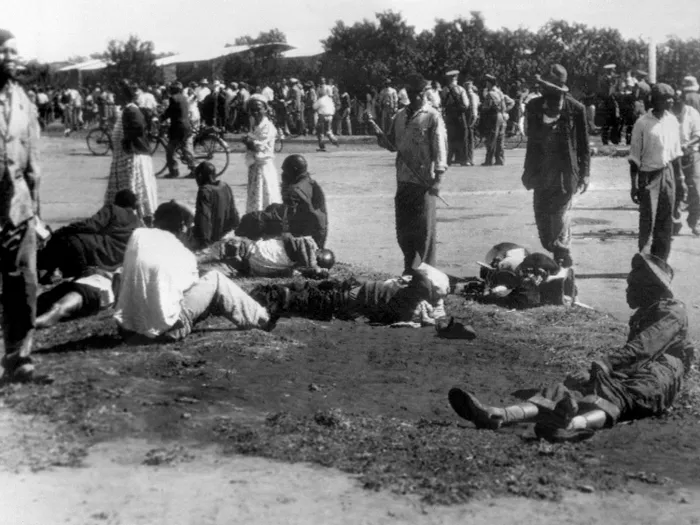
Wounded victims lie in the street on March 21, 1960 in Sharpeville following a brutal attack by the apartheid police on protesters who were demonstrating against the notorious pass laws. 69 protesters were massacred on the day which is now commemorated as Human Rights Day in a democratic South Africa.
Image: AFP
Dr. Reneva Fourie
On 21 March, South Africa observes Human Rights Day, commemorating the 1960 Sharpeville Massacre when apartheid-era police killed 69 peaceful protesters opposing pass laws. The tragedy remains a defining moment in our history, reminding us of the brutality of the past and of our enduring duty to protect and deepen the freedoms that so many struggled to achieve.
This year’s commemoration carries particular significance as it marks 30 years since the adoption of our democratic Constitution. Forged through intense negotiation amid bloody conflict, it provided a framework for a divided country to imagine a shared future.
At its heart lies the Bill of Rights, guaranteeing not only civil and political freedoms but also social and economic rights, including access to housing, healthcare and education. For a society emerging from systematic oppression, this affirmed the dignity and respect of every person.
Equally vital are the Chapter 9 institutions created to defend these rights. These independent bodies protect human rights, promote equality and ensure ethical governance. Their existence reminds us that democracy requires more than goodwill, and that strong institutions are needed to hold power accountable.
Three decades later, South Africans have much to celebrate. The constitutional order helped the country avoid the full-scale civil war that many once feared. While political tensions remain, South Africa has experienced a degree of institutional stability.
This stability would have seemed impossible during the darkest days of apartheid. Citizens now vote in regular elections. Courts exercise independence. Civil society organisations can operate without repression.
But as we celebrate these achievements, we acknowledge that Human Rights Day also serves as a solemn and urgent reminder to confront the unfinished work of realising South Africa’s constitutional ideals.
Despite the Bill of Rights, our country still faces stubborn unemployment, inequality and poverty. Millions remain excluded from meaningful economic opportunity. For many families, the promise of dignity in the Constitution remains unfulfilled.
Economic justice is central to human rights. The right to dignity is undermined when people cannot find work. The right to equality is weakened when a few hold most of the wealth and opportunities. The right to freedom means little if poverty denies people control over their own futures.
Addressing these challenges requires sustained effort from government, business and civil society. A society that values rights must reduce inequality, expand opportunity and ensure development benefits all.
Human Rights Day reminds us that safeguarding rights depends on national unity and social cohesion. The Constitution provides a shared framework for South Africans of all backgrounds to live as equal citizens. This unity requires respect, dialogue and a commitment to the common good.
In a diverse society, social cohesion requires recognising our interconnected futures. When communities are divided by suspicion or exclusion, democracy weakens. Protecting human rights, therefore, means strengthening the bonds that hold society together and ensuring that no group feels marginalised or denied dignity and cultural expression.
Closely linked to this is the importance of defending South Africa’s sovereignty and territorial integrity. The democratic order that emerged from the constitutional settlement was built on the principle that the people of South Africa have the right to determine their own future.
A country that values human rights must ensure that its democratic institutions remain strong, that its laws are respected and that its independence is preserved. Defending sovereignty does not mean closing ourselves off from the world.
Rather, it means engaging internationally from a position of principle, ensuring that decisions about our national development and democratic future remain firmly in the hands of our people.
Human Rights Day also calls us to confront other forms of injustice that persist in our communities. In recent years, South Africa has witnessed troubling incidents of hostility towards migrants and refugees. Individuals who have come to this country seeking safety or opportunity have at times been met with suspicion, exclusion or even violence.
This intolerance contradicts our history and values. Migrants helped build South Africa’s economy and supported the struggle against apartheid, while many countries sheltered exiled South Africans fleeing persecution during those difficult years. A society committed to human rights cannot choose whose dignity to recognise. Equality and justice must apply to all within our borders.
Our responsibility extends beyond national borders. South Africa’s own experience with oppression should make us alert to injustice everywhere. Many communities worldwide still face occupation, discrimination, displacement and violence. When such injustices happen, silence can become complicity.
Advocating for human rights internationally is a moral obligation rooted in our history. Just as global solidarity strengthened the anti-apartheid struggle, today’s justice movements depend on people willing to speak out against oppression and inequity.
Human Rights Day reminds us that constitutions and institutions cannot defend rights on their own. The protection of rights depends on the choices of ordinary people. It needs citizens who reject discrimination, workers who demand fair treatment, communities that welcome those in need, and leaders who value justice over narrow interests.
Championing human rights is everyone’s task. It belongs to teachers and religious leaders who teach respect and compassion. It belongs to journalists who hold power accountable. It belongs to young people challenging injustice in their communities. It belongs to citizens who insist that dignity and equality guide public life.
Thirty years after the democratic Constitution’s birth, South Africa’s human rights foundations are strong. But foundations are not enough. The real task is to build a society where rights on paper become real for everyone living here.
On this Human Rights Day, South Africans are called not only to remember Sharpeville and honour the sacrifices of the past. Above all, each of us should take concrete action to challenge injustice, demand accountability, support those in need, and actively work to realise justice, dignity and equality for all.
The ideals of dignity, equality and freedom will endure only if each generation chooses to defend and advance them – starting with us today. Upholding human rights is not optional. Let us act, speak out, and stand together for these ideals every day.
* Dr Reneva Fourie is a policy analyst specialising in governance, development and security.
** The views expressed do not necessarily reflect the views of IOL or Independent Media.