

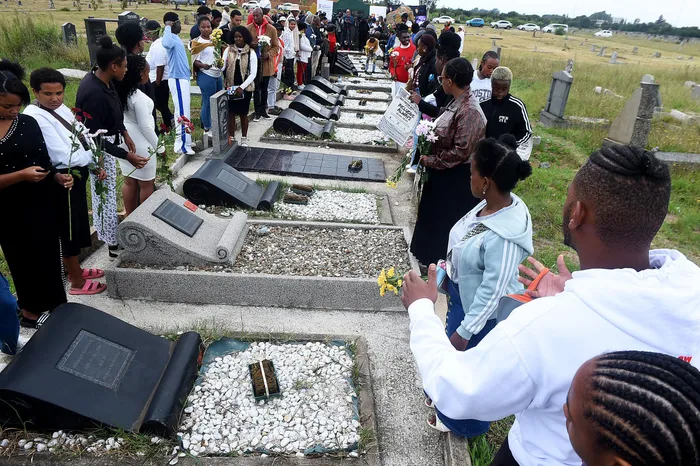
Relatives of the victims of the Sharpeville massacre taking part in an event to remember them at the Phelindaba Cemetery. The cemetery visit was also part of preparations for the national commemoration of the tragedy on Saturday, March 21. As we observe Human Rights Day, previously known as Sharpeville Day, the writers pose some hard questions about the unfinished business of the apartheid past where some relatives and survivors continue to be denied justice and closure.
Image: Itumeleng English/Independent Newspapers
As we commemorate Human Rights Day, we remember and honour the victims and survivors of the brutal massacre carried out by apartheid-era security forces in Sharpeville on 21 March 1960. We also reflect on the countless others who paid the ultimate price for South Africa’s democracy, including Nokuthula Simelane, Ramatua Nicholas “Boiki” Tlhapi, Iggy Mthebule, Kehla Nkuta, Ntombikayise Kubheka, Musawakhe “Sbho” Phewa, and so many more. Yet, while countless families across the country sacrificed their loved ones in the struggle for freedom, they have received little recognition, let alone justice, from the democratic state.
South Africa’s 1994 transition to democracy was built on a solemn promise: that the Truth and Reconciliation Commission (TRC) would uncover the horrors of apartheid, offering conditional amnesty to perpetrators of gross human rights violations who made full disclosure and demonstrated that their crimes were committed in pursuit of a political objective.
For victims and their families, however, the “broken promise” lies in what followed. Those who were denied amnesty, or who refused to apply for it, were meant to be investigated and prosecuted. Instead, it is widely alleged that, for three decades, systemic political interference has suppressed these cases, undermining the commitments made to survivors and eroding public confidence in the rule of law.
The families of victims of apartheid-era crimes have endured not only the initial harm inflicted through gross human rights violations, murders, kidnappings, torture, enforced disappearances, and more, but also a second layer of injustice. This has come at the hands of the democratic state itself, which has denied them their right to an effective remedy, including timely investigations and, where appropriate, prosecutions.
Refusing to allow the pursuit of truth and justice to be buried by state inaction, twenty-five families and survivors, alongside the Foundation for Human Rights, launched a landmark lawsuit on 20 January 2025. At its core, the case seeks to expose why almost no apartheid-era crimes were investigated or prosecuted between 2003 and 2017. In doing so, the applicants asked the courts to declare that the state violated the constitutional rights of survivors and their families, to award R167 million in constitutional damages for the deliberate suppression of investigations and prosecutions, and to compel the establishment of an independent commission of inquiry to uncover the mechanics of political interference in TRC cases.
Following negotiations between the parties, President Ramaphosa established a Commission of Inquiry on 29 May 2025. Chaired by retired Constitutional Court Justice Sisi Khampepe, and supported by retired Judge President Frans Diale Kgomo and Advocate Andrea Gabriel SC, the Commission is tasked with a critical mandate.
At its heart, the Commission is investigating whether, from 2003 to the present, attempts were made to prevent the investigation and prosecution of apartheid-era crimes. This includes examining whether and why efforts were made to halt police or prosecutorial work on TRC cases, whether politicians improperly influenced or colluded with state officials to obstruct justice, and which individuals may have been implicated in suppressing these investigations and prosecutions. It is also mandated to recommend further action, including possible criminal prosecutions, to determine whether the state’s conduct violated the constitutional rights of victims and survivors, and to advise on the appropriateness of constitutional damages.
The Khampepe Commission finally commenced public hearings in February 2026, with witnesses beginning to testify about alleged political interference in apartheid-era investigations and prosecutions.
Yet the Commission’s work has not proceeded without obstruction. A series of legal challenges, most notably the refusal by former Presidents Jacob Zuma and Thabo Mbeki to cooperate, and their attempts to remove Justice Khampepe as Chair, have significantly affected the proceedings. After their applications for her recusal were dismissed, both approached the High Court to review that decision. President Mbeki has gone further, seeking to have all proceedings of the Commission to date set aside, a move that could force the entire process to begin anew.
In a troubling development, President Ramaphosa has joined the court proceedings aimed at removing the very Chairperson he had appointed. While formally stating that he will abide by the Court’s decision, his position in effect supports the relief sought by the former Presidents, raising serious questions about his confidence in Justice Khampepe’s ability to fulfil her mandate.
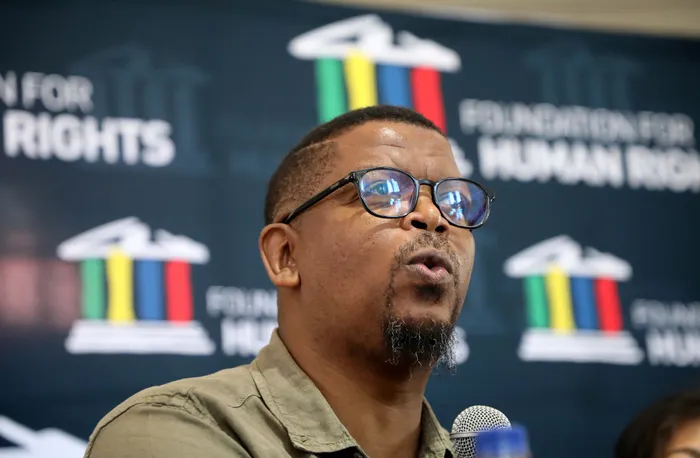
Lukhanyo Calata, son of one of the Cradock Four activists killed by the apartheid government's agents in 1985, Fort Calata. He believes that the Khampepe Commission of Inquiry is the "last hope" for his and other families of the victims of the apartheid-era human rights violations made to wait for years in vain for justice or closure.
Image: Timothy Bernard / Independent Newspapers
In parallel, the constitutional damages case has continued to move through the courts. In July 2025, the Pretoria High Court dismissed attempts by former President Mbeki and former Minister of Justice Mabandla to join the proceedings. In October 2025, the Court rejected an application by President Ramaphosa and the Government to delay the matter pending the outcome of the Khampepe Commission. The Court was clear: a commission of inquiry cannot substitute for the judiciary in determining constitutional rights. Emphasising the urgency of justice, it ordered the case to proceed and awarded costs against the President and the Government on the highest scale.
Some may question the need for yet another commission of inquiry, its relevance, its cost, and its place within South Africa’s constitutional order. They may argue that revisiting these issues risks undoing the fragile gains of reconciliation or diverting attention from pressing socio-economic challenges.
But this line of reasoning misses a fundamental point.
The rights of victims to truth, justice, and an effective remedy have been violated. The South African state is under both constitutional and international obligations to address these violations. The Khampepe Commission is, at its core, an attempt to correct these wrongs. Unlike the TRC, it does not focus on the primary violations, murders, torture, and disappearances committed during aparthied, but on systemic failures within the democratic justice system itself. It seeks to uncover why investigations were blocked, who was responsible, and how such interference was allowed to persist.
There is, understandably, a growing fatigue with commissions of inquiry in South Africa. But to dismiss them outright is to overlook their role as instruments of accountability in their own right.
First, their very establishment signals that the state recognises the seriousness of the issue. Second, they create a platform for public scrutiny that courts, bound as they are by procedural constraints and adversarial processes, cannot always provide. Commissions can investigate broadly, subpoena witnesses, and uncover evidence beyond the confines of litigation. In doing so, they generate truth and foster public accountability. Those implicated are brought into the open, questioned, and compelled to account for their actions, if not legally, then morally and politically.
Finally, while their recommendations may not be binding, they become part of the public record, a record that cannot simply be erased or ignored.
The failure to prosecute apartheid-era crimes stands as South Africa’s original accountability deficit. It has not only denied families their right to truth and justice, but has also emboldened future abuses of power, from the Arms Deal to State Capture.
The ongoing Madlanga Commission of Inquiry into criminality, political interference, and corruption in the criminal justice system offers a stark reminder of this reality. The issues emerging before it underscore a simple truth: when accountability failures are left unaddressed, they deepen systemic rot. Arguably, the state’s failure to act on TRC cases has helped create the very conditions that enable today’s corruption and other criminal scandals, including the alleged infiltration of the SAPS, the NPA, and other justice institutions by criminal syndicates.
As the Khampepe Commission continues its work, albeit under the shadow of potential court intervention, we are left with an unavoidable question: would today’s crisis of impunity and “justice capture” be as severe had earlier allegations of political interference, particularly in TRC cases, been properly investigated and acted upon?
* Zdunczyk is the Programme Manager for the TRC Programme at the Foundation for Human Rights (FHR) and Kimmie is the Executive Director of the FHR,