

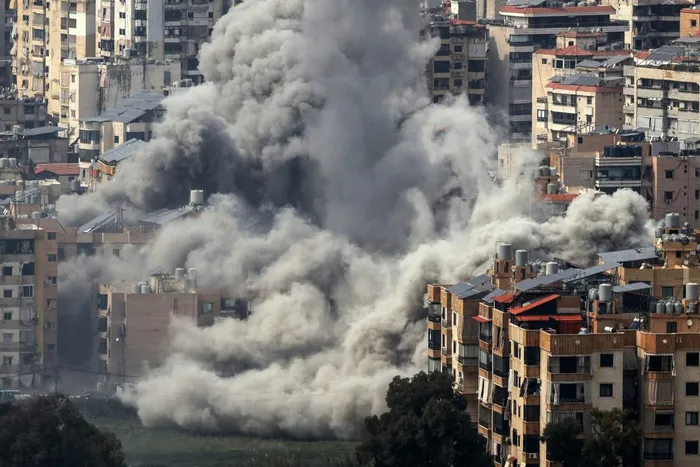
Smoke rises from the site of an Israeli airstrike in Beirut’s southern suburbs on March 6, 2026.
Image: AFP
In the ancient story found in the Hebrew Bible, the young shepherd David confronts the towering Philistine warrior Goliath. The giant stands armoured in bronze, confident that no opponent could defeat him. David, armed with nothing more than faith, courage and a sling, proves him wrong.
For centuries this story has symbolised the triumph of the seemingly weak over the apparently invincible. It is an enduring metaphor for asymmetrical conflict.
Today, the unfolding confrontation between Iran and the Western power bloc, dominated by the United States and its allies, has increasingly been framed in similar terms. But history warns us that the David and Goliath dynamic is not merely a biblical parable. It has played out repeatedly in modern geopolitics. Two of the most powerful examples are Vietnam War and the War in Afghanistan.
Modern Western military doctrine has long rested on the assumption that technological superiority, economic might, and global alliances guarantee victory. Yet the past half-century has demonstrated the limits of such power.
No country in history has wielded military power on the scale of the United States. Its defence budget dwarfs that of most nations combined. It maintains hundreds of overseas bases, commands the most advanced air force on earth and dominates global intelligence networks. But military power does not operate in a vacuum. It collides with terrain, culture, ideology, and the stubborn determination of those fighting on their own soil. Below is a list of some of the 700-odd USA bases across the world.
| Base Name | Location | Host Country / Territory | Branch | Strategic Purpose |
| Ramstein Air Base | Ramstein | Germany | Air Force | Air hub for Europe & Middle East operations |
| RAF Lakenheath | Suffolk | United Kingdom | Air Force | Fighter operations in Europe |
| Naval Air Station Sigonella | Sicily | Italy | Navy | Mediterranean logistics & surveillance |
| Naval Station Rota | Rota | Spain | Navy | Missile defence & naval operations |
| Incirlik Air Base | Adana | Turkey | Air Force | NATO operations, strategic deterrence |
| Camp Lemonnier | Djibouti City | Djibouti | Navy/Joint | Counterterrorism in Africa |
| Naval Support Activity Bahrain | Manama | Bahrain | Navy | Headquarters of US 5th Fleet |
| Al Udeid Air Base | Doha area | Qatar | Air Force | Largest US base in Middle East |
| Camp Arifjan | Near Kuwait City | Kuwait | Army | Logistics hub for regional operations |
| Naval Support Activity Naples | Naples | Italy | Navy | Command for US Naval Forces Europe |
| Yokosuka Naval Base | Yokosuka | Japan | Navy | Home of 7th Fleet |
| Kadena Air Base | Okinawa | Japan | Air Force | Major airpower hub in Asia |
| Camp Humphreys | Pyeongtaek | South Korea | Army | Largest US overseas base |
| Andersen Air Force Base | Guam | Guam | Air Force | Strategic bomber base in Pacific |
| Naval Base Guam | Guam | Guam | Navy | Submarine & naval operations |
| Diego Garcia Naval Support Facility | Diego Garcia | British Indian Ocean Territory | Navy/Air Force | Strategic Indian Ocean base |
The United States entered the Vietnam War believing it could decisively defeat communist insurgency through overwhelming force. Instead, it encountered an enemy that refused to fight by conventional rules. The Viet Cong and North Vietnamese forces relied on guerrilla warfare, tunnel networks, political mobilisation of the population and strategic patience.
The United States dropped more bombs on Vietnam than were used in the entire Second World War. In these years, advanced aircraft, helicopters, chemical defoliants and massive troop deployments were all brought to bear. Yet victory remained elusive. Instead, thousands of American troops perished only to be euphemistically hailed as “veterans”. And very dead they were.
The Vietnamese strategy was simple but devastating: survive long enough for the superpower to lose the will to continue. Year after year the war dragged on. Casualties mounted. Television images of destruction reached American homes. Domestic opposition intensified. Eventually the United States withdrew in 1973. Two years later Saigon fell. The giant had been defeated not by superior firepower but by patience and endurance.
Not a generation later, history repeated itself. Following the attacks of September 11, 2001, the United States launched the War in Afghanistan (2001–2021) against the Taliban. At first the campaign appeared decisive. The Taliban government collapsed quickly. Western leaders proclaimed victory. But Afghanistan has long carried a reputation as the “graveyard of empires.” The rugged terrain, deep tribal structures and fierce independence of its people had already defeated the British Empire in the 19th century and the “mighty” Soviet Union in the 1980s. The United States soon discovered the same reality.
Despite advanced surveillance, drone warfare and the most sophisticated military logistics ever assembled, the Taliban steadily rebuilt their insurgency. They did not need to defeat the United States militarily. They simply needed to outlast it. Twenty years later, the United States withdrew. Within weeks the Taliban returned to power in Kabul.
The most powerful military alliance in history had again failed to impose its will.
And America replaced the Taliban … with the Taliban.
| Category | Vietnam War | Afghanistan War |
| Duration | 1955–1975 (major US involvement 1965–1973) | 2001–2021 |
| Total Financial Cost (US) | ≈ $1 trillion (inflation-adjusted) | ≈ $2.26–$2.3 trillion |
| US Military Deaths | 58,220 | 2,456–2,461 |
| US Military Wounded | ≈ 153,000 | ≈ 20,700 |
| Local Military Deaths | ≈ 1–1.3 million Vietnamese combatants | ≈ 66,000–75,000 Afghan military/police |
| Civilian Deaths | ≈ 600,000 – 2 million+ in Vietnam | ≈ 47,000 – 176,000 civilians |
| Total Estimated War Dead | ≈ 2–3.8 million people | ≈ 200,000+ people |
| US Troops Deployed | ≈ 2.7 million | ≈ 800,000 |
| Peak US Troop Presence | 543,400 (1969) | ~100,000 (2011) |
| Cost per US Death (approx.) | ≈ $17 million | ≈ $935 million |
The current unprovoked war involving Iran must be understood within this broader historical pattern. Iran is not a superpower. Its economy has been battered by sanctions imposed by western nations at the behest of the USA and its proxy, Israel. Its conventional military capabilities cannot match those of the Western alliance. Or so the Americans and the world thought. Iran, it has to be remembered, sits astride a region of centuries old civilisation. Mostly from Central Asia.
Built of fortitude and wisdom eked out of a religious belief system, Islam, that encouraged peering into the skies and to contribute to the upliftment of humanity. This has produced an incredible range of thinkers and scientists that has contributed hugely to world civilisation. And so, Iran has spent decades developing the very strategies that frustrated America and western powers in Vietnam and Afghanistan.
Rather than confronting the West directly, Iran will have built a network of allied movements across West Asia that complicate any attempt at decisive military victory. In this sense, Iran’s “sling” consists not only of weaponry but of strategy, patience and geography. Whereas America’s “superpower” status is based largely on threatening violence to those who resist.
Another factor complicating the confrontation is the central role of Israel. For Israeli leadership, Iran represents the most serious long-term strategic challenge in the region. Iranian support for groups opposing Israeli policies has turned the rivalry into one of the defining conflicts of West Asia politics.
Critics would argue that Western confrontation with Iran is often shaped by Israeli security calculations and lobbying pressure, drawing global powers deeper into a regional struggle whose consequences could be catastrophic. It is the history of occupation and ethnic cleansing that drives the present resistance narrative.
Instead of adopting a policy of a shared destiny for Palestinians and Jews, a fiction driven by the “antisemite” slogan and rapid de-Arabisation through mass killings and dispossession of the whole region, resulted in the Ayatollah Khomeini of Iran to the declare Israel a non-state. Iran has never been anti-Judaism. There are still thousands of Jews living there.
The lesson from Vietnam and Afghanistan is not that powerful nations inevitably lose.
It is that power alone cannot guarantee victory. Military superiority can destroy armies and infrastructure, but it struggles to defeat ideas, movements and populations willing to endure immense hardship. The story of David and Goliath endures precisely because it captures this truth. The giant believes his armour makes him invincible. The shepherd understands that agility, courage and conviction can neutralise size. History repeatedly vindicates the shepherd.
The world now stands at a moment where miscalculation could ignite a wider war across Western Asia. If that happens, the lesson of history should weigh heavily on those who believe overwhelming power guarantees quick victory. Vietnam proved otherwise. Afghanistan proved it again. And if the ancient story still carries wisdom, it is this: the giant should never underestimate the shepherd with a sling.
Human Cost in Perspective
Vietnam
The Vietnam war devastated an entire region.
Afghanistan
The Afghanistan war became the longest war in US history, lasting 20 years.
Major human losses included:
Financial Scale
Vietnam War
Afghanistan War
Total cost estimated at $2.3 trillion.
Breakdown includes:
| War | Strategic Outcome |
| Vietnam | US withdrawal (1973); fall of Saigon (1975) |
| Afghanistan | US withdrawal (2021); Taliban returned to power |
In both cases: the superpower withdrew; the local insurgent movement ultimately took control of the country.
These statistics illustrate a recurring pattern in modern warfare:
Industrial military power does not guarantee political victory. In both Vietnam and Afghanistan:
The implication for contemporary conflicts is stark:
Even overwhelming military and financial superiority can struggle against local resistance movements with ideological motivation, terrain advantage, and strategic patience.
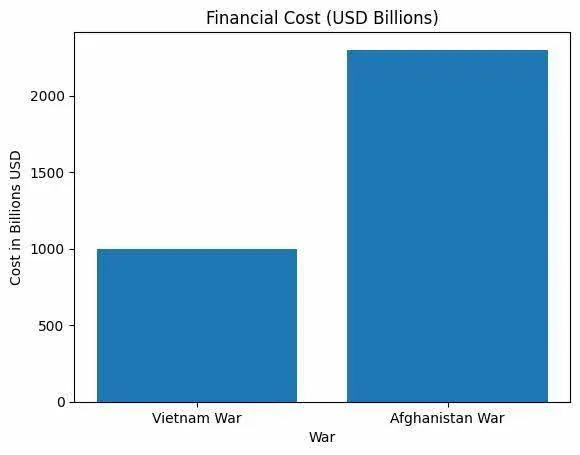
Financial Cost
Image: Supplied
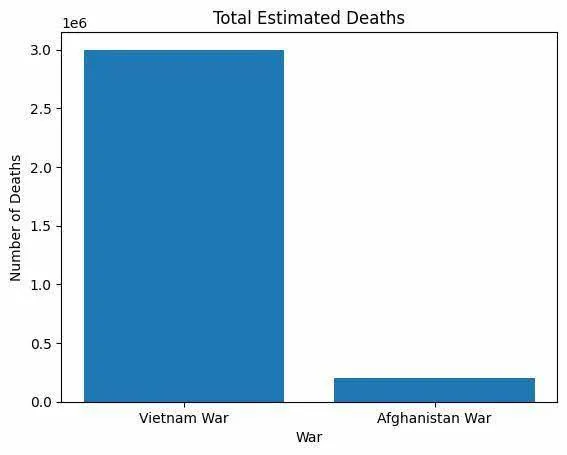
Total Estimated Deaths
Image: Supplied

The ancient tale of David and Goliath resonates in today's geopolitical landscape, particularly in the context of the Iran War and the lessons learned from the Vietnam and Afghanistan conflicts, writes Shabodien Roomanay.
Image: Supplied
* Shabodien Roomanay is the board Chairman of Muslim Views Publication, founding member of the Salt River Heritage Society, and a trustee of the SA Foundation for Islamic Art.
** The views expressed do not necessarily reflect the views of IOL or Independent Media.