

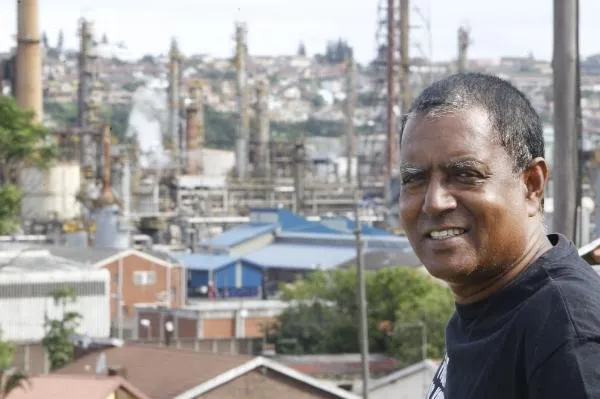
South Durban Community Environmental Alliance (SDCEA) leader Desmond D'sa is among the environmental activists who are opposed to the reopening of the flood-damaged Sapref crude oil refinery in Durban. Instead, he believes the plant and the nearby Engen refinery in Durban should be decommissioned and the area rehabilitated.
Image: Supplied
Calls to urgently reopen South Africa’s largest oil refinery, Sapref, now under the South African National Petroleum Company (SANPC), reflect a troubling continuity in the country’s energy governance: short-term energy security concerns are once again being prioritised over long-term environmental accountability. The push by Minerals and Petroleum Resources Minister Gwede Mantashe to restore refining capacity is framed around stabilising fuel supply and prices. While this is a legitimate concern, it obscures a far more pressing issue, one that remains unresolved despite years of public scrutiny: Who is responsible for the legacy environmental and social damage associated with Sapref in South Durban?
In my previous work for The Conversation, I examined the controversial sale of Sapref for what amounted to a nominal price to the state Central Energy Fund (CEF). This transaction raised serious concerns, not because of the figure itself, but because of what it appeared to exclude. When major oil companies such as BP and Shell exited the refinery, the central question was whether environmental liabilities were fully accounted for or effectively transferred along with the asset. That question remains unanswered. The risk now is that the South African state, through SANPC and the CEF, has inherited a contaminated asset without ensuring that those responsible for decades of pollution have met their obligations. If so, the burden of environmental remediation is being shifted away from multinational corporations and onto taxpayers, and, more critically, onto the communities who continue to live with the consequences.
This is particularly concerning in South Durban, and especially in the Island View precinct – the new site targeted for the Sapref reopening, where fuel storage and distribution infrastructure is being expanded as part of a broader strategy to strengthen energy security. This is not a neutral industrial zone. It is an already overburdened pollution hotspot, shaped by decades of petrochemical activity. Communities in areas such as Merebank and Wentworth have long been exposed to cumulative environmental and health risks. Air pollution, soil contamination, and repeated industrial incidents are part of everyday life. These conditions are not just historical; they are ongoing structural injustices, and in some cases, worsening.
The 2022 KwaZulu-Natal floods exposed infrastructure failures at Sapref, leading to significant oil spills that contaminated beaches, residential areas, and sensitive ecosystems. Against this backdrop, calls to reopen Sapref, without first addressing its environmental legacy, are deeply problematic. Framing environmental regulations and legal challenges as “obstacles” to development by Mantashe misrepresents their role. These are not barriers; they are constitutional safeguards designed to prevent the externalisation of environmental costs onto vulnerable communities. In South Durban, they are often the only mechanisms through which residents can assert their right to a safe and healthy environment.
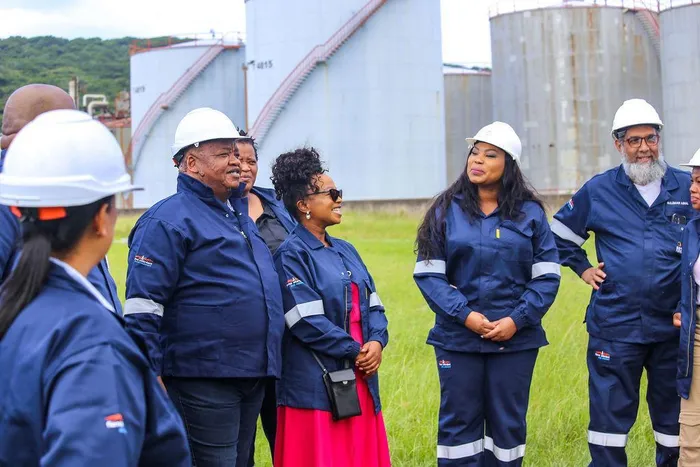
eThekwini City Manager Musa Mbhele (third from left) and the Deputy Minister of Mineral and Petroleum Resources Phumzile Mgcina (third from right) together with other officials in Durban on Monday visiting the former Sapref refinery as part of plans to reopen it as the SANPC Refinery.
Image: eThekwini Municipality
The starting point cannot be future profitability or supply stability. It must be accountability. This requires, first, establishing clear legal responsibility for historical environmental damage. The exit of BP and Shell does not absolve them of liability despite the sale of the Sapref premises. Environmental obligations do not disappear when assets are sold, particularly not when those assets have caused documented social and environmental harms. Second, there must be a comprehensive, transparent, and independently audited environmental and social assessment of the previous refinery site and surrounding areas. Communities have a right to know the extent of contamination, the risks they face, and the timelines for remediation. Third, and most critically, cleanup must precede any consideration of Sapref reopening. Not in parallel, not deferred, and not partially implemented. Reopening Sapref at Island View precinct, already a highly polluted site, cannot be a consideration when legacy impacts remain unresolved.
The governance process currently unfolding raises additional concerns. A study into Sapref’s future is expected to inform parliamentary oversight and decision-making. However, the involvement of industry actors in shaping this process risks undermining its independence.
The Parliament of South Africa has a constitutional responsibility to ensure that oversight is not only procedural, but substantive. This includes interrogating the terms of the original sale, the allocation of environmental liabilities, and the adequacy of remediation efforts to date. The state’s dual role, as both regulator and operator through SANPC, further complicates matters. Without strong safeguards, there is a risk that energy security imperatives will override environmental governance.
This reflects a broader policy dilemma. South Africa appears to be oscillating between reliance on fuel imports and the revival of domestic refining capacity. But this binary framing misses the deeper issue: the need to transition away from fossil fuel systems that impose disproportionate environmental and health costs on specific communities.
A just energy transition requires more than shifting supply sources. It requires confronting the legacy of existing infrastructure and ensuring that the costs of that legacy are borne by those who created it, not those who are least able to resist it. At present, the risk is that South Africa is moving in the opposite direction: socialising environmental costs while privatising profits. The logic of wealth production dominates the logic of risk production.
* Llewellyn Leonard is a Distinguished Research Professor, Environmental Sciences, and Chair of the Centre of Excellence: Adaptation and Resilience at the University of South Africa.
* The views expressed here do not necessarily reflect the views of IOL or Independent Media.

Environmental scientist Professor Llewellyn Leonard, is cautioning against rushing to reopen South Africa's largest oil refinery that closed after flood damage in 2022 formerly known as Sapref.
Image: SUPPLIED