

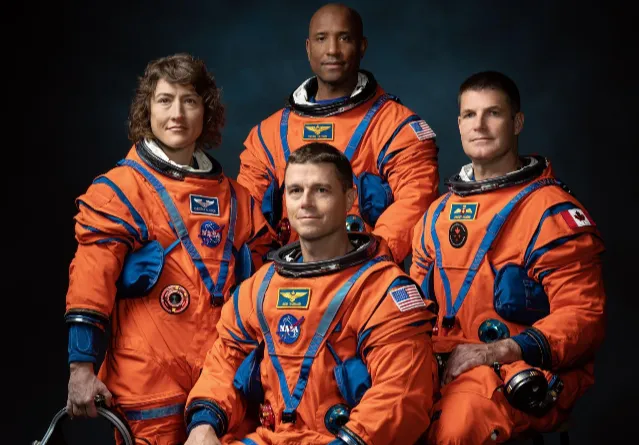
The Artemis 2 crew: Commander Reid Wiseman, Victor Glover, Christina Koch and Jeremy Hansen. In a dark year of wars and geopolitical tensions, the space mission shines brightly as a beacon of hope, showcasing the power of international collaboration in science and space exploration.
Image: Facebook/NASA
This time last year, the main global story was US President Donald Trump’s “Liberation Day” tariffs war declaration. This April, the world is once again reeling from the White House Bully’s recklessness, but the worst seems behind us all now following the US-Israel-Iran ceasefire announced this week. And there’s another more positive story providing a lovely counterbalance.
After close to six decades since Neil Armstrong set foot on the Moon, humans have ventured back out there. This time, it was not a race to the Moon by political rivals. There was no Soviet Union to beat by touching down first on that barren, airless lump of rocks circling around our world.
Instead of political rivalry, this time camaraderie and cooperation rule. It was lovely to see US astronauts not just working together but getting along nicely with their Canadian colleague. And the focus is on the science, on development to benefit all of humanity, including preparations for humans to one day settle on the Moon.
By highlighting the difference in the political atmosphere, I am by no means minimising the technological benefits brought to our world by the Apollo missions of the 1960-70s. Out of that geopolitical race to the Moon, came the microchip that started the computer revolution of the 1980s. Not to forget the cordless tools, water purification systems and other technologies that we take for granted today.
There were other important things that were lovely to see from the Artemis mission – other than those boring but important pictures of the “lunar Grand Canyon” taken from the far side of the Moon. Humans have actually been – for the first time – to the real-McCoy Back of the Moon!
But there were more important records broken. The team of astronauts included a woman and someone similar in skin tone to many fellow ordinary South Africans.
Commander Reid Wiseman, Victor Glover, Christina Koch and Jeremy Hansen’s mission was not to simply equal or beat Armstrong’s feat. It was not about leaving footprints on the Moon, but genuinely taking another giant scientific leap forward for all humanity.
Their mission is a reminder that together we can go far – or farther and farther, as the Americans say. It's also a challenge for the youth of today to beat the 248, 655 miles away from the Earth they've recorded.