

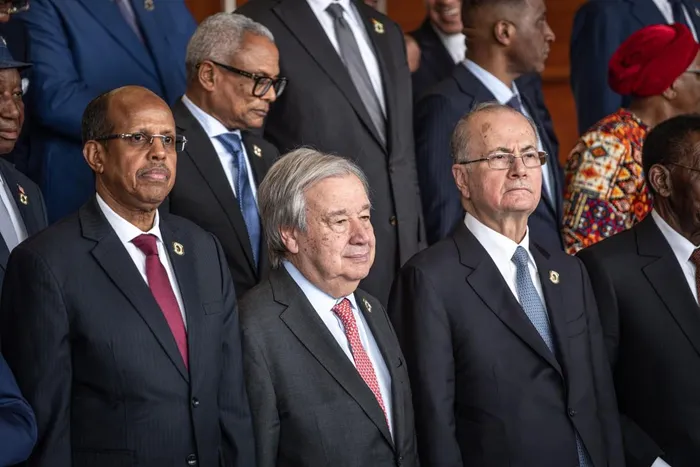
(FROM left) Mahmoud Ali Youssouf, Chairperson of the African Union Commission, Antonio Guterres, Secretary-General of the United Nations, and Mohammad Mustafa, Prime Minister of the State of Palestine, during the 39th Ordinary Session of the Assembly of the African Union at the AU Headquarters in Addis Ababa on February 14.
Image: AFP
Kim Heller
António Guterres's term as the United Nations' Secretary General comes to a close in December 2026. The race for his replacement takes place in a world experiencing considerable geopolitical flux. Superpower rivalry is intensifying. The undercarriage of multilateralism is shaky.
In the Western-centric power and governance matrix of the UN, racial and gender imbalances are prominent. A woman has never led the United Nations in its 80-year history. It is a game of thrones where the traditions of racial and patriarchy have yet to be unseated. Despite the rise of Global South presence and promise, Western hegemony remains firmly in place.
Africa has yet to display the unity of purpose and coordinated strategy that could see it decisively shape the contours of global governance. The race for the next Secretary-General of the UN offers the Continent an opportunity to showcase its leadership mettle. However, it is already off to a bad start.
In a terribly awkward diplomatic misstep, Burundi moved to nominate former Senegalese president Macky Sall for the SG position. This bypassed the African Union's formal consultative processes, disregarding and degrading the principles and practices of consensus.
Senegal distanced itself from the nomination, and close to twenty member states expressed their opposition. It is noteworthy that the African Union has not endorsed Sall's candidacy. In a letter dated March 27, the AU Commission stated that the draft decision "on UN Secretary-General candidacy of H.E. Macky Sall….has not been adopted."
The false start nomination of Sall has become a source of embarrassment for Africa. For policy analyst, Dr Solomon Ayele Dersso, this unfortunate episode has exposed the "procedural fragilities" within the AU and undermined its diplomatic credibility. The nomination process should have been a winning coordinated move.
However, it has become a glaring fault line of the AU's institutional weakness and the lack of strategic coherence among its member states.
The AU must swiftly correct this move. Consultation and consensus are the right starting point. A winning move would be to unite behind a single, high-calibre candidate who can garner continental and Global South endorsements.
Africa has had two UN Secretary Generals: Boutros Boutros-Ghali (Egypt, 1992–1996) and Kofi Annan (Ghana, 1997–2006). It is now time for an African woman. The selection of an African woman as the next SG of the United Nations would signpost a strategic shift towards regional and gender representivity and balance.
If Africa wins the seat and the position is used effectively, it could help assert the Continent as an active shaper of global leadership governance, rather than a passive recipient of Western norms and frameworks.
Africa is not short of outstanding women leaders. The first female Chairperson of the AU, Dr Nkosazana Dlamini-Zuma, is an inspiring symbol of exemplary African leadership. Her development and stewardship of Agenda 2063, steering of peace and security frameworks across the Continent, and advancement of gender parity within the AU have left an impactful imprint.
Amina Mohammed, the current Deputy Secretary-General of the UN, is a beacon of effective leadership. Mohammed's keen focus on Global South issues, coupled with her firm track record in advancing gender equity, climate justice, and peacebuilding, makes her an ideal candidate.
She is currently Nigeria's most senior representative at the UN and is directly involved in implementing the Sustainable Development Goals. There are many other African women grounded in good governance, peace negotiations, and institutional reform who would excel in the post.
In 2026, the UN finally made significant strides toward gender parity in its senior leadership positions. Close to 50% of senior UN leadership roles are now held by women. It is now time for a female Secretary General.
The UN's protocol of regional rotation is likely to see a Latin American candidate be first in line for the Secretary-General position, and nominations of powerful women from this region are already forthcoming.
Regional rotation is an informal practice rather than an inscribed or binding policy, which means that Africa still has a fighting chance. The Continent will need to secure the support of the UN Security Council's permanent members—the P5, who are the key decision makers.
However, first and foremost, the African Union must achieve Continental consensus on a suitable candidate. A unified Continental lobby for a credible female candidate is likely to garner support from the Global South.
A clarion call for an African woman to serve as Secretary-General is intrinsically linked to the lack of Global South representation on critical global bodies. The UN, the International Monetary Fund, and the World Bank continue to reflect historical power pacts and practices which discount African participation and agency.
The reconfiguration of the global governance architecture is no easy win. It is both a sprint and a marathon. It requires determination and dexterity to drive toward a destination set by an African compass and Global South coordinates.
Global power is shifting. There is a strong pull towards the Global South. The African Union needs to take advantage of the current gap. The African Union can turn a diplomatic setback into a prime opportunity for strategic repositioning.
Uniting behind an African woman candidate will resonate well beyond the UN, signalling a continent-wide commitment to a stronger African voice on the global governance stage and to high-level gender participation.
The race for the next UN Secretary-General is heating up. The question should no longer be about whether Africa or African women are ready to lead. It is whether Africa can move with clarity and conviction and in concert to centre itself in the game of global power.
* Kim Heller is a political analyst and author of No White Lies: Black Politics and White Power in South Africa.
** The views expressed do not necessarily reflect the views of IOL or Independent Media.