

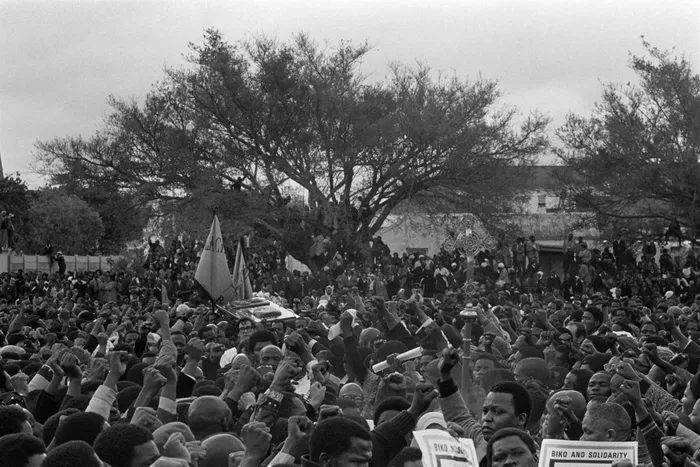
Thousands of mourners attended the funeral of Black Consciousness Movement (BCM) leader Steve Biko on September 25, 1977 in King William's Town. Biko was murdered by the apartheid regime's security police. The family of Biko opposed amnesty for his killers, labelling the TRC as a “vehicle for political expediency", says the writer.
Image: AFP
Sithembiso Bhengu
On 10 November 2025, the Judicial Commission of Inquiry into Allegations Regarding Efforts or Attempts to Stop the Investigation or Prosecution of Truth and Reconciliation Commission Cases (TRC Cases Inquiry), chaired by Judge Sisi Khampepe, began its proceedings.
The President established the commission in May 2025 to determine whether attempts were made to prevent the investigation and prosecution of apartheid-era crimes. The Presidency stated, “the establishment of this commission of inquiry is part of an agreement reached in settlement discussions in a court application brought by families of victims of apartheid-era crimes”.
The Khampepe Commission was established exactly 30 years after the TRC, established in 1995 as a basis for exposing abuses and atrocities during the apartheid era, aimed to both offer a semblance of truth and closure for families of apartheid victims, as well as to offer amnesty to perpetrators of atrocities, based on the truthfulness of their testimonies and remorse for their actions.
It was also to compile factual records of abuses, killings, and atrocities, from which the prosecuting authorities and the DOJ would prosecute to ensure sufficient measures of justice, especially for families of victims of apartheid crimes.
Yet, 22 years after the TRC Final Report was released in March 2003, very little to no progress has been made by the NPA across six government administrations in investigating and prosecuting TRC cases, forcing families to seek justice by taking the government to court.
The failure of the NPA to prosecute TRC cases laid bare the hollowness of the reconciliation project, exposing these processes as merely cosmetic, as justice remains elusive for families of victims of apartheid crimes. Instead, several cases that should have been investigated and prosecuted by the TRC have been initiated by the efforts of affected families.
On 26 June 2017, the family of Ahmed Timol successfully brought to the Pretoria High Court the reopening of an inquest on the killing of Timol, murdered on 27 October 1971. The ruling by Judge Mothle on 12 October 2017 overturned the initial 1972 inquest, ruling that Timol was pushed to his death after assault and torture by the Security Branch.
In the same vein, the family of Dr Neil Aggett initiated an inquest into his killing, which was heard between 2020 and 2021, resulting in the overturning of the initial inquest. There are numerous similar cases, including the case of Dr Hoosen Haffejee, killed in custody on 3 August 1977, whose inquest in 2023 affirmed that he was killed in custody by the Security Branch.
Another case of Ernest Moabe Dipale, who was killed in custody at the John Vorster Square Police Station on 8 August 1982, was heard at the Johannesburg High Court. The ruling on 11 July 2023, revoked the death report, ruling that the Security Branch killed him. Also, the case of Abdullah Haron, killed on 27 September 1969, was heard in 2022/3, with a ruling confirming that Haron had died of torture at the hands of Special Branch.
Presently, an inquest on the Cradock Four, who were arrested, tortured, and murdered on 27 June 1985, is being heard at the Gqeberha High Court. There are numerous outstanding cases of victims killed by apartheid police and assassins in ambushes and attacks, like Nokuthula Simelane, killed in 1985, and scores of other victims of apartheid surrogate forces in Bantustans, and in communities in proximity to hostels in various parts of Gauteng and KZN.
The common thread from all these matters, and thousands upon thousands of unheard and silent cases, is ‘justice deferred and justice denied’, as many family members are forced into historical amnesia of apartheid atrocities, and left alone to lick the sceptical wounds of victims that have not been afforded justice (restorative justice).
The main critique of the TRC and its aftermath has consistently been that, in more than two decades after the final report of the TRC was published, scores of families of victims of apartheid killings and abuses have not seen the prosecution of justice.
Many of those implicated in the killing, abuse, and atrocities against their family members have not faced any accountability or justice, as most of these cases remain dormant. The Rodrigues v Director of NDPP case, heard at the South Gauteng High Court in 2019, ruled that political interference had materially affected the ability of the NPA to properly deal with TRC cases, and that resources that were necessary to conduct proper investigations were not forthcoming.
The persistent failure of the NPA to investigate and prosecute TRC cases represents a significant factor in the criticisms of the TRC and its failure to secure justice and reconciliation.
In 1998, a study by South Africa's Centre for the Study of Violence and Reconciliation surveyed several hundred apartheid-era victims and found that most victims and their families felt that the TRC had failed to achieve reconciliation. They believed that justice, a prerequisite for reconciliation, was reduced to an alternative to it, making the TRC be seen as weighted in favour of the perpetrators.
The TRC was also criticised for its narrow mandate and “compromised truth”. Its focus on individual ‘gross human rights violations’ between 1960 and 1994, ignored the ‘structural violence’ of apartheid, e.g., forced removals, forced proletarianisation, pass laws, and economic exploitation.
It is these systemic abuses that continue to allow beneficiaries of the system of apartheid to escape responsibility. This focus on individualism vs. systemic injustice produced a TRC that failed to “put apartheid on trial”.
The ‘amnesty for truth’ compromise, adopted at the TRC, saw a core trade-off, granting amnesty in exchange for truth, but equally stripping victims of their right to pursue justice in court. As a result, many of the most affected felt that the TRC favoured perpetrators, who were often reintegrated into society, while victims were left stranded, without justice.
For instance, more than 300 individuals recommended for prosecution by the TRC were never investigated and prosecuted, ‘making a mockery’ of those who testified. In six government administrations, the state has either been slow or has not moved to implement reparations, leading to disillusionment, reducing the TRC to ‘symbolic tokenism’.
To this, Professor Mahmood Mamdani called it “the TRC and South Africa’s ‘false reconciliation’”. Mamdani argued that the TRC promoted a superficial reconciliation between political elites, failing to reconcile the deeply divided racial and economic landscape of South African society.
In this sense, the TRC merely sanitised the past, with its focus on emotional catharsis, with the state using the tears and testimonies of victims for ‘cleanup’ rather than delivering concrete, long-term transformation.
Families of victims also criticised and objected to the amnesty provisions in the TRC, as the basis for truth-telling. The family of Steven Biko, who was killed in police custody, opposed the amnesty for Biko’s killers, labelling the TRC as a “vehicle for political expediency, ‘robbing’ them of their right to justice”.
At the centre of these critiques has been decades of a failed reconciliation project, with persisting apartheid inequalities, and a complete failure of any meaningful distribution.
As a result, the country’s reconciliation project produced a legitimising of racialised wealth concentration and inequality, easing the conscience of the historically privileged, while condemning scores of poor blacks as accomplices to their own misery.
* Sithembiso Bhengu is Executive Director of the Chris Hani Institute.
** The views expressed do not necessarily reflect the views of IOL or Independent Media.