

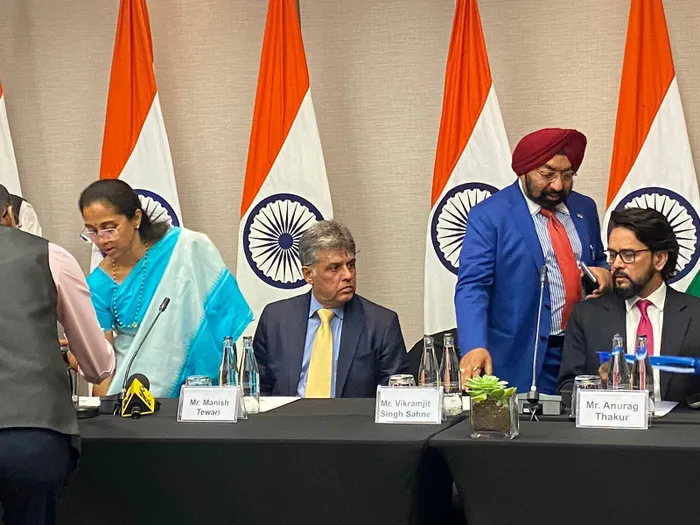
Part of a multi-party delegation from India visiting South Africa after the Pahalgam attack last year. India has long maintained that terrorism emanating from across the border remains a serious threat to regional peace.
Image: Supplied
It’s been a year since the brutal 22 April 2025 terrorist attack at a tourist attraction meadow in Pahalgam, in the state of Kashmir, India, where 26 people, mostly tourists, died tragically after being mowed down by gunfire.
India blamed the attack and killings of 26 “Hindu tourists” on Pakistani terrorists called The Resistance Front (TRF) based in the Pakistani part of Kashmir, who have over a period of time been launching attacks against India and some of its tourist sites.
According to reports from India, documentary evidence points the finger at Pakistan for the string of terrorist attacks on Indian soil. The report also said the US Justice Department has classified the TRF as a terrorist organisation.
Following the attack last year, South Africa reiterated its condemnation of “terrorism in all forms”, stating that such acts of violence and extremism have no place in society. The government’s Department of International Relations and Cooperation (DIRCO) issued a statement expressing sadness over the attack on tourists, extending condolences to the victims' families and the Indian government. South Africa’s leading political party, the African National Congress (ANC) also at the time expressed solidarity with India during meetings with a visiting Indian parliamentary delegation, condemning terrorism in all forms. There were also protests by South African Hindu organisations with protesters expressing solidarity with the victims.
The Pahalgam attack had immediate and serious economic repercussions for India which reportedly had to shut down 50 tourist spots in Jammu and Kashmir.
However, after upgrading security measures in and around the area, this year the sites were gradually opened to cater once more for local and international tourists.
For many years India has had to endure terrorist attacks from its neighbouring country and in many ways, it has managed to avert some and prevented the loss of lives while it continues with business as usual.
I was in India in October 2008 together with a group of journalists from BRICS countries when India was hosting the 3rd IBSA (India-Brazil-South Africa) Summit and we stayed at some of India’s best hotels, including The Oberoi and the Taj.
We travelled safely around the country being shown tourist sites and attractions, not knowing that less than a month later India would suffer its own version of 9/11 when a group of terrorists allegedly from Pakistan, launched the most brutal attack against the country.
About 166 people died and more than 300 sustained injuries when ten terrorists said to be members of Pakistan-based Lakshkar-e-Toiba targeted tourists attractions, including The Oberoi and the Taj, the city’s train station, a hospital and a restaurant and other sites where the rich and foreign visitors congregated between 26 and 29 November.
India-Pakistan relations are always tense, defined by the 1947 Partition, the Kashmir dispute, and multiple wars and attacks on India. Both nations are nuclear-armed and face persistent border conflicts along the Line of Control (LoC).
However, India seems to have managed to survive in spite of the constant threat of terrorism from its neighbour.
India has also beefed up its security in the Kashmir region and a year after the Pahalgam attacks, the famous meadows are buzzing with tourists once more. Visitors come from all over the globe to experience the splendour of what has been dubbed “mini Switzerland”.
The Middle-East conflict triggered by an Israel-US attack on Iran about two months ago has once more brought instability in the region.
This has affected business and tourism in the region. especially in places like Dubai and Qatar where infrastructure has been badly damaged by the war. But Pahalgam is rebuilding and rising once again as a key global tourist destination.
* Mkhuma is a veteran journalist, former editor of the Pretoria News, and Editor: Higher Education Media Services.