

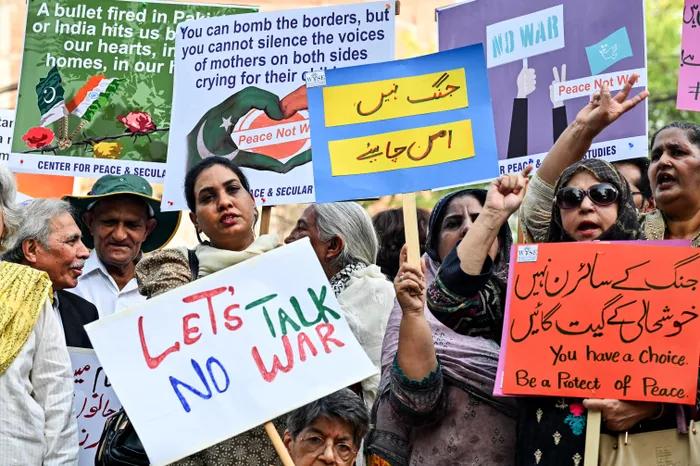
Demonstrators taking part in a peace rally after tensions escalated between India and Pakistan last year following a deadly attack in Kashmir. A year later, India remembers the victim and stands united in "grief and resolve".
Image: AFP
The European Union has expressed solidarity with India on the first anniversary of the Pahalgam terror attack. In a statement, the EU said it stands with the people of India in remembering the 26 victims who lost their lives in the 22 April attack last year.
The EU reiterated its strong condemnation of terrorism in all forms.
The British High Commission in New Delhi also paid tribute, reaffirming the United Kingdom’s commitment to peace and security. The attack took place in Jammu and Kashmir and was carried out by the Pakistan-based group Lashkar-e-Taiba, killing mostly tourists.
Hidayat Bhutto, UK and Europe Organiser of the World Sindhi Congress, was quoted as saying: “We remember with profound sadness and unequivocal condemnation the innocent lives that were brutally taken and the families whose lives have been forever marked by grief and loss."
Bhutto described the attack as a grim reminder of the continuing threat and menace posed by militant networks operating in South Asia. He alleged that Pakistan’s long-standing approach of backing non-state actors contributed significantly to regional instability.
Calling for urgent action, Bhutto stressed the need for a strong and coordinated international response. “A firm, consistent and accountable approach grounded in international law is essential to dismantle these networks and prevent future attacks,” he said.
British journalist, author and part-time BBC presenter Owen Bennett-Jones unpacked the conflict during a Political Tours webinar following the rise in tensions last year. He said the India-Pakistan conflict had momentarily raised the spectre of a nuclear war.
USA President Donald Trump’s view that the "great tension" has "always been the same" and should be left up to the leaders of the two nations to sort out, was correct, Bennett-Jones said.
“And the world has to thank the very same source of fears of a terrifyingly destructive war – the nuclear arsenals both the neighbouring nations possess – for the fact that the recent flareup (last year) did not escalate to a full India-Pakistan war and, instead, a ceasefire was quickly agreed to and seems to be holding,” he said.
Bennett-Jones said last year's conflict – described as probably the worst in 20 years – started with the Kashmir tourist attack, an act he described as a “direct attack” on Indian Prime Minister Narendra Modi’s policy of keeping Kashmir safe so as to boost tourism to the area for its economic benefits.
He described it as a major “terrorist” attack where the victims were allegedly first asked if they were Hindus before being killed. It then quickly escalated – in a matter of days or hours – with terrifying exchanges hitting strategically important military targets on both sides.
What helped to stop the escalation was that “both sides realised they were climbing the escalatory ladder with astonishing speed”. They realised they were “looking at a nuclear war” and they had to stop; they had to quickly agree to a ceasefire.
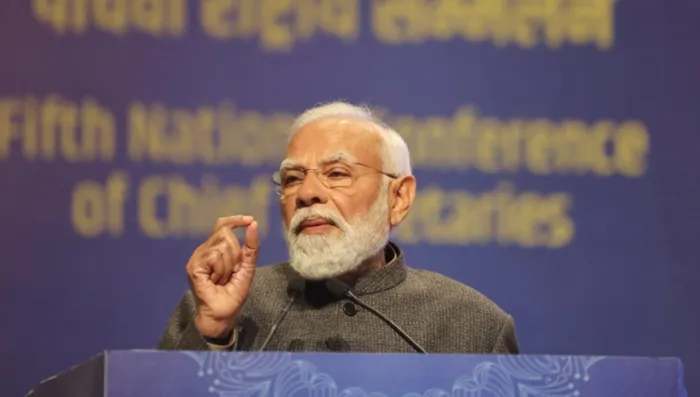
“Remembering the innocent lives lost in the gruesome Pahalgam terror attack on this day last year. They will never be forgotten," says India Prime Minister Narendra Modi’s administration in a social media post about the April 22, 2025 massacre.
Image: Facebook
India is prepared to accept the status quo and under Modi has come to view Kashmir as a “regular” part of India.
“So, it's not the economy, stupid, it's Kashmir?” asked the webinar’s facilitator as to the reasons for the conflict and the recent fighting.
It seems, therefore, that this “great conflict” between the two nuclear powers with arsenals “good enough to blow each other out completely”, as Bennett-Jones put it, will simmer on as it has for many years to come with each watching the other closely but not prepared for another full-scale war, and definitely not a nuclear war. For now.
Following the Pahalgam massacre, India launched Operation Sindoor targeting terror infrastructure in the Pakistan occupied Jammu and Kashmir region.
The Indian High Commissioner said in a statement: “On the first anniversary of the Pahalgam attack, we remember a day that changed the nation forever.
“The nation pays tribute to the innocent lives lost and India responds with resolve as the armed forces launched Operation Sindoor to dismantle terror camps. April 22 2025, stands as a symbol of courage and unity.”
Prime Minister Modi paid tribute to the 26 victims of Pahalgam terror attack stating that India "will never bow to any form of terror".
Modi expressed solidarity with the families who lost their loved ones saying those killed will never be forgotten.
In a post on X, Modi described the April 22, 2025 attack as a tragedy that continues to weigh on the nation’s conscience.
“Remembering the innocent lives lost in the gruesome Pahalgam terror attack on this day last year. They will never be forgotten. My thoughts are also with the bereaved families as they cope with this loss,” he said.
“As a nation, we stand united in grief and resolve. India will never bow to any form of terror. The heinous designs of terrorists will never succeed,” the Prime Minister added.