

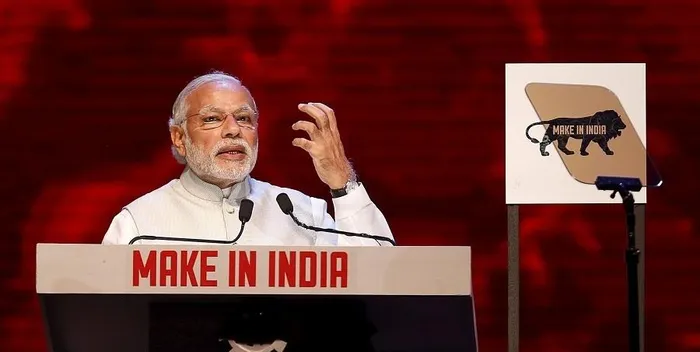
India's Prime Minister Narendra Modi speaks during the inauguration ceremony of the “Make In India” week in Mumbai, India, in 2014. The initiative for transforming the country into a global design and manufacturing hub will benefit from the Free Trade Agreement signed by India and New Zealand last month.
Image: XINHUA
The recently-concluded India-New Zealand Free Trade Agreement (FTA) is not only a major step forward for the two democracies with long-standing strategic cooperation in trade, education and Indo-Pacific security, but another leap forward in right-setting global trade following US President Donald Trump’s trade war declaration last year.
The two countries have had good relations for decades. As the Consulate General of India in Auckland put it in a bilateral brief, “India and New Zealand (NZ) have historically shared close and cordial ties. Similarities such as membership of the Commonwealth, common law practices and pursuing shared aspirations of achieving economic development and prosperity through democratic governance systems for diverse communities in both countries … provide an excellent backdrop for deepening the friendly ties. Tourism and sporting links, particularly in cricket, hockey and mountaineering, have also played a significant role in fostering goodwill between the two countries.”
However, trade between the two countries has been limited, but has been growing steadily in recent years. Now the FTA aims to boost it further and turn their relationship into a stronger and longer-term strategic partnership.
Total trade increased from about $900 million in 2019/20 to $1.3 billion in 2024/25. India’s exports rose sharply from USD 379 million to USD 711 million, while imports from New Zealand grew more moderately from USD 522 million to USD 587 million.
While the scale of trade between the two countries has remained modest, recent trends and the structure of the agreement indicate strong potential for accelerated and sustained growth. This growth reflects increasing economic interdependence, with both economies finding mutually beneficial areas of exchange.
The FTA thus builds on an existing foundation rather than creating new trade flows from scratch.
A defining feature of the agreement is the provision of 100% duty-free access for Indian exports to New Zealand. This is expected to significantly enhance the competitiveness of Indian goods by removing tariff barriers that previously increased costs.
Sectors such as textiles, pharmaceuticals, engineering goods, machinery, and processed food products are likely to see immediate gains.
For India’s micro, small, and medium enterprises, the agreement opens access to a stable, high-income market with strong purchasing power. As a result, both the volume and diversity of Indian exports are expected to expand.
The agreement is equally important for New Zealand, which gains improved access to one of the fastest-growing major economies in the world. India’s expanding middle class, rapid urbanisation, and rising consumer demand create opportunities for New Zealand’s strengths in agriculture, horticulture, timber, wool, and premium food products.
Additionally, New Zealand firms can expand their presence in agri-technology, education, and sustainability solutions. This complementary trade structure – India’s manufacturing and services capacity alongside New Zealand’s agricultural and technological expertise – provides a strong basis for long-term engagement.
While trading in goods will benefit from tariff elimination, the most significant long-term gains are likely to come from services trade. The agreement includes commitments across sectors such as information technology, finance, education, telecommunications, and professional services.
India’s global competitiveness in services positions it to capitalise on these openings. Indian IT firms, financial service providers, educators, and healthcare professionals can expand their footprint in New Zealand, leveraging their expertise in high-value, knowledge-driven sectors.
One of the biggest benefits is that Indian goods can now enter New Zealand without any import taxes. This will make Indian products cheaper and more competitive and will help sectors like textiles, medicines, machinery, and food products while also supporting small and medium businesses in the country. As a result, India is likely to export more goods and a wider variety of products.
Given the growth potential and value addition of services, this component could become the central pillar of bilateral economic relations.
Another important dimension of the agreement is the proposed USD 20 billion investment commitment over 15 years. This has the potential to deepen economic ties beyond trade by supporting India’s infrastructure development, renewable energy transition, and industrial growth.
For New Zealand investors, India offers scale and long-term growth opportunities, while India benefits from capital inflows, technology transfer, and job creation. This investment component transforms the relationship from a transactional exchange into a more integrated economic partnership.
The India-New Zealand FTA comes after the conclusion of a “mother of all deals” signed between India and the European Union in January – a major step by the two global economic giants towards resetting world trade relations following Trump’s disruptive “Liberation Day” import duties announcement in April last year.