

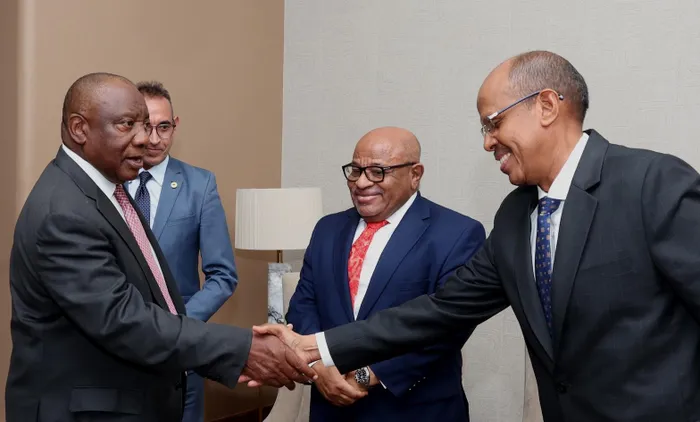
President Cyril Ramaphosa and Chairperson of the African Union Commission Mohamoud Ali Youssouf exchange greetings at the Union Buildings in Pretoria on April 29..Youssouf was in South Africa to oversee the election process of the The Pan-African Parliament's (PAP) Bureau on April 30 2026 in Midrand.
Image: GCIS
Kim Heller
The cartography of colonialism continues to distort Africa's political landscape. The borders drawn at the Berlin Conference remain etched into the continent's contemporary reality, not only territorially but also in the geography of power, identity, and economic dependency.
The foreign forces that once tore parasitically through Africa have not withdrawn. Their influence has merely been reconfigured through newer, more sophisticated forms of economic and political influence and coercion.
The African Union (AU) and its legislative arm, the Pan-African Parliament (PAP), were established to address the enduring legacy of colonialism and advance a project of continental unity, sovereignty, and democratic participation. However, two decades after the PAP's establishment, this promise is largely unrealised.
The PAP's Extraordinary Session of the Seventh Legislature was held from 28 to 30 April 2026 in South Africa. The Chairperson of the AU Commission, Mahmoud Ali Youssouf, reaffirmed the Commission's support for ongoing institutional reforms to bolster the PAP's effectiveness and legislative authority. In line with the AU's principle of regional rotation, Algeria's Fateh Boutbig was elected President of the new Bureau.
Africa is battling. External debt exceeds $1 trillion. This places enormous pressure on the fiscus of African governments. Loan repayments are prioritised over the provision of public services. Conflicts, often aggravated by foreign actors competing for resources and geostrategic influence, bring death, devastation, and displacement.
Structural poverty and underdevelopment across much of Africa crush hopes for sustainable prosperity and self-determination. The PAP was conceived as the "voice of the African peoples", with a mandate to scrutinise the policies of the AU, advance human rights, promote good governance and democracy, and support the Africanisation of legal frameworks across member states and Regional Economic Communities (RECs).
The PAP's role as a continental oversight body and agent of development and decolonisation is critical. The PAP needs to cast aside its ceremonial garb and get its hands dirty on the ground as it actively transforms aspirations into action.
However, its ability to serve remains severely curbed. The founding vision was that the PAP would be an elected legislature with binding powers. This vision, however, has yet to be realised.
The Malabo Protocol, adopted in 2014, was intended to recast the PAP from a consultative body into a legislative institution. It would grant the PAP both the authority to develop model laws for adoption by the AU Assembly and to exercise meaningful oversight over continental governance processes.
However, to date, only 15 member states have endorsed it, well short of the 28 required for it to enter into force. Without this threshold, the PAP's resolutions remain advisory and its oversight largely symbolic. In other words, the PAP is a paper tiger that Africa can ill afford.
In practice, many African governments are not keen to cede even limited authority to a supranational parliamentary body or to be subject to its scrutiny. If the PAP were accorded the authority to expose governance failures, it would curb executive power and unsettle entrenched political interests.
The PAP faces a score of other challenges. In particular, chronic underfunding has diminished its operational capacity, hampering meaningful oversight and effective policy implementation. Audit irregularities and leadership disputes have eroded public confidence.
PAP has nonetheless exhibited its potential. It has lobbied for the African Continental Free Trade Area, critiqued the injustices of the global extractive economy, supported demilitarisation initiatives, and advanced proposals to strengthen food security. The PAP has also taken principled stances on the decolonisation of Western Sahara and on education systems across the continent.
The PAP provides a continental platform where parliamentarians from across political divides can engage. This includes opposition politicians who are often marginalised in their own legislatures and can participate directly in regional and continental issues.
An empowered PAP would play a critical role in strengthening democratic accountability and implementing best-practice governance standards across member states. If it developed stronger relations with civil society, it could help redirect the locus of political power away from elite-driven, top-down norms towards more participatory, bottom-up governance.
In The Wretched of the Earth, Dr Frantz Fanon wrote that political independence without meaningful popular participation is likely to reproduce hierarchies. Without grounded, participatory democratic accountability, both the AU and the PAP are little more than vessels for elite continuity.
This is a failure to adhere to their founding mandates to be effective vehicles of collective liberation in the post-independence era.
A strengthened, grounded PAP has the potential to advance Agenda 2063 aspirations, moving beyond paralysing declaratory politics. The AU Commission's renewed endorsement of institutional reform provides an opening for the PAP. The ratification of the Malabo Protocol must be the primary priority.
Until it has legislative authority, the PAP will remain structurally constrained and unable to fully exercise its mandate. Those member states that have yet to ratify the protocol must be convinced to support it. Another urgent measure is to democratise the PAP's composition. Its legitimacy would increase if elections were held directly rather than through national parliaments.
This would ensure that a legislature claiming to represent the people is chosen by them. Committees within the PAP need to become dynamic centres of policy development and oversight. Adequate financial resourcing is essential.
The PAP cannot remain a symbolic institution. For it to be little more than a ceremonial appendage to the AU is to diminish its original purpose as the institutional heart of a united, decolonised Africa. The unfinished project of decolonisation demands more than rhetoric.
* Kim Heller is a political analyst and author of No White Lies: Black Politics and White Power in South Africa.
** The views expressed do not necessarily reflect the views of IOL or Independent Media.