

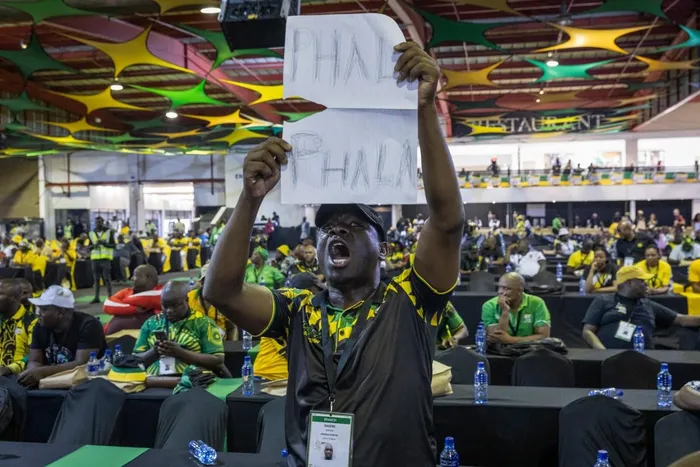
A DELEGATE holds a sign reading ‘Phala Phala’, referring to a theft that happened at President Cyril Ramaphosa’s farm with the same name, during the 55th National Conference of the ANC at NASREC in Johannesburg on December 16, 2022. The Constitutional Court on May 8, 2026, overturned a vote in Parliament that had quashed the opening of impeachment proceedings against Ramaphosa following the cash-heist scandal. The tone of Ramaphosa’s address in light of the court’s judgment left a bitter taste in the mouth, says the writer.
Image: AFP
Prof. Bheki Mngomezulu
The Phala Phala matter is like an onion; the more you peel it, the more it stinks. It is like an inferno burning in the bush, where if the fire restarts each time the wind blows, it seems to have died down once the wind subsides.
For an incident that happened in February 2020, one would have expected that the issue would have been laid to rest by now. This did not happen.
When the National Assembly voted against accepting the report of the three-member Section 89 panel led by former Chief Justice Sandile Ngcobo in December 2022, it thought the issue had been permanently put to rest. The ANC had the majority in parliament. Its mistake was to assume that this majority would be retained indefinitely.
Even President Ramaphosa, who had already initiated a process to take the report under review, arguing that it had flaws, abandoned his action because he was convinced that the matter was over. Little did both the National Assembly and Ramaphosa know that parties like the Economic Freedom Fighters (EFF) and the African Transformation Movement (ATM) would pursue the matter through legal channels to this point.
The Constitutional Court ruling on May 8, 2026, stating that the National Assembly erred when it rejected the Section 89 panel report with 214 votes against 148 that accepted it, resurrected this matter, both for parliament and for Ramaphosa.
The Constitutional Court’s decision intrinsically vindicated former Public Protector Busisiwe Mkhwebane, who expressed her determination to probe the Phala Phala matter and was subsequently removed from her office under dubious circumstances. Even the rules on how to remove someone in her position had to be quickly put together since they did not exist.
When the presidency released a statement announcing that Ramaphosa would be addressing the nation at 20h00 on May 11, 2026, there were many speculations on what he was likely to say to the nation. Some thought that he was going to resign as he did in 2022, while others were almost certain that he would refuse to step down. By the time Ramaphosa finished his address, the country was divided about his posture more than his decision not to resign.
The tone of Ramaphosa’s address left a bitter taste in the mouth. He stated, “I therefore respectfully want to make it clear that I will not resign.”
Firstly, he was defensive – insisting that he had consistently told the nation that he did not do anything wrong. Secondly, he insisted that he had not violated the Constitution. Thirdly, he painted a picture that it was the National Assembly that was wrong, not him. On these bases, there was no reason for him to resign.
Factually, Ramaphosa was right. The Constitutional Court blamed parliament for its action and concluded that parliamentary Rule 129(i) was unconstitutional. But the reason for the Constitutional Court not to delve into whether Ramaphosa was innocent or guilty was that it was not what the EFF and the ATM had approached the Court to pronounce on.
Therefore, it was premature for Ramaphosa to conclude that, as he indicated before, he is innocent. This will be ventilated and established after the impeachment committee has concluded its work. As the Court stated, “unless and until the report is set aside on review.”
Another concerning issue is that instead of allowing parliament to correct itself, Ramaphosa told the nation that he will resume his legal process to take Justice Ngobo’s report on review. He argued that he would not resign because “to do so would be to give credence to a panel report that unfortunately has grave flaws.” The tone of his statement did not create the impression that he felt that the report had flaws. He was certain and adamant that it “has grave flaws.”
Indeed, Ramaphosa’s argument may be legally sound. However, his tone and his subsequent decision are morally questionable. A question which begs for attention is the following: Is his primary aim to prove his innocence in a legal platform or to abruptly stop the impeachment process so that he does not have to answer for himself in parliament? Is Ramaphosa’s stance both morally and legally grounded, or is it morally flawed? Clearly, morality and legality were pitted against each other in Ramaphosa’s address.
There were several glaring concerns in Ramaphosa’s address. At one point, he stated that “to resign now would be to give in to those who seek to reverse the renewal of our society, the rebuilding of our institutions and the prosecution of corruption.”
Do such utterances assume that Ramaphosa is an indispensable character without whom the play could not be staged? In other words, does he see himself as the only person who can fix this country by rebuilding institutions and overseeing the prosecution of corruption? Since he assumed office on February 15, 2018, has corruption declined?
Had Lieutenant General Nhlanhla Mkhwanazi not convened the historic media briefing on June 6, 2025, would the rot in the South African Police Service (SAPS) have surfaced? If Ramaphosa were to leave office in whatever way, would the revelations made by Mkhwanazi suddenly be abandoned? I don’t think so. Therefore, Ramaphosa seemed to be claiming credit for something he had not done.
What also emerged from Ramaphosa’s address was that he created the impression that he puts South Africans first. He stated that “I will remain in your service and will continue to act in your interests and in the interests of our diverse and remarkable nation.” Did he act in the interest of the country when he did not handle the Phala Phala saga properly?
Therefore, Ramaphosa’s address to the nation was legally sound but morally flawed. It raised more questions about how he views himself and how he perceives parliament. His reason not to resign pitted morality against legality. He derived his strength from the ANC and the coalition partners.
* Prof. Bheki Mngomezulu is Director of the Centre for the Advancement of Non-Racialism and Democracy at Nelson Mandela University.
** The views expressed do not necessarily reflect the views of IOL or Independent Media.