

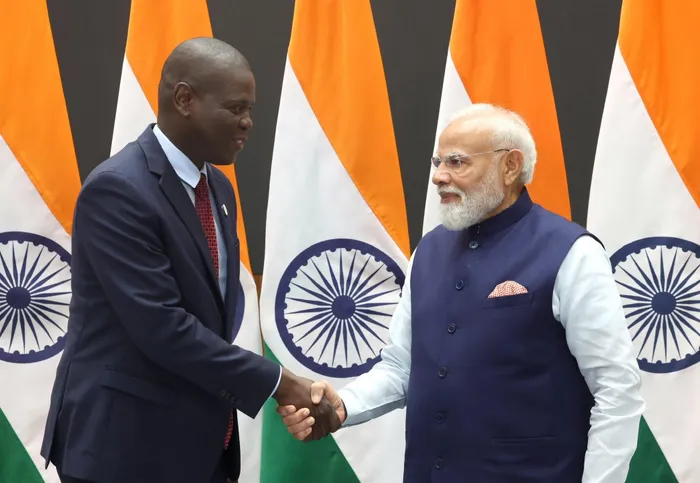
South African Minister of International Relations and Cooperation Ronald Lamola (left) greets Indian Prime Minister Narendra Modi on the sidelines of the BRICS Foreign Ministers meeting held in New Delhi on May 14. India will host the BRICS 2026 Summit.
Image: DIRCO/X
The growing influence of BRICS in the global economy marks a decisive shift towards a more balanced, inclusive, and multipolar international order. Over the past two decades, BRICS, comprising Brazil, Russia, India, China, and South Africa, has evolved from a loose coalition of emerging economies into a powerful geopolitical and economic grouping representing the aspirations of the Global South.
With the recent expansion of BRICS+ to include Saudi Arabia, the UAE, Egypt, Ethiopia, Indonesia, and Iran, the bloc has significantly enhanced its global footprint and strategic relevance. Today, BRICS+ accounts for nearly 46 percent of global GDP and around 55 percent of the world’s population, giving it growing influence in shaping international economic governance.
BRICS has emerged as a vital platform for South-South cooperation, enabling developing economies to collaborate on economic, technological, financial, and development priorities. Unlike many traditional Western-led institutions, BRICS emphasises mutual respect, sovereign equality, inclusiveness, and consensus-based cooperation. This approach has strengthened the confidence of emerging economies seeking greater representation and fairness in global decision-making.
The significance of BRICS was further reinforced at the BRICS Ministers of Foreign Affairs meeting in New Delhi on 14–15 May 2026, under India’s Chairship theme, “Building for Resilience, Innovation, Cooperation and Sustainability.” The ministers reiterated their commitment to strengthening the BRICS strategic partnership across political, economic, financial, cultural, and people-to-people dimensions. The meeting emphasised the need for a more democratic, representative, and accountable international system, while promoting multilateralism, sustainable development, and stronger cooperation among emerging economies. The discussions highlighted that BRICS is no longer merely an economic grouping but a major platform shaping global governance reforms, climate action, technology cooperation, food security, digital transformation, and international trade.
The BRICS bloc is increasingly a strong voice for reforming global institutions such as the United Nations, the World Trade Organization, the International Monetary Fund, and the World Bank. During the New Delhi meeting, the ministers reiterated the urgent need for comprehensive reforms of the Bretton Woods institutions to make them more representative and aligned with contemporary global realities. The ministers also supported reforms to the United Nations Security Council to increase the representation of developing countries from Africa, Asia, and Latin America. China and Russia reiterated their support for India and Brazil to play a greater role in the UN system, including the Security Council.
India’s leadership role within BRICS has gained prominence under Prime Minister Narendra Modi. At the BRICS Summit 2025, held in Rio de Janeiro on 6–7 July 2025, Prime Minister Modi emphasised climate justice, sustainable development, terrorism-free global cooperation, resilient supply chains, and digital public infrastructure. India advocated enhanced cooperation in fintech, healthcare, digital governance, innovation, and renewable energy, while also supporting stronger coordination through the New Development Bank (NDB) and the BRICS Contingent Reserve Arrangement.
India’s expanding economic engagement with BRICS and BRICS+ nations underscores the grouping’s growing importance within India’s trade and foreign policy framework. India’s total trade with BRICS countries doubled from USD 113 billion in 2018-19 to USD 226 billion in 2024-25. Trade with BRICS+ countries rose significantly from USD 250 billion in 2018-19 to USD 402 billion in 2024-25. This remarkable expansion reflects deepening economic complementarities and stronger strategic partnerships among emerging economies.
Among BRICS nations, China remains India’s largest trading partner within the grouping, with bilateral trade reaching USD 127.6 billion in 2024-25. Russia has also emerged as a major strategic economic partner, particularly in the energy sector, with total trade rising sharply to USD 68.6 billion. India’s trade with Brazil increased to USD 12.1 billion, while trade with South Africa rose to USD 17.9 billion. Within the expanded BRICS+ framework, the UAE emerged as India’s strongest trading partner, with bilateral trade reaching USD 100 billion, followed by Saudi Arabia at USD 41.8 billion.
India’s major exports to BRICS countries include pharmaceuticals, engineering goods, automobiles, textiles, rice, chemicals, IT services, and healthcare solutions. Brazil and South Africa have emerged as promising markets for Indian automobiles, agro-products, and medicines. Russia and China continue to import industrial products and intermediate goods from India. On the import side, India sources crude oil, natural gas, fertilisers, machinery, telecom equipment, electronic components, and solar panels from BRICS countries.
The strategic importance of BRICS+ is expected to grow further in the coming years. As complementarities deepen and economic integration strengthens, India’s trade with BRICS+ nations could double to nearly USD 800 billion by 2030. Ministers at the New Delhi meeting emphasised the need to build resilient, stable supply chains and to encourage developing economies to participate more actively in higher-value manufacturing and industrial production. BRICS members stressed the importance of technology transfer, industrial cooperation, and trade facilitation to enhance economic resilience amid growing global uncertainties.
One of BRICS's most significant achievements has been the establishment of the New Development Bank, headquartered in Shanghai. The NDB has emerged as an important alternative source of development financing for emerging economies, without imposing rigid structural adjustment conditions. The bank has approved numerous infrastructure and development projects in India, including metro rail systems, renewable energy projects, transport infrastructure, and smart city initiatives.
The New Delhi ministerial meeting emphasised the NDB's growing role in reducing development inequalities and supporting infrastructure modernisation in emerging economies. BRICS ministers encouraged the NDB to expand local-currency financing, diversify funding sources, and support sustainable infrastructure investments. They also reiterated support for expanding NDB membership and for enhancing the role of the BRICS Contingent Reserve Arrangement in strengthening financial stability among member nations.
Another major focus for BRICS is digital transformation and innovation-led growth. India’s globally recognised digital public infrastructure model, encompassing digital payments, Aadhaar-enabled services, fintech innovation, and startup ecosystems, has positioned the country as a leading driver of digital cooperation within BRICS. At the New Delhi meeting, ministers emphasised the need to strengthen digital connectivity, enhance ICT cooperation, promote startup ecosystems, and improve access to finance for micro, small, and medium enterprises.
The BRICS countries also recognised the transformative role of Artificial Intelligence in driving economic growth and sustainable development. The ministers appreciated India’s successful hosting of the AI Impact Summit in February 2026 and emphasised the importance of international cooperation to ensure safe, inclusive, and trustworthy AI systems. BRICS members agreed to strengthen cooperation on AI governance, digital innovation, cybersecurity, and emerging technologies.
The grouping is increasingly focusing on energy security, climate action, and sustainable development. BRICS ministers reaffirmed their commitment to the Paris Agreement and emphasised the importance of just and equitable energy transitions, grounded in national priorities and development needs. They recognised the importance of renewable energy, low-emission technologies, resilient energy supply chains, and climate-resilient agriculture.
India’s leadership in renewable energy and climate diplomacy has strengthened its influence within BRICS. The grouping acknowledged India’s International Big Cats Alliance initiative and underscored the importance of biodiversity conservation, forest preservation, water security, and sustainable agriculture. BRICS members also emphasised the need for disaster-resilient infrastructure and early warning systems, recognising the Coalition for Disaster Resilient Infrastructure (CDRI)’s important role.
Food security and agricultural cooperation have become key priorities for BRICS. Ministers emphasised the need to ensure stable food supplies, mitigate fertilizer shortages, and strengthen agricultural value chains. Discussions on establishing a BRICS Grain Exchange and enhancing intra-BRICS agricultural trade gained momentum at the New Delhi meeting. BRICS countries recognised the role of family farmers, smallholders, and rural communities in ensuring sustainable food systems and reducing global hunger.
Healthcare cooperation is another key pillar of BRICS engagement. The grouping has strengthened collaboration across vaccine research, infectious disease surveillance, traditional medicine, digital health, and antimicrobial resistance. The ministers reiterated their support for the BRICS Vaccine Research Center and the BRICS Integrated Early Warning System for infectious diseases. India’s pharmaceutical capabilities and healthcare innovations continue to play a vital role in strengthening healthcare cooperation among developing countries.
The BRICS nations are also expanding cooperation in science, technology, and industrial innovation. The New Delhi meeting highlighted progress towards establishing a high-speed submarine-cable communication network among BRICS countries to improve digital infrastructure connectivity. The ministers also supported deeper cooperation under the Partnership on the New Industrial Revolution and welcomed the establishment of the BRICS Startup Knowledge Hub. In global trade, BRICS countries have emerged as strong defenders of a fair and rules-based multilateral trading system. The ministers strongly opposed unilateral tariff and non-tariff barriers inconsistent with the WTO.
In conclusion, the growing influence of BRICS and BRICS+ reflects the emergence of a more balanced, inclusive, and multipolar global economic order. As emerging economies deepen cooperation across trade, technology, finance, climate action, digital innovation, and sustainable development, BRICS is becoming a transformative force shaping global governance reforms. India’s proactive leadership, expanding trade partnerships, and strong role in digital infrastructure, renewable energy, and South-South cooperation positions it at the centre of this transformation. Long into the future, BRICS will significantly shape global economic stability, resilience, and inclusive growth.
* Edwin Naidu heads Higher Education Media Services (HEMS), an education media start-up, publishing www.ednews.africa
** The views expressed do not necessarily reflect the views of Pretoria News, IOL or Independent Media.