

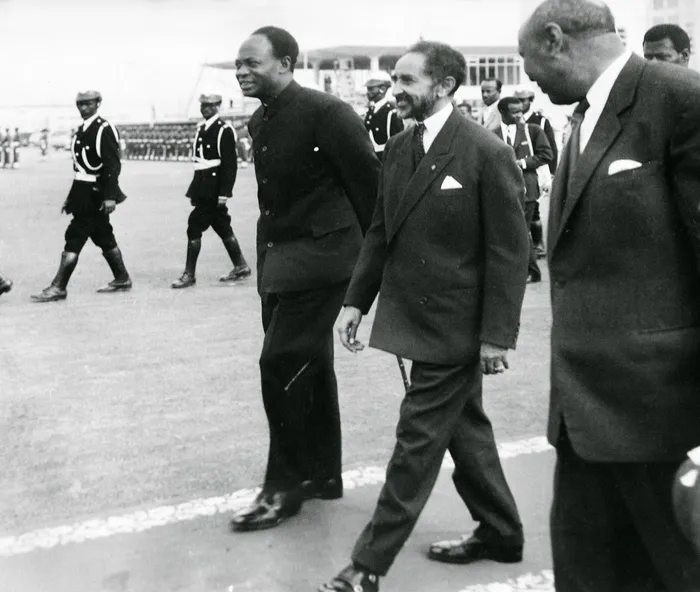
Ghana's founder and first President Kwame Nkrumah (left) and Ethiopian Emperor Haile Selassie (centre) at the formation of the Organization of African Unity (OAU) in Addis Ababa, Ethiopia on May 25, 1963. The formation of the OAU, now the African Union (AU), is celebrated as Africa Day.
Image: AFP
Kim Heller
Africa Day was never intended to be purely ceremonial. Africa Day was born in the blaze of revolutionary battles against colonial occupation and imperial plunder. It arose from a vision of a post-independent Africa grounded in continental development, dignity, and sovereignty.
Celebrated annually on May 25, Africa Day commemorates the formation of the Organisation of African Unity (OAU) in 1963, the predecessor of the African Union. It was envisaged that the OAU would serve as a potent post-independence instrument of rejuvenation after a centuries-long period of colonial extraction and fracture.
Six decades later, this vision remains undone.
Today, Africa continues to bear the scars of political fragmentation, economic dependency, cultural conquest and epistemological erasure.
There were early forewarnings from key Pan-Africanist leaders. Kwame Nkrumah cautioned that political independence without continental unity and economic sovereignty would render Africa vulnerable to recolonisation through foreign finance and trade.
Frantz Fanon predicted the rise of a national bourgeoisie that would serve as intermediaries between foreign capital and the African masses rather than dismantling colonial systems of power and extraction. Both Patrice Lumumba and Thomas Sankara warned of the untenable dependency inflicted by former colonial powers and global financial institutions.
Their words were prophetic. Today, across the Continent, foreign governments and businesses continue to extract enormous wealth, perpetuating Africa’s structural underdevelopment. In the contemporary struggle for economic domination, debt has become a highly effective weapon.
Many governments across Africa are now caught in a debt cycle, refinancing crisis after crisis, exacerbating unemployment, inequality, and social instability.
Many nations remain trapped in protracted conflict and displacement. Sudan remains volatile and violent despite a series of high-profile ceasefire initiatives.
The guns in eastern Democratic Republic of the Congo have yet to be silenced in the lucrative scramble for strategic minerals. In the Sahel, the wildfire of insurgency debilitates attempts at regional development and self-determination.
The emancipatory vision that shaped Africa Day has yet to dawn.
Added to this strife is the explosive rise of xenophobia across parts of the Continent, particularly in South Africa. This is a horrendous breach of the spirit of Africa Day.
There can be no celebration of Africa Day while African migrants are being hounded, scapegoated and subjected to horrific intimidation and violence. Xenophobia is more than an economic and social crisis. It is a rupture of Pan-Africanism and a profound historical betrayal.
Colonialism purposefully fractured African unity through artificial borders, ethnic manipulation and other sinister systems of "divide-and-rule" to weaken continental sovereignty and solidarity.
Today, high levels of unemployment, persistent inequality, poor governance and political opportunism fuel xenophobia. The poor and powerless suffer as the structural causes of economic exclusion are not confronted or addressed.
Fanon warned about how in untransformed societies, anger and pain are often directed against vulnerable individuals rather than against systems of power and exploitation.
Given the multiple crises on the Continent, Africa Day must move beyond ceremony and symbolism. The abundance of summits, declarations or commemorative speeches is outlandish. The original vision of Africa Day requires an earnest, unapologetic process of decolonisation and structural transformation.
The outward flow of African wealth must be confronted and challenged. The dignity and self-determination of the Continent is impossible while its wealth is being exported en masse. Industrialisation, regional trade integration, food sovereignty, and technological investment must be grounded in African realities and developmental priorities. The African Continental Free Trade Area needs to advance African economies rather than multinational capital.
Alongside this economic recalibration, there is an imperative for Africa to reclaim intellectual and cultural sovereignty. Africa cannot liberate itself while its epistemological core and educational systems mimic and seek validation in Eurocentric modalities.
There is a need for African-centred knowledge systems which reflect and respond to African realities and aspirations. Decolonisation must therefore extend beyond economics and politics into language, curriculum, identity, historical memory and cultural confidence.
Pan-African solidarity must become a lived practice rather than a diplomatic performance. The African Union must move beyond elite diplomacy and foster deeper economic, political, and social integration among ordinary Africans. The struggle against xenophobia is central to this project.
Africans cannot claim continental unity while simultaneously turning on one another during economic crises and insecurity.
As Africa Day dawns, leadership deficits and crises in Africa must be confronted head-on. Many liberation movements succeeded in defeating colonial rule but failed to dismantle authoritarian political cultures. Corruption, repression, patronage politics, state violence and elite accumulation continue to weaken democratic institutions and public trust.
Africa's renewal requires both resistance to external domination and internal accountability. Africa's promise is enormous. Its youthful population is beginning to rise against the greed of political elites and the lack of economic opportunities.
Across the Continent, community activists, progressive intellectuals, and grassroots formations are demanding dignity, justice, equality, and greater accountability from incumbent leaders. These struggles signify the unfinished business of Africa Day.
Africa Day must become a moment of political reckoning so that the liberation project is realised. A true celebration of Africa does not lie in slogans or symbolic performances of unity. Beautifully choreographed festivals and state ceremonies are meaningless.
The true meaning of Africa Day lies in building an Africa that is sovereign, accountable, just, confident and united.
This was the noble dream of great Pan-Africanist leaders, including Nkrumah, Sankara, Lumumba, Fanon, and Amílcar Cabral. Africa Day must honour both the vision and the sacrifices of these visionaries and freedom fighters.
* Kim Heller is a political analyst and author of No White Lies: Black Politics and White Power in South Africa.
** The views expressed do not necessarily reflect the views of IOL or Independent Media.