

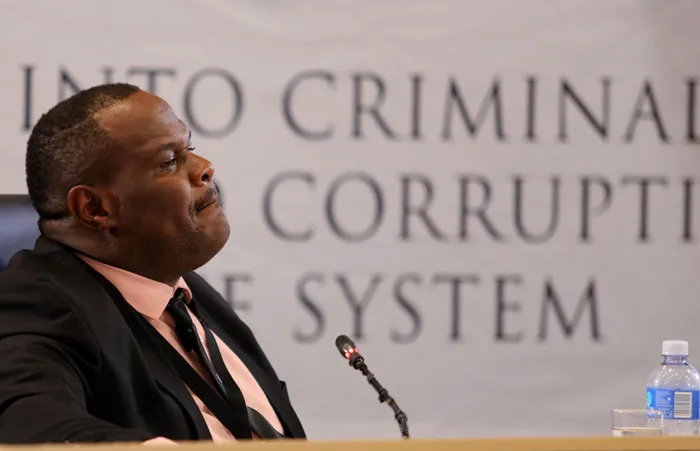
The Pretoria Magistrate’s Court has denied suspended Sergeant Fannie Nkosi’s request to remain in a prison hospital wing.
Image: Oupa Mokoena / Independent Newspapers
The Pretoria North Magistrate’s Court has ruled that suspended Sergeant Fannie Nkosi should not remain in a prison hospital wing, despite health concerns and fears of being poisoned.
Nkosi’s case was postponed to April 20 for a formal bail application. He remains in custody.
The 42-year-old returned to court on Monday for his bail hearing, which the National Prosecuting Authority (NPA) is opposing.
Nkosi was arrested on April 2 during a raid at his home in Pretoria North.
He is suspended from the South African Police Service’s (SAPS) organised crime unit, with the suspension taking effect on March 28.
He has also testified before the Madlanga Commission.
During his initial court appearance last week, the court heard that police allegedly found more than R50 000 hidden under a mattress, along with firearms, explosives and other items.
Nkosi faces multiple charges, including unlawful possession of explosives, three counts of failing to safeguard firearms, eight counts of failing to safeguard ammunition, defeating the administration of justice, failure to comply with firearm safe regulations; and theft.
He is also accused of acting as a middleman between alleged crime boss Vusimuzi “Cat” Matlala and senior police officers.
Nkosi is being held at Kgosi Mampuru Correctional Facility.
He previously requested not to be detained there, citing fears for his safety.
A Pretoria High Court order had earlier placed him in the prison’s hospital wing.
However, his lawyer, Siza Dlali, argued that Nkosi should remain in the hospital wing due to his diabetes and concerns about being poisoned.
Magistrate Thandi Theledi rejected the request, saying diabetes alone does not justify admission to a hospital wing.
She said the facility is intended for detainees who require medical treatment, observation or nursing care, and not as a form of protective custody without medical necessity.
Theledi also dismissed Nkosi’s fears of being poisoned, saying there was no clear basis for the concern and that such risks would not necessarily be mitigated by placement in a hospital wing.
She added that prison authorities are responsible for ensuring the safety and well-being of all detainees and should be allowed to exercise their discretion.
“I am not going to micromanage the prison,” she said. Theledi ruled that Nkosi should remain in the general population unless prison officials determine otherwise.
The case was postponed to April 20 to allow the State to proceed with its schedule and continue with the bail application.
Earlier, the State said it has a strong case supported by evidence.
The State told the court that the raid uncovered several original dockets and copies, some dating back to 2016, that were never finalised.
The investigating officer believes Nkosi kept the dockets to obstruct justice, including cases involving car hijackings and common robbery.
Nkosi has denied the charges. Through his lawyer, he argued that the State’s case is weak and lacks evidence.
He said he does not understand the charges and that any potential sentence would not justify fleeing.
Nkosi, who earns R16 500 a month, said he could afford bail of R10 000, with family and friends willing to assist.
SATURDAY STAR