

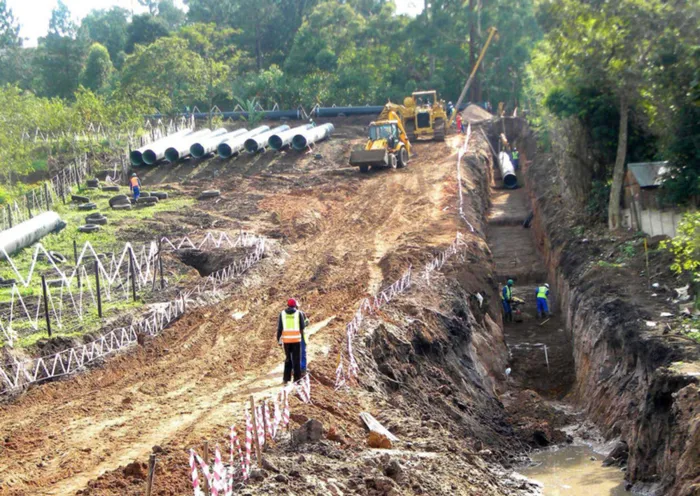
Work under way on the first phase of the Western Aqueduct, completed last year and now in use by eThekwini Water and Sanitation. Work on the next phase will not start soon. Work under way on the first phase of the Western Aqueduct, completed last year and now in use by eThekwini Water and Sanitation. Work on the next phase will not start soon.
T he controversial e100 million French loan, intended primarily to finance the Western Aqueduct, has been temporarily shelved.
For months it was argued whether the loan was necessary or would over-extend the city. eThekwini Municipality’s executive committee decided this week the loan from the French Development Agency – worth about R1 billion – would not be drawn this financial year.
eThekwini has almost double the value of current loans compared with any other metropolitan municipality in SA.
Municipal manager S’bu Sithole told the committee at the meeting on Thursday that “it was better we don’t go the route of this loan”.
The Western Aqueduct was put on hold following a Pietermaritzburg High Court decision last year.
The court ruled the tender award was irregular and ordered that it be scrapped and a new one be advertised.
By far the biggest portion of the loan was for the aqueduct.
Speaking at the meeting on Thursday, Sithole said the loan was not needed now.
“The new tender for the Western Aqueduct will go out before the financial year-end, but it will have a financial impact only in the new financial year,” he said.
All political parties supported taking the loan off the agenda, especially the Minority Front’s Patrick Pillay, whose party has repeatedly voted against the city drawing this and other multimillion-rand loans.
“I’m happy we’re not taking out this loan.
“I understand that loans are sometimes necessary, but ultimately ratepayers have to pay the interest on such loans,” he said at the meeting.
It was also argued that the city was over-extending itself with loans.
Just last week, the executive committee approved a R1bn loan from FirstRand Bank to fund long-term capital expenditure, despite already having outstanding loans totalling more than R9bn.
It will cost ratepayers R1.2bn to repay the loan over the 20-year period, at an interest rate of 10.28 percent.
The Tribune contacted finance officials in Cape Town, Joburg and Tshwane (Pretoria) to establish the value of current loans in those metros.
Their responses revealed eThekwini has almost double the debt and that only Tshwane was considering drawing loans this financial year.
Cape Town has about R5.6bn in outstanding loans and Joburg about R4.35bn. Tshwane has about R5.4bn, but this will increase by R1.5bn with its first municipal bond issue later this year.
Combined Ratepayers’ Association of Durban chairwoman Lilian Develing said she was delighted that the French loan had been frozen.
“Finally, common sense has prevailed,” she said, but added the city was still over-extended.
“They are not looking at the forward costs of these loans.
“Who is going to service and pay for them? The city hasn’t expanded its rates base, commercial or residential.
“It’s unsustainable and unaffordable,” Develing said.
At the executive committee meeting, Sithole justified the taking out of loans.
“We can’t be reckless by saying the city has too much debt. If you look at the gearing ratio, we are still well within the norms.
“Also, infrastructure is generational; if you build now, even future generations must pay for it.
“If we get to the situation where we can’t repay the loans, that would be a major concern. For now, the municipality should not be too concerned,” he said.
matthew.savides@inl.co.za