

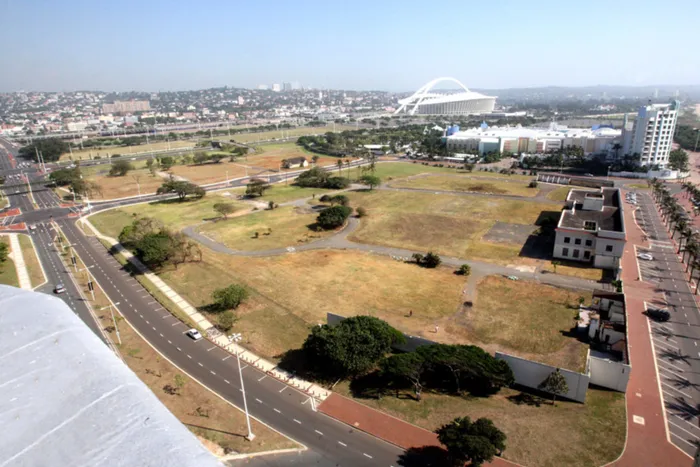
DURBAN25022012 Natal command site. Picture: SANDILE NDLOVU DURBAN25022012 Natal command site. Picture: SANDILE NDLOVU
T HE fight for ownership of the Natal Command site on Durban’s famous Golden Mile could be entering its final rounds, with the Supreme Court of Appeal to hear the case tomorrow.
Sold by the eThekwini Municipality for R15 million to film-maker Anant Singh in 2003, the 21ha piece of land has been the subject of ongoing legal battles after businessman Sunny Gayadin challenged the sale in court in 2005.
Seven years and several court dates later, and the fate of the land is still undecided, preventing the municipality from developing the site.
Singh’s company, Rinaldo Investments, was sold the land in a private treaty instead of through the conventional public tender process.
Singh wanted to build a R700m film studio on the land, which he said would have generated massive investment in the city and boosted the local economy.
Gayadin took umbrage to the fact that other companies, including his Giant Concerts, were not able to make offers for the site because of the treaty.
Gayadin argues in Supreme Court papers that businessmen other than himself had made offers for the land, but these were ignored by the city council.
He said the sale of the land should have gone through a public tender process.
The national Department of Defence owned large portions of the land, with eThekwini owning other parts. However, in October 2009, the defence department relinquished ownership of the land and it was returned to the municipality.
Gayadin’s court documents, seen by the Tribune, say the R15m sale represented just 21 percent of the site’s open market value.
If Gayadin is correct, the land could have fetched about R75m.
Currently, based on an estimate of what the Point Development fetched, the land is worth more than R200m – 13 times what Singh would have paid for it.
Opposition parties slated the delays in developing the site, particularly because it is so close to the beachfront, Suncoast Casino, Moses Mabhida Stadium and the associated sports precinct.
Until the court proceedings are finalised and the ownership of the land determined – that is, whether the sale to Singh will be upheld or rejected and the property retained by the municipality – the council is unable to build on the land or let it go out to tender.
Mike Andrews, project executive in the city’s strategic projects unit, said a clean-up of the area under way was part of a broader project and he didn’t know these costs, but they could be easily determined.
DA caucus leader Tex Collins said he wasn’t aware of how much the revamp cost, but in the budget documents for the coming 2012/13 financial year, about R6m had been set aside for the site.
This means that, if the ruling does go in Singh’s favour and he takes ownership of the land, he’s likely to score even more.
Having already bought the land at a heavily reduced value, he’ll now have had the clean-up paid for by the council.
Collins said the sale at a knocked-down price was suspect from the start. “How could they have sold property worth more than R200m to someone for R15m?
“The only assumption to make is the man was politically connected. It’s simply unacceptable.
“This deal points to a city which, at the time, was horribly managed. It tells me that there was a disregard for even the most fundamental of accounting principles. They knew damn well it was worth more than R15m,” he said.
The Natal Command facelift has seen the old road running through the site revamped and many of the old buildings demolished.
The only structures left standing are the beach-facing facade and a church that is listed as a historical building.
In September 2010, Pietermaritzburg High Court Judge Jerome Mnguni ruled against Singh and the municipality, saying the sale process had been “contaminated”. Thus the sale was overturned.
At the time, the eThekwini Municipality said it would not challenge the ruling and was looking at other plans for the site.
Singh, however, took the battle a step further, lodging an appeal with the Supreme Court. In April last year, the court granted him leave to appeal, with the case to be heard during the course of this week.
It’s not known how long it will take for judgment to be handed down, but it could still be several months before a verdict is reached.
The Tribune is in possession of Gayadin’s heads of arguments in the matter, but attempts to obtain Singh’s court documents were unsuccessful because he was overseas and they could not be released without his permission.
Gayadin contends in his court papers that the municipality wasn’t authorised to sell the property because it didn’t own the land and that the sale was approved by an acting MEC who did not have delegated authority from the provincial premier for this purpose.
Gayadin also argues that the sale of the land was not properly or adequately advertised.
The papers state that an advertisement was placed for the sale of the land on December 12, 2003, but “on the same day, a written agreement of sale was concluded between the municipality and Rinaldo in respect of the properties”.
Based on their arguments in the high court, it is likely that Singh’s legal team will argue that Gayadin is disqualified from instituting legal action because he was previously convicted of fraud, theft, forgery or uttering a forged document, in line with the Close Corporations Act 69 of 1984.
His team is also likely to argue that Giant Concerns lacked sufficient interest to pursue relief from the courts.
matthew.savides@inl.co.za