

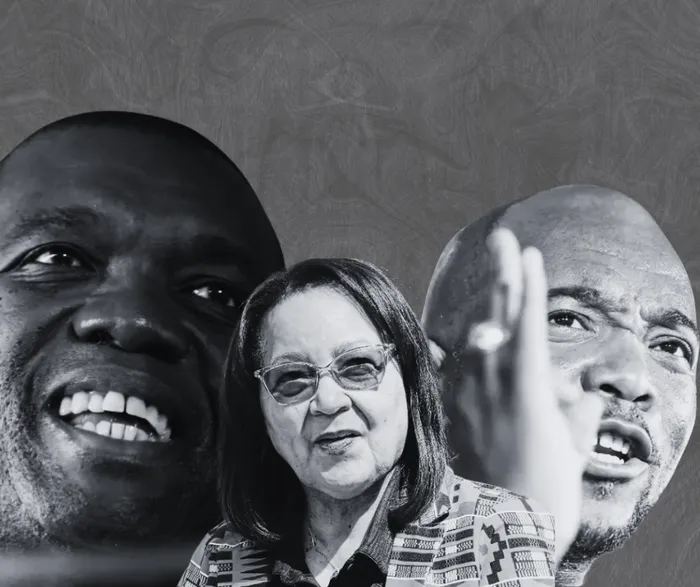
Songezo Zibi's Rise Mzansi, Patricia De Lille's GOOD party and Mmusi Maimane's BOSA party who have formed a new centrist party ahead of the next year's local government elections.
Image: Independent Media / IOL graphics
MHLABUNZIMA MEMELA
Image: SUPPLIED
Just when South Africans thought politics could no longer surprise us, along comes a plot twist worthy of a telenovela.
Out of nowhere, three political startups, Rise Mzansi, GOOD, and Build One South Africa (BOSA), yes, that BOSA led by Mmusi Maimane, who once mimicked former U.S. President Barack Obama’s style of leadership and rhetoric while leading the Democratic Alliance (DA), were later pushed out by the same party that had used him as an experimental figure to attract black voters.
Rise Mzansi, GOOD and BOSA have announced their grand merger to form a so-called “centrist party” called United for Change. Their mission? To contest the 2026 local government elections under one banner. Their reality? To entertain a weary nation.It’s as if democracy itself decided to hold auditions for a new comedy show, and this trio got the part.
In last year’s general elections, each of these parties managed to scrape a space in Parliament. They told us the electorate’s message was clear: no single party is good enough to lead South Africa alone.
Fair enough. But this merger feels less like a response to the people and more like a memo from their shared funder, who probably got tired of watching his political investments collect dust on the opposition benches. One imagines a frustrated donor summoning them to a boardroom, wagging a finger like a disappointed parent: "You, Rise Mzansi, stop pretending to rise. GOOD, stop acting righteous".
And BOSA, "for heaven’s sake, try to behave! Now go play together and make Daddy proud".
And just like that, a new “centrist miracle” was born, promising to unite ethics, ambition, and opportunism under a single logo. Rise Mzansi once promised to “build a modern movement.” GOOD declared it would “fix South Africa.” BOSA claimed it would “unite the nation.”
Now, the three have joined forces to form what they call “a people’s alternative”.The only problem? None of them actually attracted enough people to be called an alternative. Combined, their 2024 votes could barely fill a soccer field, maybe even a high school hall on a rainy day.This merger is less a political masterstroke than a group project where everyone failed individually, so they have decided to fail collectively but with matching T-shirts this time.
They insist they will “occupy the centre of South African politics.” But no one really knows what that means. What precisely is the "centre of South African politics"?
The ideological spectrum, or the buffet table at the next fundraising dinner?If this is centrism, then it is the kind that sits comfortably between principles and tenders, between talking about ethics and emailing donors. Their eventual slogan might as well read:“Together we rise for good governance, responsibly funded.”
Democracy of many parties and few voters
It’s time we had a serious talk about how easy it has become to register political parties in South Africa. The Electoral Commission of South Africa has turned our ballot paper into a menu of confusion. Every election, we discover new parties that sound like inside jokes. Remember the KISS Party (Keep It Straight and Simple), or the Dikwankwetla National Party, or the ever-ambitious AIC (African Independent Congress), NADECO, or SADECO?
Most vanish before the ink on the ballot has dries.These parties know they will get a slice of public funding and maybe a few newspaper mentions, and that is enough. The IEC keeps approving them, even as voters lose track of who is who. Democracy is supposed to offer choice, not chaos.
The funder behing the curtain
The real comedy, though, lies behind the scenes, where democracy quietly bends under the weight of big money. It would not surprise us when it turns out that the same funder has been bankrolling all three of these political start-ups.
So while South Africans thought they were choosing between different parties, they were really picking between different branches of the same franchise.It’s like walking into a mall and thinking you are choosing between grilled chicken, roast beef, and vegetarian stew?
Only to find they all come from the same catering company. And just like that, our democracy has been reduced to a franchise war for political attention, where the customers (voters) are never told that the recipes come from the same kitchen.
From conviction to convenience
In a healthy democracy, parties merge because their ideas align. In South Africa, they merge because their donors demand refunds. Let’s be honest, this is not about ideology, but it’s about survival. None of these parties could win enough seats to negotiate lunch in Parliament.
So they have decided to tie their fortunes together and hope the merger will magically look like momentum.It’s political arithmetic at its most desperate: 0 + 0 + 0 = “A New Beginning”.
We have seen this movie before. When politicians fail alone, they rediscover the power of “unity”. When that fails too, they rebrand.
Do not be surprised or fooled if, by 2027, we are introduced to “Rise for GOOD South Africa (Pty) Ltd” with a vision statement approved by auditors.
Politics as performance art
What makes this merger truly revealing is how politics has turned into performance art. Parties are not built in communities anymore; they are designed in boardrooms. As we might have seen, the Afrika Mayibuye Movement of Floyd Shivambu who jumped ship from EFF when tired of being overshadowed by Julius Malema. Shivambu joined MKP another stokvel led by South Africa's former President Jacob Zuma, whose voice ruled in the party.
Shivambu was suffocated and quickly jumped with the few individuals to build a new vehicle, but the tyres are already showed wires. It's clear that today's politicians do not build movements; they register companies, hire designers, and issue press releases about “fresh leadership”.
We do not get leaders anymore. We get product launches.Parliament, once a house of debate, has become a stage. Every election is a new season, with the same actors trying on new costumes and hoping we won’t notice.
The final act
The saddest part? We have grown used to it. We laugh, roll our eyes, and move on because the circus never leaves town. Maybe that is what this new “centrist” experiment is counting on: that we will see the joke but still give them a round of applause.
Because in South Africa, politics is not about policies anymore; it’s about performance. It appears that the ANC remains the movement whose policies resonate with the challenges of South Africans.
We might hurl all kinds of insults at the ANC but we have clear things to point out as their achievements, such as restoring the dignity of the African people and service delivery.
Although we complain about other things, good things have happened under the ANC government. But for these other parties, we can easily say, "The lights are on, the cameras are rolling, and the donors are still paying," then, as every ringmaster knows, "The show must go on."
(Memela is a former multi-award-winning journalist and government communicator. His views do nnot necessarily reflect those of the Sunday Tribune, Independent Media or IOL)
SUNDAY TRIBUNE