

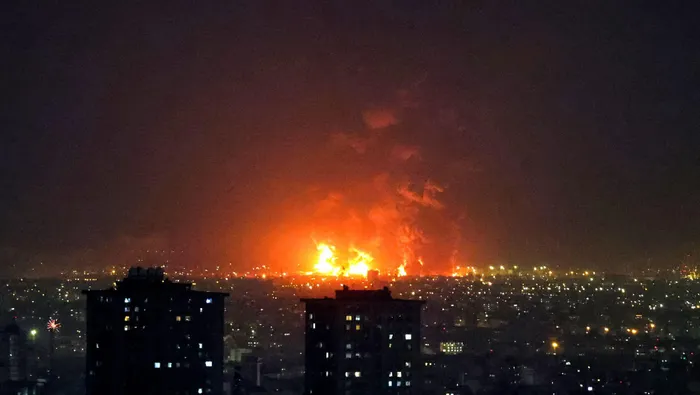
With little else to sustain the war effort, the Strait of Hormuz and its associated infrastructure have graduated into significant talking points, making the passageway the most important global chokepoint.
Image: Atta Kenare / AFP
IT IS official. We have entered the much-anticipated Orwellian times, if we have not sleepwalked into them already. This is the era of stupid, and it has been long coming. It is where everything stupid sounds genius, turning swathes of humankind into blood-lusting tribes.
Opinions that are different from the tribal war chants are frowned upon. They are considered stupid and unacceptable. It would not even matter that the debased iterations justifying senseless mass killings and wanton destruction of thousands of years of cultural iconography and critical infrastructure for the sustenance of local economies go against the grain of human survival and decency.
International law and those normative rules that provide the lowest common denominator have been jettisoned in favour of war.
So much so that it feels as if the US/Israeli attack on Iran has been willed by so many people, each with reasons idiosyncratic to themselves. Their reasoning, whether rational or otherwise, is immaterial.
It is the lack of it that represents the high watermark of the era of folly. Unsurprisingly, here we are again. The creatures of habit are at it again, predictably. The consequences of war, as learnt from the grim realities of World War II, have not provided enough incentive to bridle our stone-age cannibalistic instincts.
So, the cheering for the destruction of Iran or its mindless carpet bombing as a one-time solution is appealing to some, with as much fervour as it is purveyed by the mainstream media. It is very deceptive, however, holding as it does a plethora of false promises. Dropping enough bombs on Tehran and other major Iranian cities, a Hegseth-esque clamour, sounds like the perfect solution.
Perhaps it could be. However, the proclivity of wiping off approximately fifteen million people in Tehran using nuclear weapons does not answer the philosophical enquiry as to what question genocide at that Armageddon scale is an answer to.
For now, it does not matter. Scott Bessent, the US Treasury Secretary, is on record saying that President Trump has been contemplating ways to take over the Kharg island since 2017. The veracity of that revelation, or its place in the chronology of events, will forever be a subject of curiosity for historians.
If there are many things that the Treasury Secretary expects from this revelation, one of them would be the fact that the war has been in planning for a long time, and nothing out of its developments is fortuitous or surprising.
Donald J Trump’s foreign policy dictates are like a scientific research facility. No one knows for certain what will come out of them. They come in clothed with a lot of sensitivity. Blood and treasure in the main. But for Trump, treasure trumps blood, no pun intended!
By his own admission, especially in those interviews held airborne on Air Force One against whirring background noises, Americans must be proud of their patriotic sons who pay the ultimate sacrifice for the folly of the hegemon’s misadventures.
Treasure, on the other hand, however, gets to POTUS 47 in ways that are very particular. He gloats without end when the stock market rises after a policy announcement. Similarly, his exuberance is effusive when there is a rally of the markets after a temporary slump. For reasons personal to him, the performance of the equity market is a direct reflection of his performance as the President.
He may be correct in that assessment. It must be qualified, though. The markets are known to be imperfect, a fact which is not controverted, neither by market agents nor policy makers. Policy predilections which are predicated on the volatility of such imperfections, especially if they are not qualified, are bound to render the President’s boisterous utterances absurd.
Pam Bondi, the US Attorney General, appeared before Congress and chastised the congressmen and congresswomen for fixating on the Jefferey Epstein’s files, when, for their own good, they should all be excited about the Dow Jones trading above the 50 000 points mark.
On the opening day of the 19th of March, the Dow trading fell by 800 points, leading to keen observers to ask the question whether it is time to talk about Jefferey Epstein.
Whether or not carpet-bombing Iran using 1 000-ton bombs every hour of every day, covering every inch of their territory, will yield the desired result, is uncertain. What is certain is that the world has been here before.
As Professor John Mearsheimer observes, the US won every battle in Vietnam but lost the war. They were dropping on the North Vietnamese an average of 14 000 tons of bombs every week for 10 years, yet the inevitability of the fateful day of the 30th of April 1975 could not be prevented.
Even though the Koreans were reeling from the crucible of an indiscriminate and senseless Jeju massacre in 1948, the US bombarded every conceivable piece of North Korea until the armistice in 1953, leaving untold numbers of dead people in their hundreds of thousands.
Superior in all aspects of combat, the US still could not prevent the emergence of a North Korean state, nor contain its ability to become a nuclear-armed sovereign.
After 20 years of war in Afghanistan, with hundreds of thousands of bombs dropped on the Afghans, the Americans left Kabul less than heroically. On that fateful 15th August of 2021, the day of retreat, they left valuable munitions and collaborators on the tarmac and in many other places besides.
This grim historical record leaves Trump with severely limited options.
The most prominent of those available options is the formation of the Coalition of the Hormuz. He has touted the possibility that so many of his NATO allies with naval capability should help the US in unblocking the Strait of Hormuz and provide escort to oil tankers.
It wouldn’t be the first time such an intervention would be contemplated. During the 1987 Tanker Wars between Iran and Iraq, a small but sad chapter in the decade-long kinetic exchange between Iran and Iraq, the US negotiated its role as escort for oil tankers.
Despite US support for Saddam in intelligence gathering and target pinpointing, including the provision of munitions, ordnance and missile positioning, Iran defeated Iraq two years later.
This option is more complicated than it sounds, as deceptively framed as the ‘regime change’ proposition. It is not certain how it could easily be achieved without affecting a regime change.
Admittedly, too, there could be no regime change if there are no ‘boots on the ground’. Somebody’s boots and somebody’s navy must expose themselves as targets to the fury of the Iranian fight back.
Recognising this difficulty, especially accounting for the fact that his European allies do not possess excess armoured carriers’ capacity to lose in the Gulf, they have therefore declined to join Trump in his campaign for unblocking the Hormuz by force and escorting oil tankers out to market.
Besides, it is not far-fetched that the Europeans are getting back at Trump for abandoning their proxy, Ukraine.
With little else to sustain the war effort, the Strait of Hormuz and its associated infrastructure have graduated into significant talking points, making the passageway the most important global chokepoint.
There is no standard to measure the importance of a chokepoint in global commerce, nor the determination of the rung of its hierarchy among its peers. It could generally be said that whenever there is an alternative route away from that strait, the severity of its stranglehold is somewhat attenuated.
Of the most cited Straits, three are most prominent. These are the Bab-el-Mandeb, the Malacca and the Hormuz. In the case of Bab-el-Mandeb, it is possible to divert from the mouth of the Suez Canal and circumnavigate all around the Cape of Good Hope at both prohibitive cost and time protraction.
The Malacca is expected to be an oil choke point for China in the main. If China finds other means of accessing its western seaboard other than through the Strait of Malacca, the stranglehold vantage of the strait will be severely degraded. This leaves the Strait of Hormuz, whose attaching global significance is that it has no alternative.
What happens when two belligerents in a conflict vie for the same strategic leverage? For Trump to win this war, he must bludgeon the Iranians into submission, thereby keeping the Strait open.
For the Iranians to prevent an outright US/Israeli victory, they need to keep the Strait under their control, preferably closed. This probably means that the Strait will shape and decide the outcome of this long, drawn-out crisis.
The stakes are high. It is a battle of wits. It is a battle for leverage. The continued US hegemony depends on its forces taking the Strait, capturing the Kharg Island and while at it, effecting a regime change.
In this scenario, all of this must be carried out by US forces unaided. This superpower ego trip is designed to demonstrate that the US can prevail militarily over any country, anywhere, anytime and anyhow.
It is a battle of wits. With some contortionist trick, the Iranians have turned a kinetic war, where the US possesses escalatory dominance, into an energy war. In this chapter of conflict, the US administration may have to rely more on its collective brainpower than the trumpery of Trump and the bluster of Hegseth.
Battles for leverage are hard to win and are intrinsically a zero-sum totality. Whoever seeks to keep the leverage open or functional tends to lose. In Bridge over the River Kwai, the Japanese sought to operationalise the railway line from Thailand to Burma, as it was called at the time.
The bridge was a critical part of the alternative measure of avoiding the British torpedoes in the Burmese coast. Try as they might, the British RAF destroyed the wooden bridge and frustrated the Japanese.
It is fair to say that, like the Arnheim bridge in the Netherlands during Operation Market Garden during the Second World War, some leverages deserve to be avoided.
They may just be a bridge too far.
* Amb Bheki Gila Esq is a Barrister-at-Law.
** The views expressed here do not reflect those of the Sunday Independent, Independent Media, or IOL.