

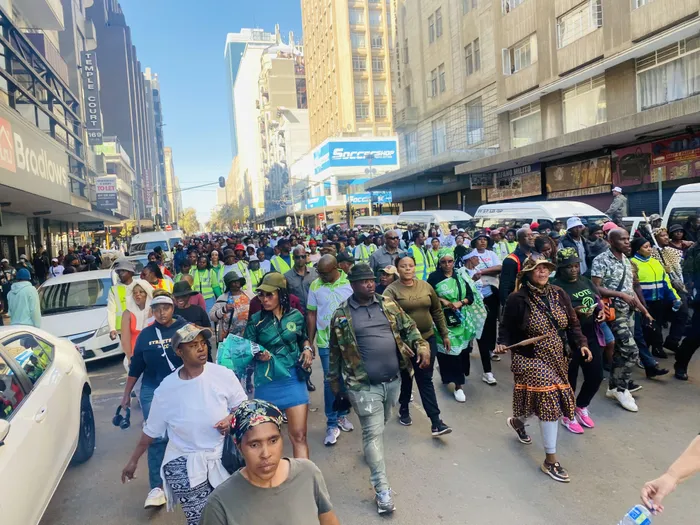
Protesters march through Johannesburg’s CBD calling for action against undocumented immigration during a demonstration at the Gauteng Provincial Legislature. Operation Dudula, whose name means “to be removed by force”, emerged directly from political rhetoric normalising the idea that foreigners have no right to be present. Responsible South African leaders have spoken against this.
Image: Simon Majadibodu | IOL
FESTUS Adedayo's article, “Why South Africans Murder Nigerians in Cold Blood” (Sunday Tribune, May 3, 2026), provides a harrowing account of xenophobic violence.
With graphic descriptions of killings and a chronicle of Nigeria’s sacrifice for South Africa's liberation, the piece evokes righteous anger. Yet for all its emotional power, the article paints with too broad a brush, suggesting Black South Africans possess an innate “bestiality” (a claim echoing white supremacist propaganda) and that violent xenophobia represents the settled will of the majority.
This commentary offers a corrective: the overwhelming majority of African immigrants in South Africa live in safety; the root crisis is poverty and unemployment stemming from governance failures across the continent; and African nations must reject politicians who weaponise xenophobia while working collaboratively to manage migration — a permanent feature of human history.
Adedayo cites specific tragedies: Two Nigerians killed in April 2026, 116 over two years, 62 in 2008. Every violent death is an outrage, and South Africa’s failure to adequately prosecute xenophobic attacks is a legitimate scandal.
But statistics require context. According to the United Nations (UN), an estimated 2.2 million African immigrants lived in South Africa as of 2025. Documented xenophobic killings range from 20 to 50 deaths annually nationwide. This is not to excuse violence but to establish proportion: over 99 percent of African immigrants will never experience physical assault, let alone murder.
The South African Human Rights Commission’s 2025 report found that most xenophobic violence concentrates in specific urban hotspots — certain informal settlements around Johannesburg, Durban, and Cape Town, where competition for housing and casual labour is most intense. Outside these zones, African immigrants run businesses, attend universities, work in healthcare and technology, and raise families without incident.
The Democratic Republic of Congo (DRC) national Adedayo quotes, whose best friend was “stoned to death like a dog”, offers real and devastating testimony. But for every such tragedy, thousands of Congolese, Zimbabwean, Nigerian, Malawian, and Somali nationals will say they feel safer in Johannesburg than in Kinshasa, Harare, Lagos, or Mogadishu — not because South Africa is without problems, but because its institutions, however strained, still function better than many alternatives.
The media amplifies violence because violence sells. Peaceful coexistence does not. Nigeria’s community in South Africa, estimated at over 300 000, includes doctors, academics, tech entrepreneurs, and small business owners who have built thriving lives. Their daily reality — one of normalcy, not terror — rarely makes headlines.
This distortion feeds a cycle of mutual fear. When Nigerians believe all South Africans are waiting to burn them alive, and South Africans believe all Nigerians are criminals, both sides retreat into tribalism, and politicians exploit the resulting panic.
Adedayo correctly notes South Africa’s unemployment rate hovers around 33% — among the world’s highest. For young Black South Africans, the figure exceeds 45%. This is the soil in which xenophobia grows.
But the article attributes this desperation primarily to apartheid’s lingering legacy. That is only half the truth. We cannot scapegoat apartheid till eternity. South Africa’s post-apartheid governments, led by the African National Congress (ANC) for three decades, have presided over systemic corruption, failed industrial policy, electricity grid collapse, and a jobs crisis that predates and will outlast any wave of immigration.
The “scarce resources” over which South Africans and immigrants supposedly fight are scarce because successive administrations looted state coffers, deindustrialised the economy, and refused necessary reforms.
Load shedding — scheduled power blackouts — has destroyed small businesses, native-owned and immigrant-owned alike. The state logistics company Transnet has failed so catastrophically that South Africa's ports are less efficient than Mozambique’s. None of this is the fault of Nigerian shopkeepers or Zimbabwean waiters.
But Adedayo’s more profound argument points northward: “If Nigerian governments… had spent the estimated $60 billion frittered on South Africa on the future of Nigerians, their offspring would not be hibernating in South Africa today.”
This is uncomfortable but essential. The primary reason millions of West, Central and East Africans migrate to South Africa is not love for biltong or Table Mountain. It is because their own nations — blessed with mineral wealth, arable land, and young populations — have been systematically plundered by their own elites.
Nigeria, Africa’s largest economy, has youth unemployment exceeding 40%. Its currency has collapsed repeatedly. Its oil wealth has financed mansions in Dubai, not hospitals in Kano. Zimbabwe, once the continent’s most hopeful agricultural economy, was destroyed by Mugabe’s land reforms.
The DRC possesses trillions of dollars in mineral reserves yet ranks near the bottom of every human development index, its elites known only for looting. These are not South African failures. They are African failures.
To acknowledge this is not to blame victims. The individual Nigerian or Zimbabwean seeking work in Johannesburg is not responsible for Abacha’s theft or Mnangagwa’s mismanagement. But continental honesty requires saying aloud: the desperation driving migration is manufactured by African political classes who have failed their people generation after generation.
Until Africans hold their own leaders accountable, pressure on South Africa’s infrastructure and labour markets will only intensify — and so will xenophobia. South Africa itself is not immune. The ANC’s corruption during the Zuma era, its protection of the Gupta family’s state capture network, and its inability to deliver basic services have all contributed to the desperation now misdirected at immigrants.
When Julius Malema says “unskilled men with no skill whatsoever say somebody took their jobs”, he is correct about the scapegoating but incorrect to imply the unemployed are lazy. The truth is crueller: South Africa's economy simply does not generate enough jobs for its own citizens, regardless of immigration. This author has worked alongside native South Africans in academia and corporate settings; they are as competent as any citizens of any continent.
Adedayo’s article falls into a dangerous trap when it invokes Joseph Conrad’s Heart of Darkness and William Golding’s Lord of the Flies to suggest that “the Blackman has within him innate bestiality”. This is not analysis but the recycling of colonial propaganda.
Conrad was a racist who depicted Africa as a dark heart of savagery needing European civilising. Golding wrote about English schoolboys, not Africans. To cite these works as explanatory frameworks for South African violence is to inadvertently vindicate the very apartheid ideology the article deplores.
The truth is both simpler and more hopeful: Black South Africans who attack other Africans are not expressing primordial savagery. They are expressing desperation, misdirection, and tribalist scapegoating — the same human behaviours that have always characterised the desperate everywhere.
White Europeans slaughtered tens of millions of other white Europeans in two world wars. Asians have committed genocide against Asians. The Irish bombed the English; the English starved the Irish. Violence is not racial. It is situational and political.
What Africans share is not a blood-soaked essence but a common history of colonial extraction, artificial borders, and post-independence governance failures that have left the continent poor not despite its riches but because those riches have been stolen by internal and external predators. The solution is not to retreat into racial essentialism but to build continental solidarity around shared interests.
Adedayo correctly identifies that politicians exploit xenophobia for electoral gain. Malema’s EFF have made anti-immigrant rhetoric a staple, though Malema himself has criticised scapegoating. This apparent contradiction is strategic: Malema wants land expropriation and nationalisation, not just immigrant expulsion.
More troubling is the uMkhonto weSizwe Party (MKP), led by Zuma, which has explicitly embraced xenophobic nationalism. MKP’s 2025 manifesto pledged to “prioritise South African workers over foreign nationals in all sectors”. Zuma, despite facing corruption charges, retains a loyal following among the most desperate.
The Zulu king’s use of “kwerekwere” — a slur implying subhuman status — represents the lowest form of leadership. Operation Dudula, whose name means “to be removed by force”, emerged directly from political rhetoric normalising the idea that foreigners have no right to be present. Responsible South African leaders have spoken against this. Ramaphosa has repeatedly affirmed South Africa’s commitment to pan-Africanism. The ANC’s official policy welcomes African immigrants.
But official policy means little when unemployment is catastrophic and politicians face no cost for xenophobic speech. Citizens of other African nations must recognise the pattern: xenophobia in South Africa is manufactured by elites who benefit when the poor fight each other instead of demanding accountability from their rulers.
Every time a politician blames a Nigerian for a lack of jobs, they avoid explaining why they blocked a new power plant or accepted a bribe. Every time a vigilante group attacks a Somali shopkeeper, the state can claim the chaos is spontaneous rather than acknowledging its own failure to prosecute corruption.
Adedayo’s article implies that if South Africa were less violent or Nigeria more prosperous, migration would cease. This is a fantasy. Human history is migration: the Bantu expansion, the Polynesian voyage, the European settlement of the Americas. People move for love, adventure, family, climate, and economic opportunity.
Even if every African government achieved Dutch-level governance, migration would continue. Young Germans move to Switzerland; Canadians to the United States; Australians to Britain. Migration is not a problem to be solved but a reality to be managed.
The question is not whether Zimbabweans will seek work in South Africa — they will, because Harare and Johannesburg are connected by history, family, and aspiration. The question is how that movement is governed.
South Africa cannot deport its way out of migration. It shares land borders with six nations. Its economy remains the continent’s most industrialised, a magnet for labour. Attempts to seal borders have failed everywhere.
The alternative is managed migration: visa systems matching labour needs with skills, pathways to permanent residency, labour protections, and regional agreements. The African Union’s Protocol on Free Movement, adopted in 2018, envisions a continent where an African can travel, work, and reside anywhere without visas—not because problems don't exist, but because the benefits of mobility outweigh the costs.
Adedayo’s suggestion that Nigeria should have kept its $60 billion and let South Africa remain under apartheid is understandable as catharsis but catastrophic as policy. Apartheid's defeat was a moral victory for all humanity. Nigeria's solidarity was strategic self-interest: a free South Africa would always be a better trading partner and ally. The problem is not that Nigeria helped liberate South Africa. The problem is that Nigeria's post-independence leaders failed to build a country worth staying in.
The worst possible response to xenophobic violence is for other African nations to sever ties or encourage their citizens to view all South Africans as enemies. This is precisely what xenophobes want: a continent divided, unable to cooperate on trade, infrastructure, or political reform.
Instead, African nations should demand that South Africa do better while offering to help. Other nations can support these efforts by sharing intelligence, as criminal networks operate across borders — some “Nigerian criminals” are real, but so are Russian, Serbian and Israeli syndicates, and bilateral agreements on criminal records would help target actual wrongdoers rather than entire nationalities.
They can invest in diaspora engagement: Nigeria, Zimbabwe, Ghana, Malawi and other sending nations should fund consular services that help their citizens comply with immigration laws, formalise businesses, and integrate into communities — the Nigerian government spends far more on luxury cars than on diaspora assistance, a self-destructive choice.
They can create regional labour market information systems, because much xenophobia arises from the perception that immigrants “steal jobs” when in fact they often take work locals refuse or fill skills gaps; a continental system tracking labour supply and demand could match workers to opportunities transparently.
They can condition diplomacy on prosecution of xenophobic violence, using the AU’s African Peer Review Mechanism to review South Africa’s handling of such attacks, as naming and shaming works when backed by regional consensus.
And they can build alternative economic magnets, because South Africa suffers partly as the only major economy in southern Africa; intentional policies to develop industrial zones and technology hubs across Botswana, Namibia, Zambia, Tanzania and Angola would spread migration pressures more evenly, giving a Zimbabwean seeking work plausible options in Lusaka, Gaborone, or Dar es Salaam, not just Johannesburg.
Festus Adedayo’s article captures real suffering. The Nigerians killed in South Africa deserved better. Their families deserve justice. The South African state has failed to provide either, and that failure should be condemned.
But the conclusion Adedayo draws — that South Africans harbour a unique, apartheid-bred savagery, that Nigeria wasted its treasure on an ungrateful nation, that the solution is to write off South Africa — is wrong historically, practically, and morally. Pan-African solidarity, not isolation, defeated apartheid.
Nigeria cannot build a functional economy by turning its back on the continent's wealthiest market. The answer to xenophobic violence is more African unity, not less. The majority of African immigrants in South Africa are safe. This is not an excuse for the violence that does occur but a necessary correction to apocalyptic narratives.
Most days, most immigrants work, study and sleep without incident. The violence is real, concentrated and unacceptable — but it is not the totality of the South African story. The deeper crisis is poverty and unemployment, produced by governance failures from Cape Town to Cairo, from Lagos to Nairobi.
The ANC failed to build an inclusive economy. Nigeria’s elites looted the future. Zimbabwe’s Zanu-PF destroyed agriculture. These failures, not migration, are the root cause of desperation. Fixing them requires African citizens to demand accountability from their own leaders. Migration is permanent. It cannot be stopped, only managed.
The choice facing Africa is whether that management happens through regional cooperation, legal pathways and shared prosperity — or through barbed wire, vigilante violence and the slow death of the pan-African dream.
The ghosts of Steve Biko, Thomas Sankara, Patrice Lumumba and Kwame Nkrumah demand a better answer. So do the living—the Nigerian doctor saving lives in Soweto, the Zimbabwean teacher shaping minds in Limpopo, the South African activist fighting for immigrant rights in Durban.
They are building a united Africa, one relationship at a time, against the odds. The least the rest of us can do is refuse to let sensational headlines and political opportunism burn that future down.
* Dr Kwame Amuah is an African native with dual citizenship of Ghana and South Africa.
** The views expressed here do not reflect those of the Sunday Independent, IOL, or Independent Media.