

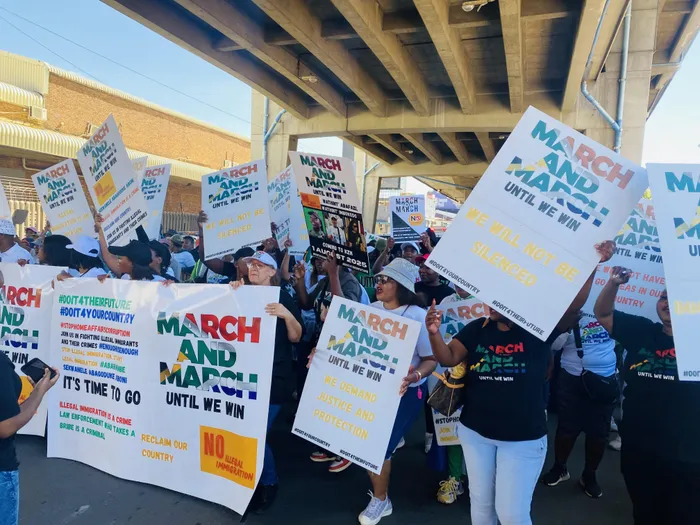
Demonstrators carry placards calling for stricter action against illegal immigration during a march in Johannesburg.
Image: Simon Majadibodu | IOL
ONCE again, we have had several big public protests, including in Johannesburg and Durban, against undocumented and illegal migrant workers. This appears to be the nub of the frustration and anger of the marchers.
Led by March and March and Operation Dudula, these marches have attracted a great deal of media attention over the past two weeks. But there have been so many different views and responses to these marches that there can be no doubt that probably many South Africans are confused about what is really going on and what these boisterous, volatile, and even combustible protests really mean.
Given the very heated nature of these marches and the visible anger of many protesters, this is not an easy analysis to make. Nothing in it is easy to understand. To the contrary, these are very complex, complicated, and contradictory phenomena.
However, let me begin by sketching the pivotal centrality of Johannesburg because it is the city where these marches have been most visible and vociferous. In fact, Johannesburg has been the city where these marches since around 2008 have been most significantly manifest.
Johannesburg is where the mining, industrial, and manufacturing industries rapidly grew since gold was discovered there in 1886. It has since then been the powerhouse of production and nerve centre of the South African economy.
And it is precisely because of that foundational history that Black African migrant workers from neighbouring African countries flocked in great droves there from the late 19th century. Most of the mine workers since 1886 were from those countries.
With the rapid growth of the mines, various manufacturing industries arose in Johannesburg to serve the mines and the mineworkers. In fact, such a big role did the mining industry play in the development of the South African economy that Black migrant labour became its foundational bedrock.
This is very briefly the real origin of the flocking of African workers from neighbouring countries in Southern Africa to Joburg and later other cities, such as Durban, East London, and Cape Town. Often those workers came from poor rural areas in neighbouring countries, seeking jobs and greener pastures.
I argue that this historical background is very important to know and understand in dealing with the current publicly perceived “anti-immigrant” marches in Joburg and elsewhere. However, by providing this background, I am not in the least trying to deflect from the burning issues that the marches have highlighted but to seek to understand it from this perspective.
There are many complex factors at play in shaping a very combustible wider environment in which these marches have taken place. In other words, those protesters are not necessarily consciously xenophobic at all.
But it can easily turn to xenophobia if the underlying issues the marches have vociferously raised are not immediately addressed. The biggest problem without any doubt at all is our huge unemployment crisis and that South African workers regard migrant workers contemptuously because they will probably be prepared to work for less pay.
It is, however, not easy for the current government to rush to address these issues, especially since they are deeply complex and systemic, which is why I tried to provide briefly a historical background.
Yet, there is a palpable sense of urgency that the marches have left on the political authorities, especially in the cities where they took place, such as in Joburg, which is precisely why Panyaza Lesufi, the premier of Gauteng, vowed to act against illegal settlements.
I strongly suspect that Lesufi’s statement had much to do, beneath the surface, with the upcoming local government elections. Yet, there is certainly indeed an urgency to address administratively the vitally important matter of legality and how corruption and inefficiency in the system need to be decisively dealt with.
This brings me to the tangible and fully justified frustration and anger that many protesters expressed about the unlawful presence of many undocumented workers from other African countries. Many of the protesters stated that this was the biggest problem that they were drawing attention to, its harmful consequences, and that they were not necessarily xenophobic.
I think that many, if not most, of the protesters are not consciously xenophobic but are deeply concerned with the undocumented and therefore unlawful presence in South Africa of this category of foreign workers. The term “xenophobia”, I think, is used glibly.
But this is not just a legal matter, because inevitably the presence of those migrants will negatively impact the utilisation of various services at the municipal level and in the public domain, such as basic services, health, and schooling, which has been for many years already in a neoliberal fiscal crisis.
The problem is that there has for long been so much corruption in the Home Affairs Department that there are probably many cases where immigrant workers were unlawfully documented, although I understood that since the appointment of Leon Schreiber in June 2024, he has effectively dealt with much of it.
Reports over the past few days also indicated that he suspended a few officials over AI-generated fake documents. There are probably many more fake documents that will hopefully be uncovered soon. Hence, the document verification process Schreiber has ordered is an important move to track and root out corruption in the system.
I think we need to come to a sober realisation around the many problems unlawful immigration or being employed without the required documentation poses. It is a very serious problem for a number of reasons, and those among the protesters who raise this issue are correct to do so.
Among the valid reasons, undoubtedly, is that it will have direct and indirect implications for the employment of South African workers and the resources and availability of various services, such as health, schooling, and welfare.
This is besides the fact that many problems are directly and indirectly related to the embedded corruption in the Home Affairs Department over many years.
But there is an even bigger problem, and that is the historical fact that racist apartheid and capitalism worked hand in glove. In fact, ultimately, we essentially have that same system still in power today, but without the fragrant racist laws on our statute books. And the Black African migrant labour system was the bedrock of that system.
In other words, probably a substantial portion or even most of the undocumented immigrant workers and those with fake documents are the ancestors of that mining working class. But what xenophobia does, when it does indeed exist, is create divisive antagonisms between different sections of the same working class.
It is in fact tragic that one section of the working class (South African) is in dire and violent conflict with the African migrant workers over jobs and municipal public services, such as hospitals and clinics.
There is also the real danger that some South African Black workers become consciously xenophobic towards migrant workers or small businesses in the townships unless these matters are dealt with by trade unions and the civil society formations, such as community or residents organisations.
However, we must not trivialise what is called “spaza” shops in the black townships. It seems that many or even most of them are not properly documented and that their businesses have raised many ethical issues, such as selling foodstuffs that have expired.
I do not agree that migrant workers should not be subjected to immigration laws and regulations. No country works like that. Besides, such a situation would certainly exacerbate the situation and related criminality, especially faced with a devastating jobless crisis.
But why target the owners of these spaza shops and not look at the endemic corruption in the Home Affairs department? And why, in the first place, do these migrant workers come to this country to seek work? It is most probably to escape the clutches of desperate poverty and joblessness, most probably even worse than in South Africa.
Besides, the brutal legacy of colonialism, the underdevelopment of African people, the widespread poverty and unemployment in the countries they come from, and what have governments in those countries done to prevent these huge migrations of labour are also important matters to address.
There is also the fact that ruthless employers in this country generally prefer African migrant workers because they get paid less and most probably work under terrible conditions, which their illegal status prevents them from acting against. It is very clearly a combination of very complex issues.
Over the past few days both the mainstream and social media have been awash with this increasing anti-immigrant crisis South Africa is facing. Things seem to be getting out of control. This is arguably the biggest crisis facing the Government of National Unity (GNU).
I am very concerned that it might be a bit too late to take action to defuse a situation that has been boiling over with pent-up anger and fury over a long period. Addressing this cauldron of anger and violence should have long ago been a top priority of the government. Let’s fervently hope it is not too late.
* Dr Ebrahim Harvey is a political writer, analyst, and commentator.
** The views expressed here do not reflect those of the Sunday Independent, Independent Media, or IOL.