

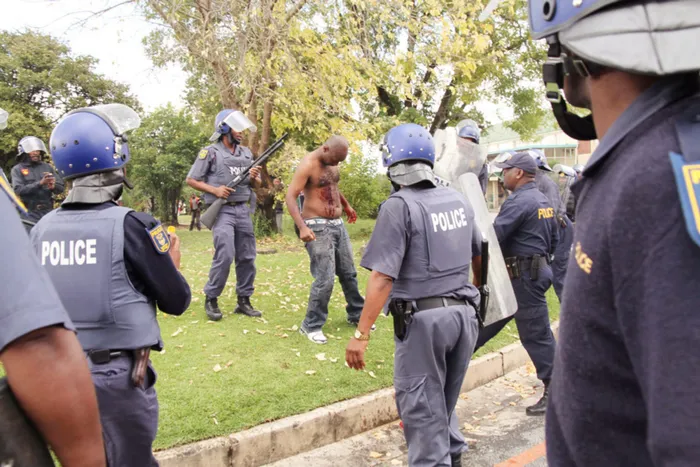
LINED UP: Andries Tatane, left, shortly before his collapse and death. His widow, Rose Motlhaping (extreme right of picture), looks away as the police officers alleged to be involved in her husband's death appear in court. Video images of SAPS brutality have gone around the world. Picture: Antoine de Ras LINED UP: Andries Tatane, left, shortly before his collapse and death. His widow, Rose Motlhaping (extreme right of picture), looks away as the police officers alleged to be involved in her husband's death appear in court. Video images of SAPS brutality have gone around the world. Picture: Antoine de Ras
Andries Tatane died last week after being beaten mercilessly, and then quite possibly shot with live ammunition, by members of the South African Police Service while participating in a march of 4 000 people demanding better service delivery in the township of Meqheleng, just outside Ficksburg, in the Free State.
His death, and the police brutality that caused it, reflects growing macho posturing and an apparent sense of impunity among senior public officials and it demands collective action to strengthen the institutions tasked with holding police accountable, most notably the soon to be launched Independent Police Investigative Directorate (IPID) and the Civilian Secretariat for Police.
Footage broadcast by the SABC shows a half dozen or so SAPS members attacking Tatane repeatedly with batons. He falls to the ground. The beatings continue. When he stands up blood pours from his chest, possibly from either rubber bullets or live ammunition. A short while later, a look of shock on his face, he drops to the ground and dies there.
According to other community members he had approached the police to intervene on behalf of an old man who was caught up in the protest but was not a part of it. When the police set upon him he briefly tried to defend himself but was no match for truncheon wielding police who, video footage shows, assaulted him over and again, even when he was on the ground.
Tatane was not a criminal. Tatane was a maths teacher. He was a community activist. He provided free maths lessons to children in his community. He demonstrated against corruption, incompetence and poor service delivery.
He was a husband to Rose and a father to Molefe.
Tatane embodied the very values that brought us democracy and that made our transition from apartheid possible: citizen activism for social justice and human rights. Activists like him produced our constitution. However, the rights enshrined in that document did him little good.
Today, Tatane is dead, killed by members of the South African Police Service.
The Independent Complaints Directorate reports that 1 769 people died in police custody or as a result of police action in 2010.
Tatane will in all likelihood be one of many people killed in 2011, unless there is serious intervention by the leaders responsible.
How did it come to this? What gave the police the sense that it was acceptable to go after him with such murderous intent? What allowed them to think it was permissible to brutalise Tatane in full view of the media and hundreds of his fellow citizens?
Other events in the news last week reflected a similar disregard for the values of our constitutional democracy. All week headlines echoed the themes of craven entitlement, brazen impunity and swaggering macho bravado.
Then, on Monday April 11, various national papers ran pictures of Julius Malema, ANC Youth League president, flanked by armed guards outside an Equality Court hearing on whether the singing of “shoot the boer” constitutes hate speech.
The papers ran images of Malema surrounded by armed private security guards carrying M-14 semi-automatic assault weapons generally intended for military use and far too powerful to be safe for close quarter crowd control – any bullet fired by an M-14 would simply pass right through one body and travel directly into another.
Even Martin Hood, spokesman for South Africa’s usually unapologetically brazen gun lobby, complained about Malema’s public display of such over the top firepower.
Coverage of Malema’s Hollywood swagger reflects the growing militarisation and macho posturing of our public discourse and political leaders. Not so long ago, Malema was threatening to “kill for Zuma” during an election campaign characterised by President Jacob Zuma singing Awulethu Umshini Wam(bring me my machine gun) to invoke his military past, no matter that nearly two decades had passed since peaceful negotiations effectively ended the armed struggle.
This militarisation and macho posturing is now also institutionalised in the South African Police Service’s decision to revert to apartheid-era military ranks.
Our police generals and our politicians now posture behind their military titles and epaulettes and trumpet the importance of a “shoot to kill” policy, intended to put criminals on notice that they are willing to act on former Deputy Minister Susan Shabangu’s entreaty to “shoot the bastards”.
The message: the police mean business and business will be conducted with extreme force.
In this climate it is perhaps not surprising that police felt both compelled and justified in using overwhelming force to put a protester in his place.
Tatane was killed trying to improve the lot of his impoverished community. His death requires redress. He is owed justice.
The announcement on Sunday, April 17, that the six police officers involved in his death have been arrested, two of them charged with murder and the other four with assault, is encouraging.
To ensure that his wife and son see justice, pressure will need to be maintained. Two institutions are tasked with this job: the Independent Complaints Directorate and the Civilian Secretariat for Police. Both bodies are tasked with monitoring and holding the police accountable.
While neither institution is able to boast a proud track record to date, there is hope for 2011 and beyond as we see Parliament enact two new bills – the Civilian Secretariat for Police Service Bill and the Independent Police Investigative Directorate Bill. The new legislation will clarify the mandate of the Secretariat and the ICD (which will become the IPID) and will give civil society a yardstick against which to monitor the bodies.
The task ahead of them is clear: To ensure that SAPS lives up to the vision articulated by the Minister of Police in his 2011 budget speech. He pledged: “The police are the institutional expression of the resolve by South Africans, as individuals and as a nation, to realise safety and security.
“The police are, and always must be, subject to the will of the people they serve.”
The concluding lines of his speech: “We also want to emphasise that 2011 is a Year of the Good Cop. Rise and shine in defence of your nation.”
Already it’s easy to draw super-ficial parallels between Tatane and Muhammad Bouazizi, the Tunisian street vendor who set himself on fire late last year to protest his humiliation at the hands of a municipal official who confiscated the fruit and vegetables he was selling from his wheelbarrow in his village of Sidi Salah.
His death sparked local demonstrations which became national and then regional.
Just four months later, his death has catalysed successful revolutions in Tunisia and Egypt and inspired citizen activism for democracy across North Africa and the Middle East, which may soon topple despots in Libya, Yemen and Syria.
Will Tatane’s death lead to a similar groundswell of determination to hold our government and public officials accountable?
Certainly Tatane’s life demands that.
n Peacock, Lesejane and Botha work for Sonke Gender Justice Network.