Stunting our development
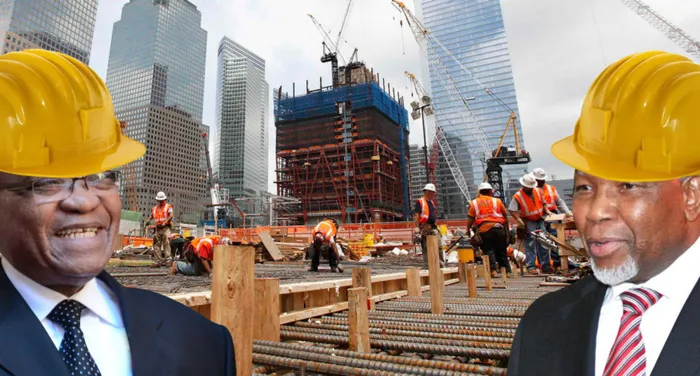
CONSTRUCTING MANAGEMENT: President Jacob Zuma and Deputy President Kgalema Motlanthe will each chair a commission to manage economic reform measures. Graphic: Sithembile Mtolo CONSTRUCTING MANAGEMENT: President Jacob Zuma and Deputy President Kgalema Motlanthe will each chair a commission to manage economic reform measures. Graphic: Sithembile Mtolo
The announcement on Friday of the creation of yet another layer of political management in the hope that it will help improve the performance of the state, demonstrates how difficult it can be to implement economic reform measures in a democracy, especially where political leadership is weak and where class dynamics are such that one class dominates the political arena.
After a three-day cabinet lekgotla, the country’s executive has decided to create two new structures – an infrastructure commission to be chaired by President Jacob Zuma and a job creation commission to be chaired by Deputy President Kgalema Motlanthe.
The cabinet said in a statement that because of the centrality of infrastructure development and job creation in dealing with poverty and inequality, it had resolved “to elevate the management of the two priorities to the Presidency”.
It is not yet clear how these commissions will operate, especially whether they will replace or complement existing structures. India has a similar commission for infrastructure, which is chaired by the Prime Minister, Manmohan Singh.
Launched in July 2009, the committee is meant to fast track the implementation of projects by deciding on big project proposals, on fiscal, financial, institutional and legal measures to enhance investment, set annual parameters and targets for performance, and review the progress of infrastructure projects.
Locally, the cabinet already has the Infrastructure Cluster chaired by Transport Minister Sbu Ndebele, and the Economic Sectors and Employment Cluster co-chaired by Rural Development and Land Reform Minister Gugile Nkwinti and Science and Technology Minister Naledi Pandor.
In addition, Zuma created the department of performance monitoring and evaluation “to monitor and evaluate the performance of government across all three spheres”. He has also signed performance agreements with each of the ministers.
These agreements detail the targets for departments, which contribute to the 12 outcomes adopted by the cabinet.
The reorganisation of government, Zuma said in May 2009 when he announced his cabinet, was meant to help the administration “effectively implement our policies.”
The creation of another layer for monitoring performance, especially on job creation and infrastructure delivery, signals Zuma is far from achieving his objective.
That being the case, the question becomes whether Zuma has a good understanding of why his administration has very little progress to show, especially why much-needed reforms have proved so difficult to implement.
Zuma’s problem is the politics in the ruling party, where, since Polokwane in particular, the appetite for the reforms that South Africa must undertake to raise the level of economic growth has dried up.
Linked to this is that the balance of forces within the ANC has shifted to organised labour, meaning Cosatu, which pushes policies that will benefit its members at the expense of national progress. This has happened at a time when there is no countervailing class to keep labour in check.
The middle class, which in other countries plays such a role, is largely disengaged from politics in general and ruling party politics, specifically.
The role of the middle class in economic development is explained by, among others, Diane Davis, a political sociologist at the Massachusetts Institute of Technology.
Davis says that when key actors in the middle class see themselves, their social and political dynamics, and their economic policy priorities as sufficiently distinct from large industrialists and wage labourers, they will enable the state’s use of a variety of measures to politically and economically discipline capitalists and labourers for the purpose of generating national prosperity and balanced growth.
“With capitalists and labourers strictly disciplined in this manner, the economy is less prone to distortion and waste, industrial policy decisions are more likely to be made with long-term frameworks in mind, national industrial growth objectives are more apt to be achieved, and sustained macroeconomic development is more likely to materialise. We call administrations that pursue these policies disciplinary regimes,” writes Davis in Discipline and Development: Middle Classes and Prosperity in East Asia and Latin America.
Where the middle classes are absent, or politically weak, states are less likely to impose discipline. They are, instead, more likely to accommodate the demands of capital or labour “in ways that allow rent-seeking, short-term profit maximisation, higher wage rates, and/or protectionist measures that in the long run limit firms’ capacities to compete domestically and abroad. Such regimes are called accommodating.
Applying this analysis to South Africa, without a middle class which has developed a class consciousness and is politically active, Zuma is forced to accommodate organised labour.
His problem is magnified by the tensions within the ANC over the elective conference next December.
Zuma and other ANC leaders have to consider his every policy move with an eye to the conference.
What South Africa must do to fix its socio-economic problems, especially those relating to the performance of its economy, is well known.
The state, as the National Planning Commission has pointed out, is critical for shaping the economic environment and “the efficacy of the state is a key determinant of how fast the economy grows and how its benefits are distributed”.
“To date, weaknesses in the economy have not been the result of a lack of ideas or disagreements, despite significant differences on key policy matters. The main problem has been the inability to implement what has been agreed to,” the commission said in its Diagnostic Overview. “The government’s decision-making capacity has not matched the support needed for growth and development so that it can transform patterns of wealth and income. Similarly, the state has not always been realistic about what it can achieve, given its limited capabilities.”
More crucially, the commission said that economic development is often “path dependent”, meaning momentum is a strong driver of the pattern of development.
“Changing this pattern is difficult, requires careful management and leadership, and involves trade-offs and sequencing that may benefit some sectors before others.
“Socioeconomic progress does not lend itself to a perpetual and uniform rise in all indicators all at the same time. And given its finite set of resources, set amid urgent and competing demands, South Africa will have to make some tough choices that will involve trade-offs. Achieving national consensus will depend on leadership from all social partners – government, business, trade unions and the community sector,” the commission added.
But given the centrality of the state in economic development, no initiative by the other social partners will make much impact without the government, especially the country’s political leadership, getting its house in order.
Yet, there is no sign that South Africa, expecially the ruling party, is making attempts, let alone progress, in addressing the structural weaknesses in its political system.
The state in South Africa has diminished capacity to broker agreements among social partners that will move the country towards higher economic growth.
This is made worse by the widening gap between government and business.
Without a social compact, South Africa has no hope in hell of creating the number of jobs needed to make a dent in unemployment, which rose in the second quarter of the year to above 25 percent.
The National Planning Commission concluded that the country’s labour laws were not the principal cause of high unemployment as they were not overly rigid relative to either developed or developing countries.
The main obstacle is the high entry-level wages (relative to the productivity of a new entrant) which result in companies not too keen to hire new entrants. In addition, collective bargaining agreements appear to benefit larger employers, a factor which undermines the competitiveness of smaller firms.
In rich countries, for example, new entrants to the labour market earn 37 percent of the average wage. In South Africa, by comparison, new entrants earn 60 percent of the average. “Therefore, starting salaries in many firms are higher than the relative productivity of a new worker,” the commission said. “This discourages firms from taking on new young workers.”
Addressing this stumbling block to job creation remains impossible as long as the ruling party and its leaders are beholden to organised labour, more specifically Cosatu.
Adding another layer of political management is not likely to raise the level of economic growth.
Nor will it create more jobs.