Call for unions to be liable for strike damage
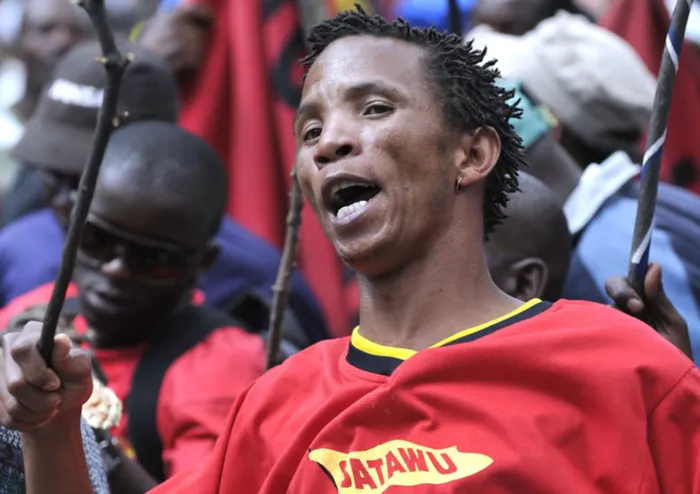
One of hundreds of Satawu and Giwusa members chant slogans as they gather around Beyers Naude Square in the Joburg CBD for a protest demanding better wages. Picture: Bongiwe Mchunu One of hundreds of Satawu and Giwusa members chant slogans as they gather around Beyers Naude Square in the Joburg CBD for a protest demanding better wages. Picture: Bongiwe Mchunu
Jabulani Sikhakhane
Business and the official opposition are pushing for changes to labour laws to include a collective liability clause to allow for trade unions to be sued for damages arising from violence during strikes.
The push comes as labour watchers are keenly awaiting the outcome of a Supreme Court of Appeal hearing into an application by the SA Transport and Allied Workers Union (Satawu).
The union is appealing a judgment by Justice John Hlope in the Cape High Court last September in which he found the union liable for damage to property during a march the union held while striking in 2006. The appeal will be heard on September 5.
Business Unity South Africa (Busa) says strikes are becoming more violent, often with loss of life and destruction of property.
Applying to the labour courts for interdicts against violence during strikes has yet to show results, said Busa’s director of social policy Vikki Habajan on Friday.
“It is time for trade unions to take responsibility for the actions of their members and supporters, in ensuring that strike action is carried out peacefully,” Busa said last month in response to violence during the strike by chemical, metal and engineering workers.
“Leaders of organised labour need to accept responsibility for the conduct of their members during strike action.”
Busa’s call has been echoed by the Cape Chamber of Commerce, which has said it is unfortunate that “major strikes in South Africa seem to be accompanied by violence, intimidation and the destruction of property”.
The Chamber of Mines would support the introduction of a collective liability clause, but only if it applied to cases where trade union leaders encouraged or did not take steps to stop violence, spokesperson Jabu Maphalala said on Friday.
The DA is pushing for such an amendment and has filed proposed changes to the Labour Relations Act with the Parliamentary Committee on Private Members’ Legislative Proposals and Special Petitions.
The submission will be debated by the committee on August 31, DA shadow minister of labour Ian Ollis said on Friday.
“This legislative proposal is not about unions, nor is it about the right to strike or the rights of workers or employers; it is about violence and the role of the courts and union bosses in clamping down or preventing violence on the streets of South Africa, when picketing or strike action occurs,” Ollis said in a statement in March.
The balancing of rights as called for by business and the DA is recognised by the International Labour Organisation (ILO).
“The right to strike, which is held by the ILO supervisory bodies to be fundamental, is not an absolute right and its exercise should be in line with the other fundamental rights of citizens and employers,” the UN body says.
“The principles of freedom of association do not protect abuses consisting of criminal acts while exercising the right to strike,” the ILO’s Committee on Freedom of Association says.
“Penal sanctions should only be imposed as regards strikes where there are violations of strike prohibitions, which are themselves in conformity with the principles of freedom of association.
“All penalties in respect of illegitimate actions linked to strikes should be proportionate to the offence or fault committed.”
Labour Minister Mildred Oliphant recently called on trade unions and workers to protest peacefully during strikes.
“It (violence) undermines the system of collective bargaining in this country…” Oliphant said during the chemical, metal and engineering workers’ strike last month.
This week the city of Cape Town was granted an interim interdict by the Labour Court preventing members of the SA Municipal Workers Union (Samwu) from intimidating non-strikers and from carrying weapons.
Samwu said in a statement that the union did not condone the looting and violence against members of the public. “Criminal elements that have infiltrated the strike action and used the strike as a disguise to further their nefarious activities must be brought to book,” Samwu said, adding that where proof is given of its members being involved, they would be disciplined.