
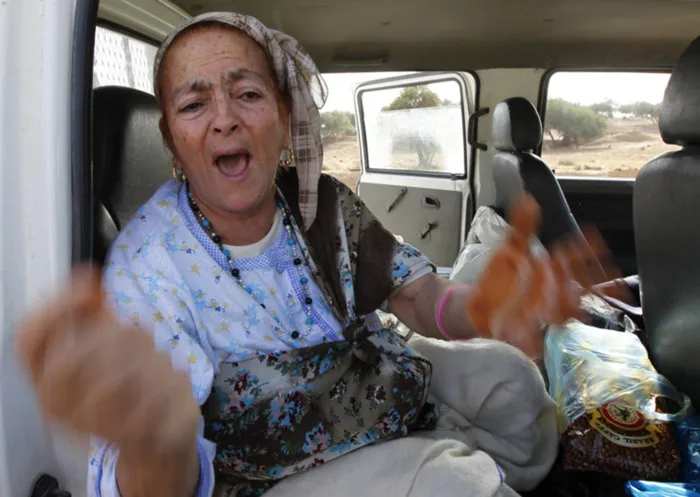
Dire: A civilian flees Tripoli. World leaders are meeting today to discuss an "end game" for Libya's Muammar Gaddafi. Picture: Youssef Boudlal / Reuters Dire: A civilian flees Tripoli. World leaders are meeting today to discuss an "end game" for Libya's Muammar Gaddafi. Picture: Youssef Boudlal / Reuters
Misrata - Western and Arab nations meet in Abu Dhabi today to focus on what one US official called the “endgame” for Libya’s Muammar Gaddafi as Nato once again stepped up the intensity of its air raids on Tripoli.
At the UN, the prosecutor of the International Criminal Court said it had found evidence linking Gaddafi to a policy of raping opponents, while in the US Congress a bipartisan group proposed that President Barack Obama use frozen Libyan government assets to pay for humanitarian aid for Libyan people caught up in the civil war.
Nato air strikes resumed in Tripoli last night after a lull that followed the heaviest day of bombings since March. Thousands of Gaddafi troops advanced on Misrata yesterday, shelling it from three sides and killing at least 12 rebels.
Ministers from the so-called Libya contact group, including the US, France and Britain, as well as Arab allies Qatar, Kuwait and Jordan, agreed in May to set up a fund to help the rebels in the civil war.
They are expected to firm up this commitment in the United Arab Emirates capital and press the rebels to give a detailed plan on how they would run the country if Gaddafi stood down as leader of the oil-producing North African desert state.
“The international community is beginning to talk about what could constitute end-game to this,” one senior US official told reporters aboard US Secretary of State Hillary Clinton’s plane which landed in Abu Dhabi last night.
“That would obviously include some kind of ceasefire arrangement and some kind of political process… and of course the question of Gaddafi and perhaps his family is also a key part of that,” the US official said.
Both Libya’s rebel Transitional National Council and its Western allies have rejected Libyan government ceasefire offers that do not include Gaddafi’s departure, saying he and his family must relinquish power before any talks can begin.
The US official said there had been general discussions about what might happen to Gaddafi, but nothing specific on “where he should go, or whether he should remain in Libya for that matter”.
Yesterday US officials announced delivery of the rebel council’s first US oil sale of 1.2 million barrels, part of a broader strategy which they hope will get money flowing to the cash-starved group.
British Foreign Office Minister Alistair Burt, who will be at the Abu Dhabi talks, said the group would be briefed by the International Stabilisation Response Team which is helping the rebel council plan for post-conflict rebuilding.
“The contact group will also reiterate the unequivocal message… that Gaddafi, his family and his regime have lost all legitimacy and must go so that the Libyan people can determine their own future,” Burt said.
“Until Gaddafi does so, the pressure will increase across the board: economically, politically and militarily.”
Nato defence ministers met in Brussels yesterday.
However, there were few signs of willingness to intensify their Libyan mission, which after four months has failed to oust Gaddafi.
The alliance says the bombing aims to protect civilians from the Gaddafi’s military, which crushed popular protests against his rule in February, leaving many dead.
The conflict has now become a civil war.
Gaddafi says the rebels are a minority of Islamist militants and the Nato campaign is an attempt to grab Libya’s oil. – Reuters