

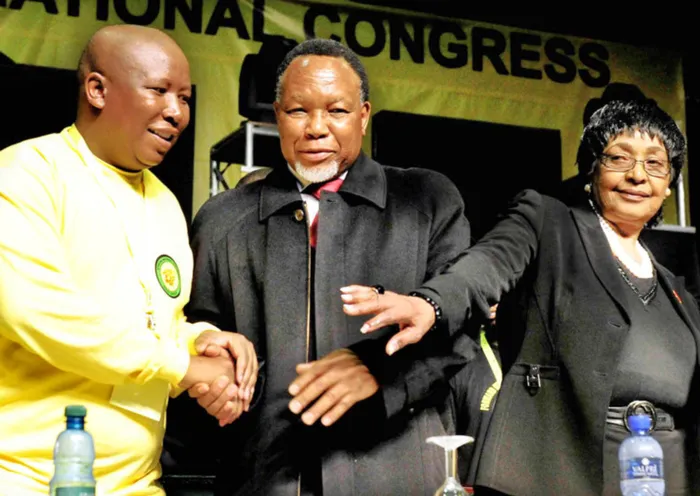
FIRED UP: Julius Malema is congratulated by Deputy President Kgalema Motlanthe and ANC stalwart Winnie Madikizela-Mandela for being re-elected as the ANC Youth League's president during its 24th congress at Gallagher Estate in Midrand yesterday. Picture: Bongiwe Mchunu FIRED UP: Julius Malema is congratulated by Deputy President Kgalema Motlanthe and ANC stalwart Winnie Madikizela-Mandela for being re-elected as the ANC Youth League's president during its 24th congress at Gallagher Estate in Midrand yesterday. Picture: Bongiwe Mchunu
CARIEN DU PLESSIS
Fresh from his victory at the ANC Youth League Congress, Julius Malema flew head first into a land policy clash with a deputy minister and national executive committee (NEC) member.
Malema’s call for a land grab without compensation was met with stiff opposition from Derek Hanekom, the deputy minister of science and technology. Hanekom is also a former minister of agriculture and land affairs.
The newly re-elected ANCYL president slammed Hanekom for saying the expropriation of land without compensation, which the league is calling for, was not ANC policy and that he would never agree with it.
Malema said the expropriation of land was “on the table of the ANC. We must ask for some respect. Some people cannot attack us in the media”.
He then implied that Hanekom, who heads the ANC’s disciplinary committee, which found Malema guilty of sowing division in the ANC last year, should himself be disciplined.
But Hanekom last night tweeted: “Some quite numerous, like my relatives, benefited from illegal acquisition of land. I’d b most grateful if u could help me find those farms! Of course I stand by what I said. Strange to be called out of order for articulating ANC policy. NEC members do that.”
Hanekom also said the league should read the resolutions of the ANC’s 2007 Polokwane conference, which made “no mention of expropriation without compensation”.
He continued: “By the way, forgot to say Trish (his wife) and I were forcibly removed from the small farm we were renting in Magaliesburg on 13 December 1983.”
His final tweet: “All said and done, the pace and quality of land reform simply has to pick up, and the restitution process must be completed. Hope we all agree.”
Malema’s call for speedier land reform was supported by ANC stalwart Winnie Madikizela-Mandela and Deputy President Kgalema Motlanthe in their speeches yesterday. Motlanthe, however, asked for “meaningful debate” on the matter.
A shift on land policy was just one of the major policy shifts that Malema and the ANCYL wants to pursue.
Malema emerged from the congress with guns blazing and politically stronger than ever, calling for a “war on policy shifts” and for “proper” leadership in the ANC.
He again tried to put President Jacob Zuma at ease by saying “we don’t want to remove anybody”.
Emboldened by his unopposed re-election by about 5 300 delegates at the league’s four-day, R37 million congress in Midrand, which ended in the small hours of this morning with a party, Malema laid into the government’s international policy, especially with regards to Libya and the “selective” disciplining of ANC leaders like himself.
In his more than two-hour speech yesterday, to which the tired and hungry delegates listened intently, a fired-up Malema called on league members to swell the ranks of the ANC and take over as many positions in the mother body as they could, in order to push the league’s views on policies like the nationalisation of mines.
Fifty percent or more of all ANC positions should be occupied by league members, he said.
“We are going to a war, comrades, a war on policy shift. Youth, you must be everywhere in the structures of the ANC,” Malema said.
Former league leader Fikile Mbalula employed a similar strategy of flooding the mother body’s structures with youth to enable the league to play the role of kingmaker in Zuma’s election as party president in 2007.
The league is now likely to use this strategy to replace secretary-general Gwede Mantashe with Mbalula at the ANC’s elective congress next year.
The league had already succeeded in getting its preferred candidates – recent or serving youth league leaders – elected as provincial secretaries, organisationally among the most powerful positions.
Malema also urged ANC leaders to show the way, otherwise “reactionaries” would emerge. “The ANC must lead our people. We are asking for radical policy shifts. We want action.”
Malema called for a more open discussion within the ANC on leadership and succession issues.
“For us to say we aren’t happy with this or that leader doesn’t mean we’re calling for the closure of the ANC,” he said.
“This thing that you can’t talk about leaders undermines our capacity that you can strengthen the ANC, including making leaders aware of their weaknesses.”