Kader and Mbeki: sour grapes?
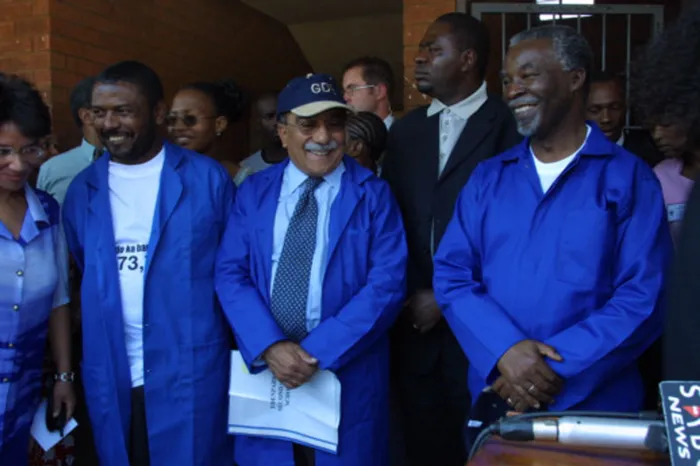
FOE OR FRIEND? Although Kader Asmal did not enjoy a warm relationship with former President Thabo Mbeki, Asmal respected his intellect. FOE OR FRIEND? Although Kader Asmal did not enjoy a warm relationship with former President Thabo Mbeki, Asmal respected his intellect.
It is quite illuminating, but somewhat startling, that the late ANC stalwart Kader Asmal did not adore his former boss, Thabo Mbeki, that much.
In his insightful and well-crafted autobiography – Politics in My Blood, A memoir(Jacana) – Asmal’s critical description of Mbeki could well be confused with the sentiments of what cartoonist Zapiro termed “Pirates of Polokwane”.
He was relentless, with an indignant tone.
Secretive, a control freak, cold and intolerant: this is how I summed up Asmal’s opinion of Mbeki after rereading the book with disbelief.
However, he acknowledged that he respected Mbeki’s intellect, his commitment to the ANC and his industriousness, and admired his perfectionist personality.
In an attempt to understand his opinion of Mbeki, I contacted Asmal’s former colleagues in the ANC and the government.
Most refused to go on record because they did not want to be seen as criticising a comrade who had passed away.
Some described Asmal’s unforgiving criticism of Mbeki as “sour grapes” because the latter had defeated him for the chairmanship of the ANC in 1993 after the death of Oliver Tambo.
Authors Mark Gevisser and William Gumede – in their respective biographies of Mbeki – did mention that both Nelson Mandela and Walter Sisulu wanted Asmal to be confirmed party chairman without elections by members of the ANC’s national executive committee.
But the then youth league leader, Peter Mokaba, fielded Mbeki to challenge Asmal. Apparently, Asmal saw this as Mbeki’s calculated machination. The outcome was 56 votes for Mbeki, and 13 for Asmal.
A former cabinet colleague and senior ANC leader said Asmal’s criticism of Mbeki “became noisy” after he was not re-appointed education minister in 2004.
In the book, Asmal admits that “it was something of a blow when I was not re-appointed”.
“I found it frustrating not to be given the opportunity to see through the initiatives I had started in my tenure as minister of education, though it wasn’t entirely unexpected. The statistics clearly showed an increase in matric pass rates during that period from 1999 to 2004”.
One former cabinet minister said he was shocked that Asmal had picked on Mbeki, who promoted him to education, while Mandela gave him the less glamorous water affairs portfolio.
In fact, Asmal admitted that he was very excited when the media speculated that he would be appointed minister of constitutional development in 1994.
But others told me that his sharp and critical opinion of Mbeki reflected the vintage Asmal – “honest and blunt”.
Mbeki’s spokesman, Mukoni Ratshitanga, was not willing to talk to me about Asmal’s fiercest attack of his boss.
He cited his respect for the African culture of not speaking ill of the dead and said he had not read the book. Instead, he referred me to Asmal’s former cabinet colleagues.
Asmal said Mbeki had secretly tried to negotiate general amnesty with De Klerk for apartheid securocrats.
He said it seemed Mbeki had gullibly believed former security police head “Krappies” Engelbrecht’s threats that if total amnesty wasn’t granted, “we could not depend on the loyalty of the police or the defence force, or even state employees in power stations and the railways”.
He was “flabbergasted” by Mbeki asking whether to give “all of them” amnesty.
Asmal said this “flew in the face of all our agreements, discussions and plans” and undermined Mandela’s “special committee”.
After Mbeki arrived unexpectedly at Asmal’s meeting with former apartheid justice minister Kobie Coetsee, “it was evident that De Klerk didn’t want to take up this issue with Mandela”.
“As De Klerk and his team clearly assumed that they wouldn’t get their way through normal negotiations, they were trying to direct things through the back door, through the person of Mbeki…”
Mbeki’s former minister and confidante, Essop Pahad, rejected Asmal’s claims, but he acknowledged that he had not read the book. I read relevant excerpts to him. He expressed shock.
“It will be inappropriate and unfortunate for any one individual … to then claim credit and on the other hand discredit someone else. No way Mbeki could have gone to negotiate behind the back of the ANC… I would dispute it.
“I regret that Kader Asmal should resort to what I consider to be a blatant disregard for the facts. This is not my recollection of what happened,” Pahad said, but acknowledged that he held Asmal in high esteem.
Asmal seemed to have preferred the then ANC secretary-general to succeed Madiba.
“Perhaps the greatest surprise of the new Mandela cabinet was the exclusion of one of the most able of all the ANC’s leaders and its chief negotiator during the critical period of the early 1990s, Cyril Ramaphosa. For many of us, including me, Cyril was a shoo-in for deputy president and was clearly Mandela’s chosen heir,” he said.
Again, he fingered Mbeki for what Asmal saw as a bad choice for foreign minister.
“Instead of the capable Ramaphosa, South Africa got Alfred Nzo as foreign minister… Mbeki was apparently the one who pushed Mandela to appoint Nzo to the foreign ministry. With Mandela spending so much of the next five years out of South Africa on international trips, a high-profile go-getting foreign minister wouldn’t have suited Mandela either. Mbeki was looking for someone who would be quietly amenable to his positions and ideas…”
Pahad, however, said Mandela was on record as saying Ramaphosa had turned down the foreign ministry offer. Pahad found it unacceptable that Asmal would disrespect Nzo, who spent 21 years as ANC secretary-general in exile and was “the most experienced person in international affairs”.
Mbeki had a tight grip on Mandela’s cabinet, Asmal remarked.
“The national budget was largely a set of Mbeki’s decisions, which is a painful thing for me to say in view of my friendship with Trevor Manuel. In truth, Mbeki decided on the important items in the budget for most of Mandela’s term and for both of his own presidential terms.”
I could not reach Manuel. But some of his former colleagues disputed Asmal’s version.
Although Asmal said he and Mbeki shared some common interests and traits – such as intellectual and literary prowess – “I cannot say that our relationship was ever warm or affectionate”.
“He could never quite make a leap from colleague to friend.” “Mbeki never once asked me, for instance, about my cancer. Nor did he criticise me to my face.”
He said that when Mbeki shuffled him out of the cabinet, “there was no regretful apology, no ‘good luck’ or ‘thank you’. “He did say he needed younger blood in the cabinet, though at least one of his appointments was older than me.”
I disagree with Asmal on this one. In 2004 Mbeki took the unprecedented step of providing reasons for not re-appointing a minister. I was at Mbeki’s press conference when he justified why he excluded Asmal and Ngoako Ramatlhodi. He said Asmal was a good minister but he had asked not to be included in the cabinet becaue of ill-health.
Asmal described the atmosphere in Mbeki’s cabinet as “bordering on anxiety”.
“As minister, you very rarely made any assessment or criticism of Mbeki, if you could help it. You never knew what the response would be. We practised the injunction of maak toe jou mond(shut your mouth).
He cited Zimbabwe and Aids as some of the issues depicting Mbeki’s officious leadership style and chastised the former president for funding the quack “snake oil” called Virodene.
Under Mbeki, Asmal wrote, “truly sensitive or difficult topics of state were kept off the agenda even at the level of the executive branch of government”, including the arms deal.
Sadly, Asmal could not finish his story – told candidly and written superbly. He died three months ago.