The symbol of SA’s shift of gear
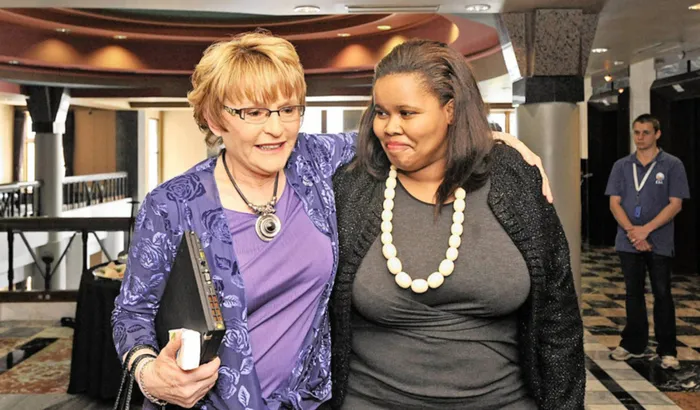
CELEBRATIONS IN ORDER: DA leader Helen Zille embraces the party's new parliamentary leader Lindiwe Mazibuko. Endorsed by Zille ahead of the election, Mazibuko defeated her predecessor Atholl Trollip to become the youngest leader of the opposition in democratic South Africa. Picture: Mxolisi Madela CELEBRATIONS IN ORDER: DA leader Helen Zille embraces the party's new parliamentary leader Lindiwe Mazibuko. Endorsed by Zille ahead of the election, Mazibuko defeated her predecessor Atholl Trollip to become the youngest leader of the opposition in democratic South Africa. Picture: Mxolisi Madela
The meteoric rise of the new DA leader in Parliament, Lindiwe Mazibuko is as much about the transformation of the party as it is about the changes that are taking place within the black community.
Mazibuko has said that the DA’s electoral gains would come from urban voters, especially the three million young South Africans who would vote for the first time in 2014 on whom the official opposition has pinned its electoral hopes to help it win 30 percent of the seats in Parliament in 2014, up from 23 percent currently.
The possibility exists that the DA will gain the additional vote because of the disintegration of the black community which has been brought about by the end of apartheid and the subsequent socio-economic transformation.
The young people that the DA is targeting are the product of this transformation.
Disintegration is happening because black people have lost the glue that held them – forced might be a better word – together. This glue is best captured by Steve Biko’s now famous phrase: Black man you are on your own.
The black consciousness leader knew that he could address himself to people with a shared experience.
It did not matter how rich Richard Maponya was, apartheid said he was black and he had to live where the law decreed black people must live.
Obed Musi, the late veteran journalist, often told the story of a black graduate who tried to buy liquor – through the back of the liquor store obviously. He produced a copy of his degree, only to be asked by the white attendant: “Where is your Standard Eight certificate?”
Apartheid set a bar for all black people: It did not matter how well-educated you were, you needed a Standard Eight (Grade 10) certificate to buy liquor. Apartheid created one common denominator for every black person, ensuring that, irrespective of education levels or income, they all had a common experience.
It is this common experience that the end of apartheid and the birth of the new South Africa have chiselled away. In this, South Africa is not alone. African Americans have undergone similar changes.
Eugene Robinson, a Pulitzer Prize-winning author and journalist, chronicles these changes in Disintegration: The Splintering of Black America.
“Black America has splintered into four groups. They are a mainstream middle-class majority with a full ownership stake in American society; a large, abandoned minority with less hope of escaping poverty and dysfunction; a small transcendent elite with such enormous wealth, power, and influence than even white folks have to genuflect; two newly emergent groups – individuals of mixed-race heritage and communities of recent black immigrants – that make African Americans wonder what black is even supposed to mean.
“These four black Americas are increasingly distinct, separated by demography, geography, and psychology. They have different profiles, different mind-sets, different hopes, fears, and dreams,” writes Robinson. “And where these distinct ‘nations’ rub against one another, there are sparks. The mainstream tend to doubt the authenticity of the emergent, but they are usually too polite, or too politically correct, to say so out loud. The abandoned accuse the emergent – the immigrant segment, at least – of moving into abandoned neighbourhoods and using the locals as mere stepping-stones. The immigrant emergent, with their intact families and long-range mind-set, ridicule the abandoned for being their own worst enemies.
“The mainstream bemoan the plight of the abandoned – but express their deep concern from a distance.
“The transcendent, to steal the old line about Boston society, speak only to God; they are idolised by the mainstream and the emergent for the obstacles they have overcome, and by the abandoned for the shiny things they own. Mainstream, emergent, transcendent all lock their car doors when they drive through an abandoned neighbourhood. They think that abandoned don’t hear the disrespectful thunk of the locks; they are wrong.”
The picture painted by Robinson is similar to that of black South Africa today.
There are differences of course, the most significant of which is that where African Americans are a minority, the people who are referred to as blacks remain the country’s majority.
Interestingly, it is in the places of worship where the signs and the impact of black disintegration are most visible. None other than US President Barack Obama drew attention to this. Reflecting on his days as a community organiser in Chicago, Obama wrote about how the black churches in Chicago were a melting pot where African Americans from all walks of life rubbed shoulders and shared values and information.
He quoted a Reverend Philips explaining to him that one of racial segregation’s hidden blessings was that it forced the lawyer and the doctor to live and worship side by side with the maid and the labourer.
“Like a great pumping heart, the church had circulated goods, information, values, and ideas back and forth and back again, between rich and poor, learned and unlearned, sinner and saved,” Obama wrote in Dreams from My Father.
Except for the odd occasion when South Africa’s black elite and the nouveaux riches visit the townships, especially for funerals and other special ceremonies, the end of apartheid has robbed the township churches of the rich and the learned.
But even in some of the congregations in the northern suburbs where the rich black folks have migrated, they have created a gulf between themselves and lower-class blacks.
Take the Bethesda Methodist Church in Berea, Joburg. It is commonly referred to as the BEE church because of the middle class and the rich black fellows who grace its pews. Bethesda runs two services, one for the elite and the other for the black people who still cling to the old black ways of worship. The service for the elite is conducted mostly in English, runs for a shorter period (about an hour or so), and churns out money like a machine slot on a lucky gambler’s night.
The second service is made up of mostly the poorest members of the congregation. It does however have a sprinkling of the wealthy and the middle classes.
So, instead of being a place where the rich and poor sit side by side, churches are splintering along income groups. Contrast this with what is happening in mosques and synagogues, where segregation along income and wealth is limited. This partly explains why Jewish and Muslim communities remain tight-knit, one of the key factors that explain their prosperity, whether measured by wealth or achievements in education.
We may use different terminology in South Africa to describe the changes Robinson refers to, but the trends are the same. Instead of the mainstream, we speak of black diamonds. South Africa’s emergent also includes a growing number of immigrants from the rest of Africa as well as Asian countries, especially Pakistan. It is these immigrants who, because of their business success, are increasingly becoming victims of xenophobic attacks in the black townships.
When Robinson asked Obama about generational succession and its impact on African Americans, he responded: “I think now young people growing up realise, you know what, being African American can mean a whole range of things. There’s a whole bunch of possibilities out there for how you want to live your life, what values you want to express, who you choose to interact with. I would say that the downside of this is you don’t have the same unifying experience, even though it was a negative experience, of discrimination that let people, at least in the early 1960s, all to be on the same page, or to be largely on the same page in terms of how to make progress as a group.
“And I do think it is important for the African American community, in its diversity, to stay true to one core aspect of the African American experience, which is we know what it’s like to be on the outside, we know what it’s like to be discriminated against, or at least to have family members who have been discriminated against. And if we ever lose that, then I think we’re in trouble. Then I think we’ve lost our way.”
The ANC is trying very hard through its rhetoric to keep alive the black experience, which it sees as its ticket to electoral victory. DA leader Helen Zille, on the other hand, sees her party’s future in the growing number of young black voters for whom being black means a whole range of possibilities.
And Mazibuko, both in her upbringing and in her meteoric rise within the DA, is the embodiment of those possibilities.