

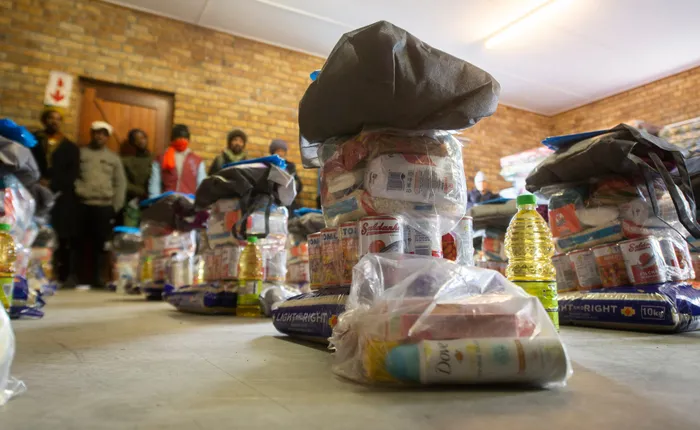
The Gauteng Department of Social Development's decision to centralise food bank operations has left thousands of vulnerable families without food assistance.
Image: Photographer: ArmandHough / African News Agency (ANA)
Thousands of vulnerable families in Gauteng are going hungry after the provincial government centralised food bank operations, leading to significant criticism.
The crisis follows the Gauteng Department of Social Development (GDSD) decision to centralise food bank operations, a move the DA had repeatedly warned against.
In the 2025 State of the Province Address (SOPA), Gauteng Premier Panyaza Lesufi announced a strategic shift towards centralising food bank operations.
This move was aimed at streamlining distribution and ensuring more efficient allocation of resources across the province, as part of a broader initiative to enhance service delivery and address systemic challenges within provincial food security programmes.
However, the DA Shadow MEC for Social Development Refiloe Nt’sekhe has criticised this, citing that the party will table a motion in the Gauteng Provincial Legislature demanding that the GDSD reverse its centralisation policy and decentralise food parcel distribution to ensure vulnerable communities across Gauteng are properly served.
Nt’sekhe added that previously, food parcels were distributed through a network of 288 Non-Profit Organisations (NPOs) and five regional food banks.
“In June 2025, the department announced and eventually implemented its plan to distribute food via a single central food bank, despite the DA's repeated warnings that this would not work and would be costly to those in need.”
She further revealed that the GDSD’s own financial report confirms the DA’s concerns, showing that the department aimed to distribute 53,025 food parcels in the 2024/25 financial year but only managed 34,114, highlighting a significant underperformance in reaching those in need.
She also pointed out that during the first quarter of 2024/25, none of the 434,595 planned pro-poor basket interventions were delivered, with the department citing “delays in supply chain management” as the reason.
“These unacceptable failures make it clear that the department is blighted by poor planning coupled with incompetent financial controls. This makes it difficult for us to believe the department's assurances that it remains committed to making up the supply of all promised items,” Nt’sekhe added.
Sibusiso Bethani, chairperson of a coalition of 260 affected NPOs, said the announcement that the GDSD would centralise food bank operations came as a shock, as the organisations were not consulted.
“We tried to engage with them, to show that the decision they were taking would harm the very communities they are meant to serve. Our warnings went unheeded, and now thousands of vulnerable people are paying the price for poor planning and lack of consultation.”
Bethani further revealed that although the GDSD did distribute food parcels, the items were of poor quality, with many containing rotten products and stained vegetables.
“From our experience with food banks, we know that they are distributing rotten products and stained vegetables. And they don't actually know people who are needy in the communities. So they distribute food parcels to people who are not needy, and then especially people who are not even South Africans.”
He expressed deep frustration over having to inform communities that food parcels would no longer be provided due to budget cuts. He accused the department of mismanagement and corruption, warning that the distribution of food may be politically motivated.
“We’ve approached the MEC, HODs, and even the Premier, but were met with claims of no budget. Meanwhile, the communities we serve continue to bear the brunt,” said Bethani.
He urged the government to restore food parcel distribution to NPOs, emphasising that these organisations are best placed to reach the truly needy.
“The parcels aren’t reaching the right people. NPOs live and work within the communities; they know who genuinely needs help,” he said.
Bethani further revealed that the centralisation of food parcel distribution has left approximately 60,000 children affected, highlighting the severe impact of the department’s decision.
Speaking to The Star in response to the criticism, GDSD spokesperson Motsamai Motlholwa stated that the centralisation of food distribution is a commitment by the Gauteng Provincial Government, as outlined in the State of the Province Address (SOPA).
He further said that the department proceeded with centralisation despite warnings from opposition parties and NPOs, explaining that budget reductions had forced a decrease in the number of food parcels being issued.
When pressed on who should be held accountable for the complete non-delivery of pro-poor baskets in the first quarter, Motlholwa responded that responsibility is dispersed across multiple units within the department, insisting that no single individual or unit can be blamed.
He further added that food distribution is ongoing across the province, with NPOs still playing a role in the process, as the current distribution centres are managed by these organisations, a statement that contrasts sharply with claims made by the DA and Bethani.
The Star
masabata.mkwananzi@inl.co.za