

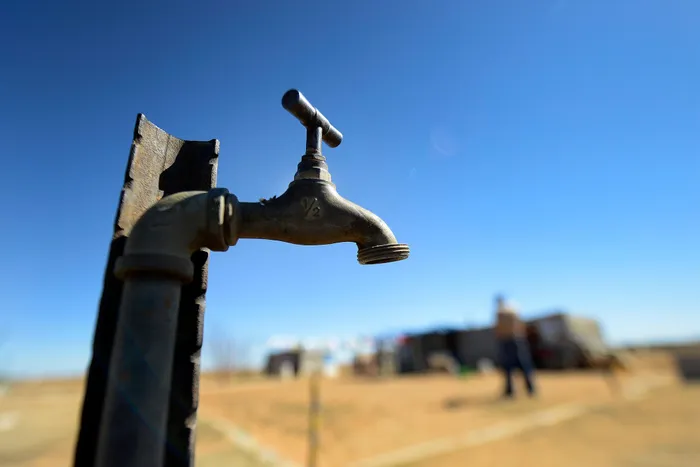
AWSISA's forthcoming Water and Sanitation Dialogue in Johannesburg will bring together 1,500 international experts to create practical solutions for Africa's water crisis as Gauteng struggles with acute water shortages.
Image: Independent Newspapers Archives
As Gauteng faces crippling water shortages, failing infrastructure, and intensifying public protests, the upcoming Africa & Global South Water and Sanitation Dialogue by the Association of Water and Sanitation Institutions of South Africa (AWSISA) arrives at a critical moment.
Themed “Towards Sustainable Water and Sanitation Security in Africa,” the forum aims to confront the continent’s escalating water crisis with innovative solutions, resilience strategies, and policy reforms.
The three-day event, taking place from November 9 to 12 at Emperors Palace in Johannesburg, will bring together over 1,500 leaders, innovators, and policymakers from Africa and beyond to drive actionable outcomes and reshape the future of water and sanitation systems.
The Dialogue is more than a discussion platform; it is a springboard for tangible change. AWSISA Chairperson Ramateu Monyokolo said the gathering is expected to produce a unified continental action plan, underpinned by partner commitments and SDG-aligned resolutions for implementation by governments, utilities, and development partners.
Outcomes will focus on infrastructure investment, institutional capacity building, and cross-border knowledge exchange, tracked through a post-dialogue monitoring framework with dedicated reporting systems and collaboration hubs.
Transparency and accountability are central to AWSISA’s approach. Monyokolo explained that all financing initiatives will follow co-designed frameworks, inclusive consultations, and impact-based procurement processes.
“We are also championing blended finance models that favour scalable, pro-poor infrastructure projects with inclusive community engagement, ensuring benefits reach those most in need,” he said.
The Dialogue will also spotlight groundbreaking technologies to address Africa’s water and sanitation challenges. Innovations such as AI-driven leak detection, solar desalination units, waterless sanitation, and smart metering for rural communities will be showcased. AWSISA, in partnership with the Water Institute of Southern Africa (WISA) and international partners like the Finnish Water Forum, is prioritising local piloting and scaling. A dedicated Innovation Pavilion and a technology-to-impact accelerator fund will help deploy solutions in high-need districts.
Beyond technology, the Dialogue emphasises youth and women in water leadership. Monyokolo explained that inclusion is not a checkbox but a driving force. Through the #WaterLeadershipMatters platform, young professionals, women engineers, and community leaders will actively shape key resolutions.
"Their voices will be captured in a Youth and Women Caucus Declaration, to be adopted into AWSISA’s long-term agenda, complemented by mentorship, leadership training, and bursary programmes to build a more inclusive sector." he said.
Monyokolo said that addressing climate risks is also central to the Dialogue. Sessions like the Climate Resilience Roundtable and Green Infrastructure Financing Panel will equip African countries with strategies such as nature-based solutions, stronger transboundary cooperation, and integrating climate risk into national water planning.
“We will also unveil a Resilient Water Toolkit to guide municipalities on adaptive infrastructure development and community-based water risk reduction,” he added.
With innovation, inclusion, and climate resilience at its core, the Africa & Global South Water and Sanitation Dialogue promise to translate discussions into real-world impact, ensuring that both local communities and broader African water systems benefit from sustainable, equitable, and forward-looking solutions.
The Star
masabata.mkwananzi@inl.co.za