

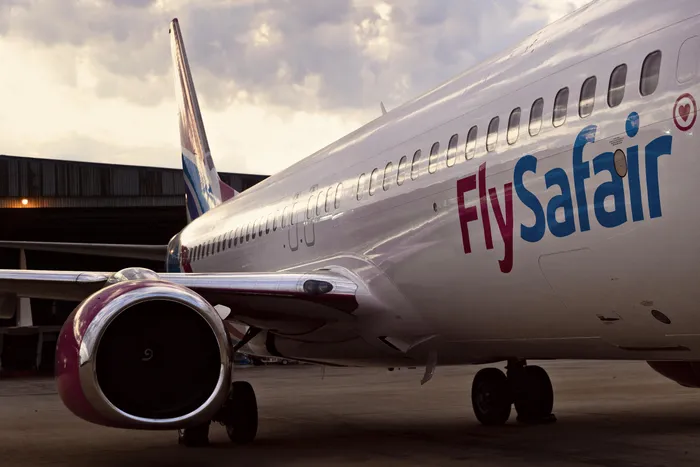
FlySafair has been referred to the National Consumer Tribunal for its overbooking tactics.
Image: Supplied/FlySafair
South Africa’s consumer watchdog has dragged low cost airline FlySafair before the National Consumer Tribunal over allegations that it overbooked and oversold flight tickets, leaving paying passengers stranded despite holding confirmed bookings.
The National Consumer Commission (NCC) confirmed on Wednesday that it has referred Safair Operations (Pty) Ltd, trading as FlySafair, for alleged contraventions of the Consumer Protection Act following an investigation into mounting complaints against the airline.
NCC spokesperson Pheto Ntaba said the probe was launched after growing public outrage, including complaints circulating widely on social media, over claims that passengers were denied boarding because flights had been oversold.
“The matter first drew public attention after a consumer reportedly purchased a FlySafair ticket and, upon arrival to check in, was informed that no seat was available because the flight had been overbooked,” Ntaba said.
The case now places one of South Africa’s busiest domestic airlines under intense scrutiny, with the tribunal expected to determine whether the airline violated consumer rights protected under the CPA.
“The NCC further noted several complaints by consumers who alleged that they had experienced the same issue with the airline. The airline publicly acknowledged that overbooking is part of its business practices,” Ntaba said.
The NCC’s investigation revealed that FlySafair’s conduct contravened sections 47, 48(1), 49(1), 22(1), 40(1), 41(1), and 19(2) of the CPA.
“These provisions deal with prohibitions including overselling of services, unfair and unreasonable contract terms, inadequate disclosure of material risks, misleading representations, unconscionable conduct, failure to provide services on agreed terms, and failure to communicate information in plain language,” Ntaba said.
The investigation assessed bookings made during November and December 2024 and January 2025.
“The investigation revealed that the overbooking or overselling of flight tickets was systematically implemented by FlySafair. The investigation further revealed that overbooking averaged up to over 5,000 passengers in the months assessed, earning the airline significant revenue that it would not have earned if it were not for this practice,” Ntaba said.
The NCC has referred the matter to the Tribunal for adjudication and for the imposition of an administrative penalty of 10% of FlySafair’s annual turnover and to have the airline’s conduct declared prohibited.
Acting Commissioner for the NCC, Hardin Ratshisusu, said: “The NCC’s investigation has found FlySafair’s booking practices to be inconsistent with multiple sections of the CPA, which is the basis of the referral of the matter to the Tribunal. The CPA prohibits suppliers from taking consumers' money for goods or services they cannot provide.”
In response to the referral, FlySafair welcomed the opportunity to fully present its position before the Tribunal.
Chief Marketing Officer at FlySafair, Kirby Gordon said the airline cooperated fully with the NCC during its investigation and the Tribunal process is the appropriate forum for resolving differences in legal interpretation between FlySafair and the NCC.
“We remain confident that, on a full consideration of the facts, the legal framework and prevailing industry practice, it will be demonstrated that FlySafair has acted lawfully, transparently and in good faith, with due and careful regard to the rights of consumers,” Gordon said.
He said a number of important facts remain central to this matter:
Gordon said while approximately 5,000 customers were on overbooked flights during the period assessed, the vast majority travelled exactly as booked because the anticipated no-shows materialised as expected.
“As a result, only 0.02% of passengers were denied boarding and every one of them was offered reaccommodation, a refund, and compensation. 93.3% of flights over that period departed on time, and no flights were cancelled,” he said.
Gordon said the airline cooperated with the NCC investigation over an extended period and provided extensive operational data and information throughout the process.
“We will continue to engage constructively and transparently through the Tribunal proceedings. FlySafair will continue to operate all scheduled flights as normal, and customer bookings remain unaffected. As the matter is now before the Tribunal, it would not be appropriate to litigate the detailed merits of the case through the media, and FlySafair will therefore refrain from further substantive public comment at this stage,” Gordon said.
robin.francke@iol.co.za
IOL