

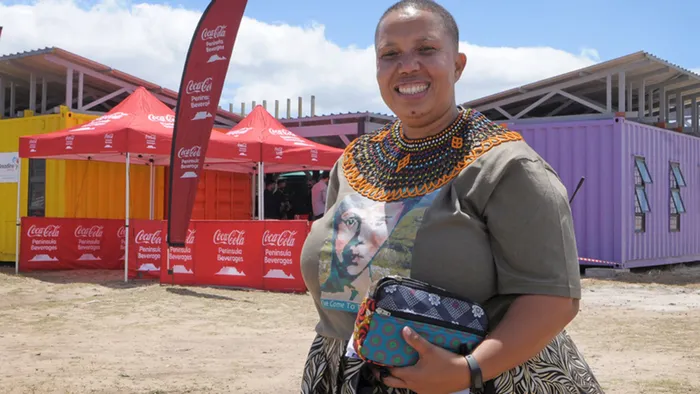
Lucinda Evans
Image: File
For women’s rights activist Lucinda Evans from Lavender Hill, a recent conversation with fellow South African Charlize Theron was more than just an interview marking International Women's Day it was a moment that highlighted the power of women recognising and uplifting each other across continents.
Evans, the founder of Philisa Abafazi Bethu, says her relationship with Theron’s foundation began during one of the most difficult periods in recent history.
“The Charlize Theron Africa Outreach Project found us in 2020 during the heart of COVID when we were building the centre in Steenberg,” Evans explained. “When Charlize’s Africa coordinator Jessie found us, the first funding we received was to get toiletry packs for women.”
That early support laid the groundwork for a connection that would later see Evans interviewed by Theron during International Women’s Month, a conversation Evans describes as both deeply meaningful and symbolic.
“Her interview with me during International Women’s Month…I’m grateful we found each other,” Evans said. “The fact that she could speak globally about what we are doing in Cape Town, in Steenberg, in Lavender Hill, when it comes to the empowerment of women.”
For Evans, who has spent more than 15 years confronting gender-based violence and advocating for women in vulnerable communities, the recognition carries particular weight.
“In our own country, even with gender-based violence being a national disaster, there has not been extra support for the work that I do,” she said. “In fact, I think I’m still being marginalised because I speak out. I hold people accountable. I hold our government accountable.”
Yet the conversation between the two women went far beyond recognition. It centred on a shared belief that collective leadership among women is essential to creating real change.
“I think the alignment that we had was that it is collective women’s leadership that’s going to save not just South Africa, but the entire world,” Evans said. “But we must also acknowledge that sometimes women can be other women’s enemies so how do we work around that? How do we create safer spaces?”
Creating those spaces has been the driving force behind Evans’ work through Philisa Abafazi Bethu. Her organisation focuses on building environments where women can find emotional, political and physical safety.
“I am creating safer spaces political spaces, emotional spaces, physical spaces, psychological spaces for women,” she said.
But Evans believes awareness alone is not enough.
“We are still not speaking about it enough. We are still not acting,” she says. “We act too late. We feel it’s none of our business. We have to speak more. We have to act more. We have to report more.”
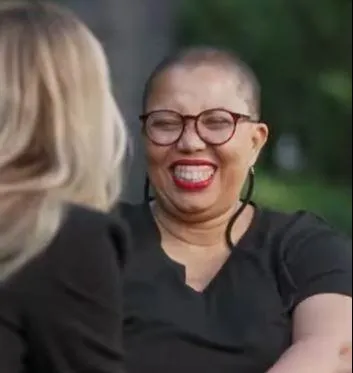
Lucinda Evans during her interview with Charlize Theron
Image: Video grab
The global spotlight created by the interview has opened new doors, but Evans says meaningful change requires resources.
“What this interview has done is create awareness on a broader platform,” she says. “But we need awareness with a monetary footprint.”
With what she calls “R20 million in un-earmarked funding”, Evans believes her organisation could dramatically expand its reach even becoming a national organisation supporting women across South Africa.
Despite the challenges, the moment of sharing a global platform with Theron was deeply personal.
“That was my moment of being very emotional, but thankful to God,” Evans said. “My gratitude to God that I am that coloured goose paving the way for other coloured goose-se in whichever career field they want to go into.”
Evans reflects proudly on her own journey from her childhood in District Six, to being forcibly relocated to Lavender Hill, and eventually building a movement for women.
“I am a brown woman born in District Six, thrown out of District Six, taken and chucked in the barren land called Lavender Hill,” she says. “I found the lavender. I made lavender. I’m still about the lavender for the hills.”
She says the conversation with Theron symbolised two women recognising each other’s influence one from the global stage and the other from the grassroots.
“She shared her space with me and I shared my space with her,” Evans said. “Even if our global stage is a little old centre made of shipping containers.”
Looking ahead, Evans hopes the momentum generated by the interview will translate into partnerships, funding and long-term impact.
Her next ambition is ambitious but deeply rooted in prevention.
“One of the last projects I want to do is build a primary school,” she said. “Gender-based violence prevention has to start with younger children.”
For Evans, investing in women and communities is not charity it is a long-term investment in society.
“It is time that you invest your money in humanitarian programmes,” she said. “The dividends you will see is the change in people’s lives. The dividends we will reap for years are healed families.”
And she has one final call not just to women, but to men with influence and resources.
“Globally, women are under siege. Women are at risk. Women are being killed and raped,” Evans said. “It is time for the good men in business, the good men in the hotel industry, the men who have money, to come and invest and help us heal women and men.”
tracy-lynn.ruiters@inl.co.za