
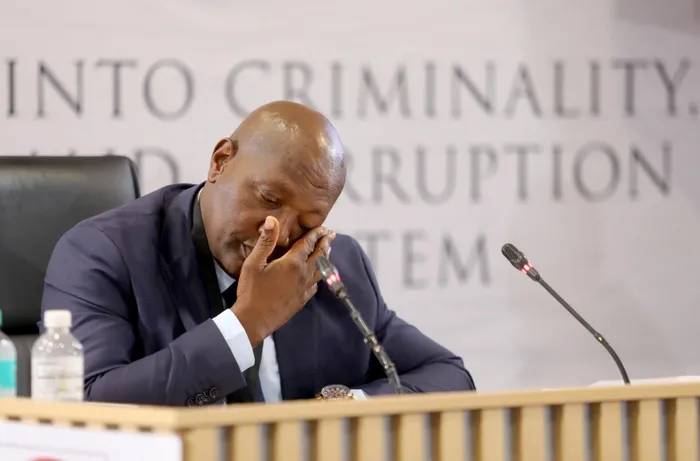
Madlanga Commission of Inquiry witness Major-General Richard Shibiri testified at the Madlanga Commission of Inquiry on Friday.
Image: Oupa Mokoena / Independent Newspapers
Suspended SAPS crime boss Major Geneneral Richard Shibiri stunned the inquiry with a series of contradictory statements about Lieutenant General Shadrack Sibiya’s alleged faction and its possible ties to the notorious “Big 5” cartel, but he did not want to reveal the names.
Shibiri’s testimony at the Madlanga Commission on Friday revealed deep divisions within the police leadership and raised questions about whether internal rivalries are compromising investigations into organised crime.
The commission is probing claims of internal power struggles within the SAPS and alleged connections to the so-called “Big 5” cartel.
Central to the confrontation was a recorded phone call in which Shibiri suggested that information about the arrest of Katiso “KT” Molefe was being sought for “the other side” rather than for National Commissioner Gen Fannie Masemola.
When the recording was played before the commission, Shibiri initially confirmed that “the other side” referred to Sibiya’s faction inside the police service.
However, his explanation shifted under questioning.
Sibiya is accused of having close links to the cartel members.
Justice Mbuyiseli Madlanga challenged Shibiri on why his interpretation of the phrase later changed.
Shibiri attempted to retract his earlier statement, claiming he had meant “family and friends” connected to the suspect rather than a faction inside SAPS.
Madlanga rejected the explanation, pointing out that Shibiri’s earlier wording clearly suggested an internal divide within the police leadership.
Under sustained questioning, Shibiri conceded that he had not been truthful about that detail, a moment that raised serious concerns about his credibility.
“I was overwhelmed,” Shibiri told the commission after being confronted with the contradiction.
Pressed further about who he meant by “perpetrators”, Shibiri said he was referring broadly to people aligned with Sibiya, but insisted he could not name them because he had no proof.
The commission indicated that the explanation did not match his earlier statements.
The inquiry also questioned Shibiri’s actions after the December 6, 2024, arrest of Molefe, a suspected figure linked to organised crime. Despite being on leave at the time, Shibiri actively sought updates about the case.
He told the commission he phoned Witness A on December 7, 2024, to obtain information and also contacted Nama, head of the serious violent crime unit.
But Witness A denied receiving the call, creating further doubts about Shibiri’s timeline. Commissioners also questioned why Shibiri was following up on the case while he was not officially on duty.
Evidence showed that Shibiri suggested crime intelligence head Lt-Gen Dumisani Khumalo obtain the arrest report through other channels.
Co-commissioner Sesi Baloyi said this created a “vacuum” in the process.
She asked why Shibiri did not simply allow the acting officer in charge to handle the matter if Sibiya required a report.
More inconsistencies emerged when Shibiri said he wanted complete information about the arrest, but admitted he never asked what Molefe had been arrested for and had not seen the docket.
Evidence leader Adv. Segeels-Ncube and co-commissioner, Sandile Khumalo, argued that the explanation failed to clarify whether Shibiri was seeking information for operational reasons or attempting to pass it on to others.
Evidence before the commission suggested there may be two rival camps within the SAPS leadership, one aligned with Masemola and another linked to Sibiya.
Despite the recordings and testimony, Shibiri denied belonging to any faction.
“Factions put me where they want me, but I am not part of anybody,” he told the commission.
The inquiry also heard recordings in which Shibiri suggested that Sibiya had close ties to influential political figures, including Economic Freedom Fighters (EFF) leader Julius Malema.
The proceedings are underway.