

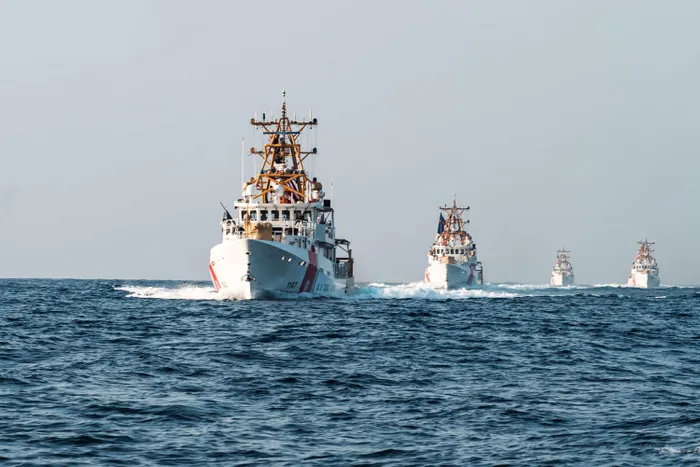
Donald Trump said the blockade would only apply to vessels travelling to or from Iranian ports.
Image: Noah Martin / Various Sources / AFP
Hezbollah leader Naim Qassem on Monday urged Lebanon to cancel a planned meeting with Israel in Washington the following day, reiterating his group's rejection of direct negotiations with Israel.
"We reject negotiations with the usurping Israeli entity... We call for a historic and heroic stance by cancelling this negotiating meeting," Qassem, whose Iran-backed group has been at war with Israel since March 2, said in a televised address.
The Lebanese and Israeli ambassadors to the United States are scheduled to meet in Washington on Tuesday to discuss holding direct negotiations between the two countries.
France and Britain will work on a "peaceful multinational mission" to restore traffic through the Strait of Hormuz but it would be "separate from the warring parties", French President Emmanuel Macron said Monday.
US-Israeli strikes on Iran in late February sparked a region-wide war and brought traffic through the Strait of Hormuz, a key route for global oil and gas shipments, to a near standstill.
Iran and the United States last week agreed to a two-week cessation of hostilities, but ceasefire talks between the warring sides in Pakistan on the weekend ended in failure.
US President Donald Trump responded by ordering his navy to carry out a blockade of the Strait of Hormuz starting Monday.
Trump also said, on his Truth Social platform, that "Other Countries will be involved with this Blockade" but did not specify which ones.
The UK-French initiative, which Macron announced on X, appeared to be separate from Trump's announced blockade.
"In the coming days, together with the United Kingdom, we will organise a conference with those countries prepared to contribute alongside us to a peaceful multinational mission aimed at restoring freedom of navigation in the strait," Macron said.
"This strictly defensive mission, separate from the warring parties to the conflict, is intended to be deployed as soon as circumstances permit."
The US military said the blockade ordered by Trump would begin at 1400 GMT, and apply to all ships leaving or seeking to dock at Iranian ports on either side of the key waterway.
UK Prime Minister Keir Starmer said Monday that Britain will not join the naval blockade of the Strait of Hormuz announced by Trump.
Russia is ready to take in Iran's enriched uranium as part of a future peace deal with the United States, the Kremlin said on Monday.
Failed talks between Iran and the United States over the weekend dashed hopes of a swift deal to permanently end the war that has killed thousands and thrown the global economy into turmoil since it began in late February.
Russia, which possesses the world's largest stockpile of nuclear weapons, has repeatedly offered to host Iran's enriched uranium as part of any peace deal.
"This proposal was voiced by President Putin in contacts with both the United States and regional states. The offer still stands, but has not been acted upon," the Kremlin's spokesman Dmitry Peskov told reporters on Monday in response to a question by AFP.
The Kremlin also criticised Trump's threat to blockade the Strait of Hormuz, a key waterway that has been at a standstill since the US and Israel began striking Iran in late February.
"Such actions will likely continue to negatively impact the international market," Peskov said.
Oil prices surged, and stocks sank on Monday after US-Iran peace talks fell apart and Donald Trump announced a blockade of the strategic Strait of Hormuz, adding to fears of energy supplies from the Middle East.
Negotiations in Islamabad at the weekend fell apart with the US delegation — led by Vice President JD Vance — blaming Iran's refusal to give up its nuclear programme and Tehran hitting out at "maximalism, shifting goalposts, and blockade".
The news dealt a blow to hopes for an end to the six-week conflict, which has sent crude prices soaring, pushing inflation up and sending shivers through the global economy.
Oil prices — which tumbled last week after the United States and Iran agreed to a ceasefire — jumped around eight percent Monday, with both contracts topping $100 a barrel.
Equities fell across Asia, with Tokyo, Hong Kong and Seoul off at least one percent, while Shanghai, Sydney, Singapore, Taipei and Jakarta were also down.
In a lengthy social media post, US President Donald Trump said his goal was to clear the strait of mines and reopen it to all shipping.
But he said that Iran must not be allowed to profit from controlling the waterway — through which a fifth of global oil and gas usually passes.
"Effective immediately, the United States Navy, the Finest in the World, will begin the process of BLOCKADING any and all Ships trying to enter, or leave, the Strait of Hormuz," Trump wrote on Truth Social.
"Any Iranian who fires at us, or at peaceful vessels, will be BLOWN TO HELL!"
He said the blockade would only apply to vessels travelling to or from Iranian ports.
The US military said Sunday it will blockade all Iranian Gulf ports on Monday at 1400 GMT, effectively seizing control of maritime traffic.
Iran's Revolutionary Guards said its security forces had full control over the strait and warned enemies would be trapped in a "deadly vortex" in case of any "wrong move".
Iran's navy chief Shahram Irani called Trump's threat "ridiculous and funny", according to state TV.
After the talks — the highest-level meeting between the two sides since the 1979 Islamic revolution — Vance said Washington had made Tehran its "final and best offer," adding: "We'll see if the Iranians accept it."
Iran's Foreign Minister Abbas Araghchi said the rivals had been "inches away" from a deal, writing on X that "Iran engaged with US in good faith to end war".
But he added "we encountered maximalism, shifting goalposts, and blockade".
Nicole Grajewski, an assistant professor at the Center for International Research at Sciences Po in Paris, warned that a US blockade was "not a minor coercive signal" but would rather be considered an effective resumption of the war.
Fawad Razaqzada, a market analyst at Forex.com, said: "The fundamental issue remains trust — or rather, the lack of it — between two long-standing adversaries who still appear some distance from common ground."
Investors are also keeping an eye on attempts to resolve the conflict between Israel and Hezbollah, as Lebanese Prime Minister Nawaf Salam said he was pushing to ensure the withdrawal of Israeli forces.
"We will continue to work to stop this war, to ensure the Israeli withdrawal from all our lands, the return of all the prisoners, to rebuild our destroyed villages and towns, and the safe return of the displaced," Salam said.
The prospect of the Middle East crisis continuing for the foreseeable future ramped up inflation fears and weighed on gold amid expectations that interest rates would be kept elevated.
Data Friday highlighted the impact of the conflict on prices, with the US consumer price index spiking at 3.3 percent in March, its highest since May last year.
AFP