

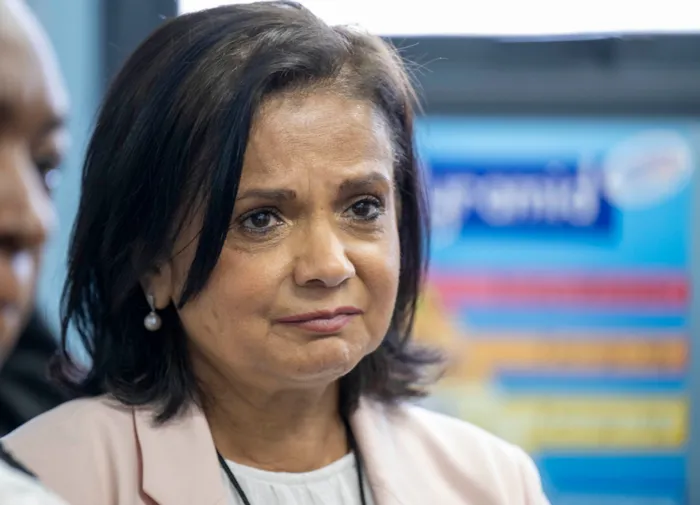
Former National Director of Public Prosecutions Advocate Shamila Batohi who testified before the TRC Cases Inquiry last week.
Image: Henk Kruger / Independent Newspapers
The role of the National Prosecutions Authority (NPA) in the “TRC cases” saga is beginning to crystalise before the Khampepe Commission which resumes on Wednesday.
Former National Prosecutions Authority (NPA) spokesperson Advocate Mthunzi Mhaga denied having any “personal” knowledge or experience of political interference in the investigations or prosecutions of the so-called TRC cases – a batch of more than 300 gross human rights abuses cases referred to the Truth and Reconciliation Commission (TRC) in 2003.
Mhaga emphasised that he was making the statement with regards to only those cases he personally handled.
Testifying on Friday, Mhaga, now a special director in the National Director of Public Prosecutions (NDPP) office in Pretoria, said he was no longer involved in the cases but assisted on an “ad-hoc basis”. He said he remained committed to help and was of the view that South Africa owed it to those who fought for the freedom enjoyed today.
Testifying ahead of Mhaga, the most recent former NDPP, Advocate Shamila Batohi, confirmed that the NPA subscribed to the view that there was indeed, in the early years, some political interference in the cases.
Responding to a question by Advocate Howard Varney, representing the Calata group of families of victims involved in some of the TRC cases, Batohi confirmed that this remained the official position, at least until she left in January this year.
Varney asked Batohi to shift her focus back to her evidence regarding the judgment. She had testified that the judgment referred to “political interference having materially affected the ability of the NPA to properly deal with the TRC cases, in that the resources that were necessary to conduct investigations were not forthcoming”.
Lukhanyo Calata, son of one of the Cradock Four activists killed by the apartheid government's agents in 1985, Fort Calata. He believes that the Khampepe Commission of Inquiry is the "last hope" for his and other families of the victims of the apartheid-era human rights violations made to wait for years in vain for justice or closure.The commission's public hearings resume on Wednesday.
Image: Timothy Bernard / Independent Newspapers
Batohi admitted that in the initial years, before her term in office, the NPA was subjected to political interference in respect of the TRC cases. She confirmed that at the time of her leaving office, the NPA’s position in respect of this previous political interference had not changed.
The judgment was a result of an application for a permanent stay of prosecution by Joao Rodrigues, a former apartheid-era security police operative who was charged with the 1971 murder of liberation activist Ahmed Timol.
The Rodrigues judgment made findings of political interference, and since then has not been challenged by the NPA.
Rodrigues, who has since died aged 82, had applied for the stay in proceedings against him arguing that that the delays in the case interfered with his right to a fair trial. But representatives of the Timol family contended that the delays were due to political interference exerted to prevent the investigation and prosecution of this and other TRC cases, an argument which was accepted by the court.
Mhaga also confirmed that his work on the TRC cases was frustrated by the lack of resources, especially the lack of investigators. He said he had to improvise and leverage on friendships in the criminal justice community to get his job done.
“It was extremely difficult to manage and deal with TRC cases due to the absence of investigative officers dedicated to this work. In the absence of any formal arrangement with SAPS, I would approach detectives with whom I had worked while prosecuting in the Eastern Cape, requesting their assistance in cases that fell within their regions,” he said.
In conclusion, he reiterated that he never personally experienced any political interference in his work with TRC cases.
“I can state that during my time handling TRC cases and serving in the TRC Task Team I never experienced any attempt or efforts to influence or pressure me to stop investigating or prosecuting TRC cases,” he said.
However, he said he considered the conduct of one of his former supervisors, in respect of a particular case, “to have been obstructive”.