

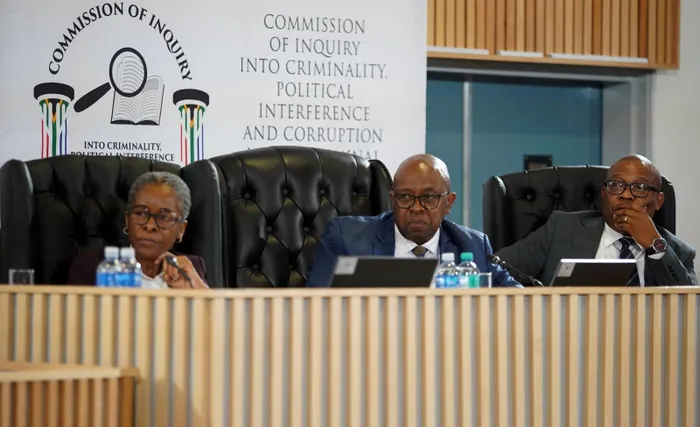
Proceedings involving Witness G have been closed to the public after the commission said partial open hearings were no longer feasible, following repeated objections over the risk of identification.
Image: Oupa Mokoena / Independent Newspapers
The chairperson of the Madlanga Commission, Justice Mbuyiseli Madlanga, has ruled that all proceedings involving a key crime intelligence witness, known as Witness G, will now be held in camera, due to security and practical concerns.
Madlanga said a prior directive issued on April 24, 2026, which allowed Witness G’s testimony to be heard partly in public and partly in camera, had become impractical.
He therefore withdrew the order and replaced it with a ruling for fully closed proceedings.
“One problem is that the order of 24 April 2026 said the testimony would be partly in camera, in the sense that the witness’s testimony would not be heard by members of the public, and also partly in camera but to be heard by members of the public,” Madlanga said.
“There is a standing order to that effect. I have to recall that order, and I do so purely because, as I have explained, it has become impractical for us to proceed along those lines. For that reason, we will now proceed fully in camera.”
Madlanga apologised to the public and the media for the change.
Witness G, is believed to be involved in crime intelligence operations with agents and informants.
Her lawyer, Tshepo Matlala, also indicated that she preferred to testify remotely and off camera.
She has given evidence relating to alleged criminality, political interference and corruption within the criminal justice system.
During proceedings, evidence leader Matthew Chaskalson SC said he was experiencing technical difficulties hearing the witness, leading to an adjournment.
The session later resumed at 11:30, but further complications followed.
Chaskalson asked Witness G to read parts of her testimony into the record.
She refused, saying she feared for her safety and that the material contained names that could identify her.
“I can’t give them aloud. They have got people’s names that are attached to me,” she said.
Chaskalson said the commission would need to resolve the matter before substantive questioning began, noting that many of his questions would involve relationships between Witness G, North West businessman Brown Mogotsi and other individuals.
“I think we need to resolve this issue now rather than when we get to the intrusive questioning,” he said. “If these are issues we cannot mention publicly, then most of my questioning is going to touch on issues that cannot be mentioned publicly.”
He added that the commission may need to determine whether all proceedings should continue in camera.
Matlala suggested it may be necessary to identify which names could not be mentioned publicly in order to prevent inadvertent identification of the witness.
“I know the adjournments are very tiring, but I think it might be an exercise we need to do so that we have a list of people that should not be mentioned if we have to do it that way,” he said.
Mogotsi, a North West businessman and self-described informant, has emerged as a central and contentious figure in policing circles.
He has been described as a go-between for suspended police minister Senzo Mchunu and alleged “Big Five cartel” member businessman Vusimuzi “Cat” Matlala.
Mogotsi said he became a crime intelligence informant in the 1990s and has remained an agent in various capacities.
He said he was first recruited in 2001, served for five to 10 years, and was later deregistered between 2001 and 2003 due to inactivity.
He added that he was again recruited in 2009 as a contact agent, marking his transition from informant to agent, and claimed to have participated in operational activities during his tenure.
simon.majadibodu@iol.co.za
IOL News