

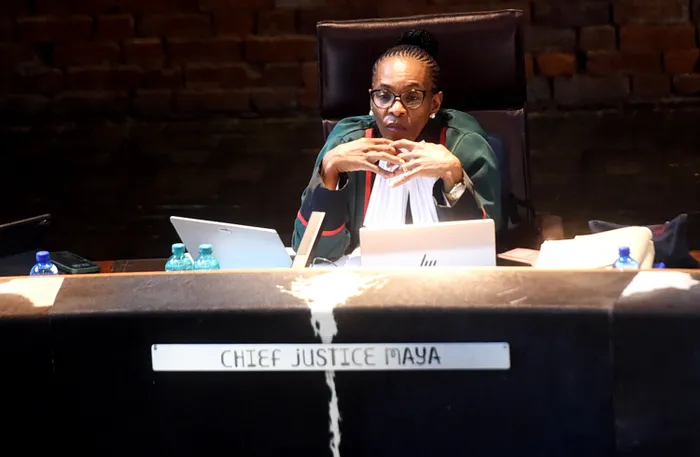
The Constitutional Court heard cases concerning South Africa’s controversial National Health Insurance (NHI) scheme. The case was brought by the Western Cape Provincial Government and the Board of Healthcare Funders (BHF), challenging the drafting of the Act.
Image: Itumeleng English / Independent Newspapers
After two days of hearings, the Constitutional Court has reserved judgment on the National Health Insurance (NHI) Act matter in which the Board of Healthcare Funders (BHF) and the premier of the Western Cape Government (WCG) seek to have the Act set aside.
The two parties placed their arguments before the apex court this week in which they said Parliament disregarded its own processes by not engaging a meaningful public participation process before the creation and passing of the Act.
On Wednesday, counsel for WCG, Geoff Budlender SC, contended that in at least two provinces, the National Council of Provinces (NCOP) breached processes and in so doing failed to provide an opportunity to influence the law-making process.
The WCG contended that, in the Western Cape where vigorous engagements were held, the timetable was unduly curtailed and unreasonable, as it requested further engagements but was denied the opportunity.
This was in stark contrast to Gauteng province, where the NCOP had not been transparent about whether it had received a report from the Select Committee on Health and Social Services, detailing where and who the representatives were that attended the meetings, and whether any were held at all.
Budlender SC stated that in the absence of reports or an affidavit from Gauteng's select committee representative who attended and can account for the engagements held, there was a failure of compliance, and its “silence is deafening”.
Budlender SC said the National Assembly and the NCOP “must do what’s required of them”, arguing that the Act be remitted back to Parliament to re-enact the law in a “competent manner”.
Responding to Acting Justice Narandran Kollapen’s question on whether the process should be regarded as that which was done and that which was not done, or viewing it cumulatively, Budlender SC said: “It is correct to look at the whole picture. Reasonableness must be viewed on the broad. But that’s subject to qualification, which is that the law, as is explained by this court, is that there are some immutable elements of the process.
“If the process but for one or two key things which are essential, which are not done, that is what upsets the apple cart.”
Rebutting the arguments made by the WCG, Parliament, and the Minister of Health, submitted that a parliamentary portfolio committee had afforded the public three months to submit written comments on the Bill, and in this process, the committee received 338,891 written submissions.
From October 26, 2019, to February 24, 2020, the portfolio committee conducted public hearings across all nine provinces. They held around 33 hearings, with as many as four in each province. More than 11,500 people attended, and over 950 oral submissions were made.
Additionally, the portfolio committee organised 29 virtual meetings between May 2021 and February 2022, where about 114 stakeholders presented oral submissions, along with written documents.
On this basis, the Minister of Health said public views did filter through by multiple channels and that the public participation process was held.
President Cyril Ramaphosa has agreed to delay the proclamation of key sections of the NHI Act until the Constitutional Court hands down its judgment.
Western Cape MEC for Health and Wellness, Mireille Wenger, said that this hearing is critical in protecting the rights of residents of the Western Cape to be heard on a matter that goes to the heart of their healthcare.
“The NHI Act proposes sweeping reforms to South Africa’s health system, directly affecting how healthcare services are governed and delivered. It is essential that such reforms be shaped through meaningful public participation that our constitution requires.”
Wenger said Parliament has a constitutional obligation to hear the voices of communities when legislating on matters that affect fundamental rights like the right of access to healthcare.
chevon.booysen@inl.co.za