

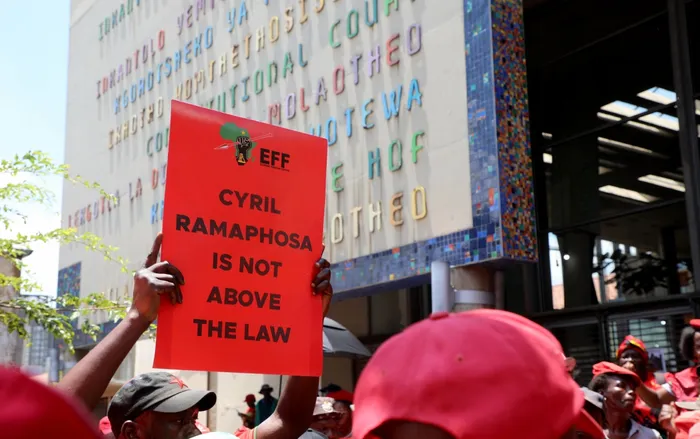
The Constitutional Court is expected to deliver the much-awaited Phala Phala judgment.
Image: Timothy Bernard / Independent Newspapers.
As the Highveld autumn morning breaks on Friday, with a cold breeze permeating the air of Braamfontein, the world holds its breath, and all eyes will be glued to the Constitutional Court.
By 8am, the stone plaza outside South Africa's Constitutional Court will begin to fill, and EFF supporters in red berets will be clustering near the entrance on Kotze Street. ANC supporters and civil society activists will drift into the plaza carrying placards and banners.
Television crews will be staking out positions along the sandstone walls, and civil society activists will be unfurling banners. At 10am on Friday morning, Chief Justice Mandisa Maya and her fellow justices will deliver the judgment South Africa has been waiting 521 days to hear.
To arrive at Constitutional Hill is to understand immediately that this place was designed to mean something.
The court was built using bricks from the demolished awaiting-trial wing of the former prison. Most of the old prison's stairwells were kept and incorporated into the new building as a reminder of the Constitution's transformative aspirations.
Inside the main chamber, a row of horizontal windows sits at head height on the inside, but at ground level outside, so those in the courtroom see the feet of passersby moving above the judges' heads. A deliberate reminder, set in glass and stone, that justice serves the people.
Nelson Mandela was held here. Mahatma Gandhi was held here. The Flame of Democracy burns outside the wooden entrance doors, lit in 2011 to mark the anniversary of the Constitution's signing. This morning it burns as it does every morning. The question before the court today is whether the document it represents burns as brightly.
The matter traces back to the February 2020 burglary at Ramaphosa's Phala Phala game farm in Limpopo, in which a large sum of foreign currency, reportedly around $580,000, was stolen from furniture at the President's private residence. A burglary the world would not have known about, had Sunday Independent not broken it on IOL.
Ramaphosa maintained that the money was a payment from a Sudanese businessman for the purchase of 20 buffalo. The Section 89 Independent Panel, chaired by former Chief Justice Sandile Ngcobo, found significant gaps in that explanation, including why the animals remained on the farm over two years later and the absence of official tax records.
The panel found prima facie evidence that Ramaphosa may have committed serious constitutional violations: failure to report the theft through proper legal channels, potential conflict of interest through active involvement in private business, and abuse of office through a secret investigation that reached as far as Namibia. IPID confirmed the transgressions, finding that "Major General W.P. Rhoode failed to register or ensure that a case docket of housebreaking and theft was opened." Rhoode remains the head of the Presidential Protection Unit today.
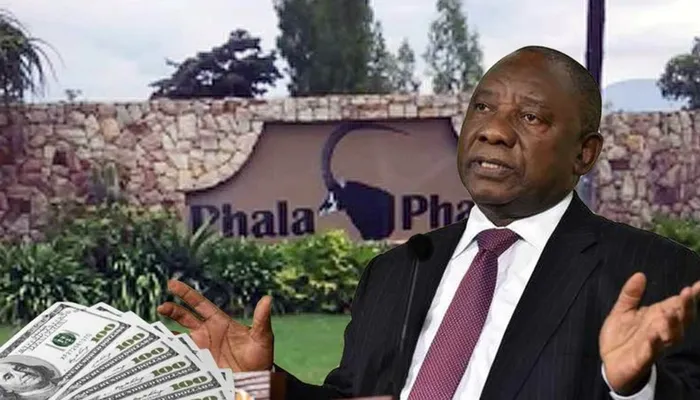
President Cyril Ramaphosa is set to know his fate today when the Constitutional Court delivers its verdict on the matter brought by the EFF.
Image: IOL
The panel recommended a full impeachment inquiry. Parliament buried it. On December 13, 2022, the National Assembly voted 214 to 148 against adopting the report, with the ANC majority defending the decision. The EFF took that vote straight to the Constitutional Court, arguing that Rule 129 of the National Assembly's impeachment procedures, which gives Parliament discretion to reject a Section 89 panel report, is unconstitutional, as it allows political majorities to override independent findings and shut down accountability before it begins.
Political analyst Professor Ntwanano Mathebula does not reach for comfortable language when describing what today's ruling means.
"So there is a lot that we can expect in the ruling by the Constitutional Court. But of course, we cannot shy away from the fact that the EFF has been complaining about the delays in the justice system, which is warranted if you look at the period during which this case has been ongoing. But this is a case for accountability," he said.
Mathebula is direct about the stakes. "If the Constitutional Court were to find against the sitting president, it would be a win and a gain for the democracy, the Constitution, and, of course, the important principles of accountability. But if we don't see that, it also says that the state apparatus is unable to hold particularly prominent politicians and the head of the executive, who is the president, to account. And that would be very sad for the Constitution," he said.
Mathebula does not disguise what he expects. "The Constitutional Court is likely to protect the president. We have seen in various courts where the president, even though there's prima facie evidence of a case to be answered, has been shielded." He invokes history: "We are reminded of the Nkandla issue." And he is blunt about Parliament's failure: "We have seen how the Section 89 panel report has been shoved aside using the majority that the ANC has."
His conclusion is sobering: "We are expecting that the Constitutional Court would dismiss the matter and the president will be let free, which, as I've already said, will be a defeat for the Constitution and accountability."
By 9.30am this morning, the plaza at Constitution Hill will be full. The people who will be gathered there with their placards and their cameras and their quiet anxieties about what their country is becoming are, in a small way, the entire point. They are the feet visible through the windows above the judges' bench. They are the people this court was built to serve.
At 10am today, in a chamber made from the bricks of a demolished prison, South Africa will find out what its Constitution means when tested against the most powerful office in the land.
karabo.ngoepe@inl.co.za
IOL