

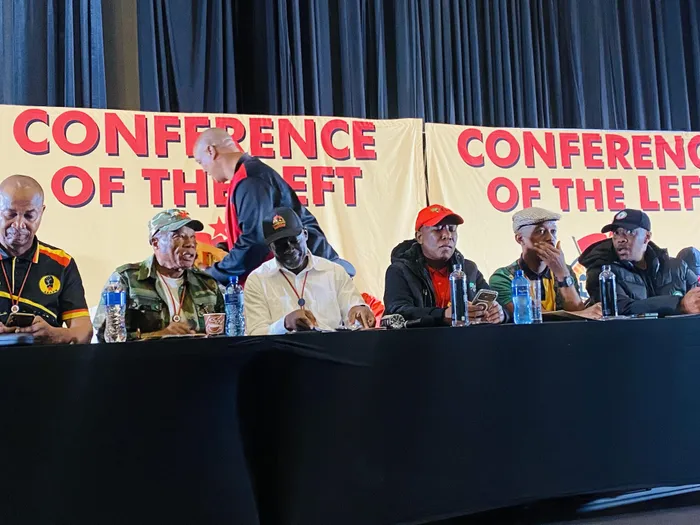
The SACP's Conference of the Left has declared the rising cost of living as the main battleground in the conflict between social classes.
Image: Simon Majadibodu/IOL
The working class is forced to bear the burden of an economic system that prioritises wealth extraction over human dignity.
The Conference of the Left, which held its inaugural gathering at the weekend, has declared the escalating cost of living a central terrain of class struggle.
The declaration comes as South Africa faces a structural crisis characterised by mass unemployment (hovering around 43.7% overall and over 71% for youth), deepening poverty, and severe inequality.
The three -day conference, was hosted by the South African Communist Party (SACP) at Birchwood Hotel in Boksburg, Ekurhuleni, from Friday to Sunday.
The conference was attended by a broad coalition of leftist and progressive organisations, including the Economic Freedom Fighters (EFF), the Umkhonto weSizwe (MK) Party, the Pan Africanist Congress (PAC), the Azanian People's Organisation (AZAPO), and the Congress of South African Trade Unions (COSATU).
Several smaller parties, labour federations, Marxist and Pan-Africanist groups, and social movements also participated.
The ANC boycotted the conference as it viewed the gathering as a strategic attempt by rival factions to attack, weaken, and dismantle the ANC-led Tripartite Alliance.
The party also objected to the inclusion of rival parties such as the EFF and MK Party, arguing that these groups do not embody genuine leftist principles.
In a document shared on social media, the SACP said food prices, electricity tariffs, transport costs, fuel, water charges, and basic goods are influenced by monopoly control, profiteering, weak public regulation, financialisation, austerity, and private profit.
The conference has called for price regulation, action against fixing and profiteering.
The conference also called for stronger measures against monopoly control of essential goods and the defence of affordable basic services as a right.
“Food, energy, water, sanitation, healthcare, education, housing, and transport must be treated as public goods, not commodities,” read the document.
The conference also opposed privatisation, prepaid exclusion, water and electricity disconnections, and the transfer of the “capitalist crisis” onto working-class households.
The conference declared its support for a permanent Universal Basic Income Grant set at a level that sustains dignity, financed through redistributive taxation on wealth, concentrated capital, and financial speculation, as part of comprehensive social security.
“The current social relief of distress grant is inadequate and falls far below what is required for a dignified life. The conference notes that millions who require income support remain excluded through restrictive criteria, administrative barriers, and underfunding.
"The struggle for a Universal Basic Income Grant must therefore be linked to expanded social protection, redistribution of wealth, land justice, and the construction of economic alternatives that place human need before profit,” reads the document.
The conference added that the country’s critical minerals must be used strategically for industrialisation, not merely as exported as new materials for foreign corporations and “imperialist” supply chains.
The conference pronounced that minerals must support beneficiation, public and social ownership, local manufacturing, energy sovereignty, rail and infrastructure development, technological transfer, skills development, worker rights, and decent work.
“The conference rejects the false choice between corruption and privatisation. Corruption, maladministration, looting, and elite impunity must be confronted decisively. But handing over electricity, rail, ports, water systems, spectrum, public health, public transport, and other strategic network industries to private profiteers is not a solution. It is a continuation of the neoliberal offensive under another name.”
The MK Party said the conference has demonstrated that progressive forces in South Africa remain resilient, active, and capable of shaping a meaningful alternative for the future.
At the same time, it highlighted the ongoing challenge of fragmentation, ideological confusion, and organisational division that continues to weaken the working class and slow the pace of transformation.
In response, the party called for the establishment of a permanent Council of the Left, which will bring together political parties, trade unions, community organisations, youth and women’s formations, intellectuals, and all progressive forces committed to social and economic change.
The party added that this structure must serve as a platform for coordination, policy development, political education, and collective action in the interests of workers and the poor.
The conference has also called for the rebuilding of public health, the insourcing of health support workers, expansion of community healthcare, public pharmaceutical capacity, democratic accountability and international cooperation in health, including with Cuba.
The conference also stands for redistribution, restitution, security of tenure, and expropriation of land with compensation where appropriate and in public interest, guided by the need to restore dignity, advance equality and place land in the hands of those who work it and live on it.
“The conference supports anti-eviction legislation to protect vulnerable land occupiers, tenants, and farm dwellers, homeless communities and working-class households from unjust, unlawful, illegal and arbitrary evictions.”
manyane.manyane@inl.co.za