

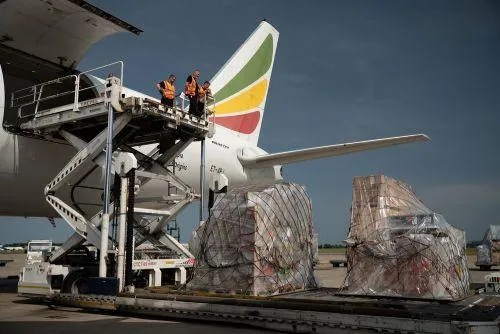
As part of the MSF response to the Ebola disease outbreak in the Democratic Republic of Congo, 70 tons of logistics and medical equipment are being loaded into a cargo airplane from Liège Airport in Belgium destined for Bunia city in the epicentre province of Ituri.
Image: Julie David de Lossy
Doctors Without Borders (MSF) has sent out a warning about the shortage of resources needed for the fight against the outbreak of the deadly Ebola disease in the Democratic Republic of Congo (DRC), saying the true scale of the outbreak “remains impossible to measure”.
The global humanitarian organisation providing care to people in crisis situations said “extremely limited” testing capacity and difficulties in accessing certain areas of the largely rural country meant that figures have to be “interpreted with caution”.
As of 28 May, 125 confirmed cases, 906 suspected cases, and 223 deaths have been officially reported across Ituri, North Kivu, and South Kivu provinces of the DRC, MSF reported.
In an update on its website, the organisation said that in eastern DRC people had been living through insecurity and with an under-resourced health system for years. The Ebola Bundibugyo virus strain – which does not yet have approved vaccines or specific treatments – is posing a major additional challenge.
MSF said its teams were working to contain the spread of the disease and strengthen patient care, alongside the local ministry of health.
“We are working in a particularly difficult context,” said Dr Alan Gonzalez, MSF deputy director of operations.
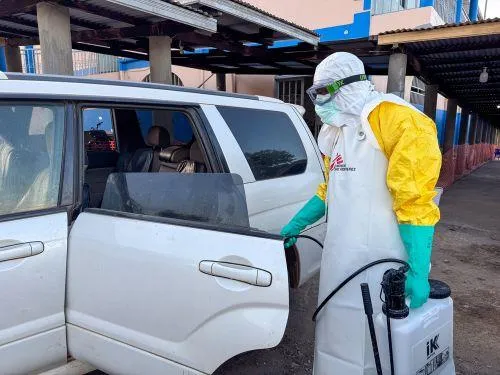
A Doctors Without Borders (MSF) staff member photographed last week in full personal protective equipment sanitising a vehicle used to transport suspected Ebola patients at the Elikya Treatment Center (ETC) in Bunia, Ituri province, DR Congo, following strict infection prevention and control protocols.
Image: Anna Schonhofer
“For the past two weeks, our ability to get supplies and teams into the affected areas has been hampered by air and land travel restrictions. Testing capacity remains insufficient, and hundreds of samples are still awaiting processing in laboratories. Isolation and care capacity are also insufficient. All of this is impeding the rapid scale-up of the response and creating legitimate anxieties and fears among communities.”
Only a limited number of specialised organisations, including MSF, are currently responding in the Ituri province – the epicentre of the outbreak – and people’s needs far outweigh the available capacity.
Meanwhile, a team of Chinese medical experts was expected to depart from Beijing in the early hours of Tuesday for the DRC to support local Ebola control efforts, China's National Health Commission (NHC) said on Monday.
The Chinese government decided to send the high-level medical expert team after the World Health Organization declared the latest outbreak of Ebola on May 17 a public health emergency of international concern.
Xinhua news agency reported that the experts with extensive experience in epidemic control will work with the Chinese medical team already in the DRC and strengthen cooperation with local medical and public health agencies to help contain the outbreak.
The dispatch of the expert team underscores China's commitment to international cooperation in fighting the epidemic, said an NHC official.